Do you ever wonder if that momentary pause before remembering a name or fumbling for keys means your brain is changing, or is it just another common part of the human experience? Understanding the difference between typical moments of forgetfulness and actual cognitive decline is essential for your long-term peace of mind. Whether you are arranging a summer family gathering or finalizing plans for an upcoming holiday trip, noticing the subtle shifts in your memory helps you stay sharp. Aging might bring slower processing, but it does not inevitably lead to the loss of your cognitive identity. Staying informed about your brain health is a smart, proactive choice.
Quick Questions and Answers
Question: Is dementia a normal part of aging?
Answer: No. The CDC says dementia is not a normal part of aging, and many older adults never develop it. Normal aging can include slower recall or occasional forgetfulness, but dementia involves changes that interfere with remembering, thinking clearly, or making daily decisions.
Question: What memory changes are normal as you get older?
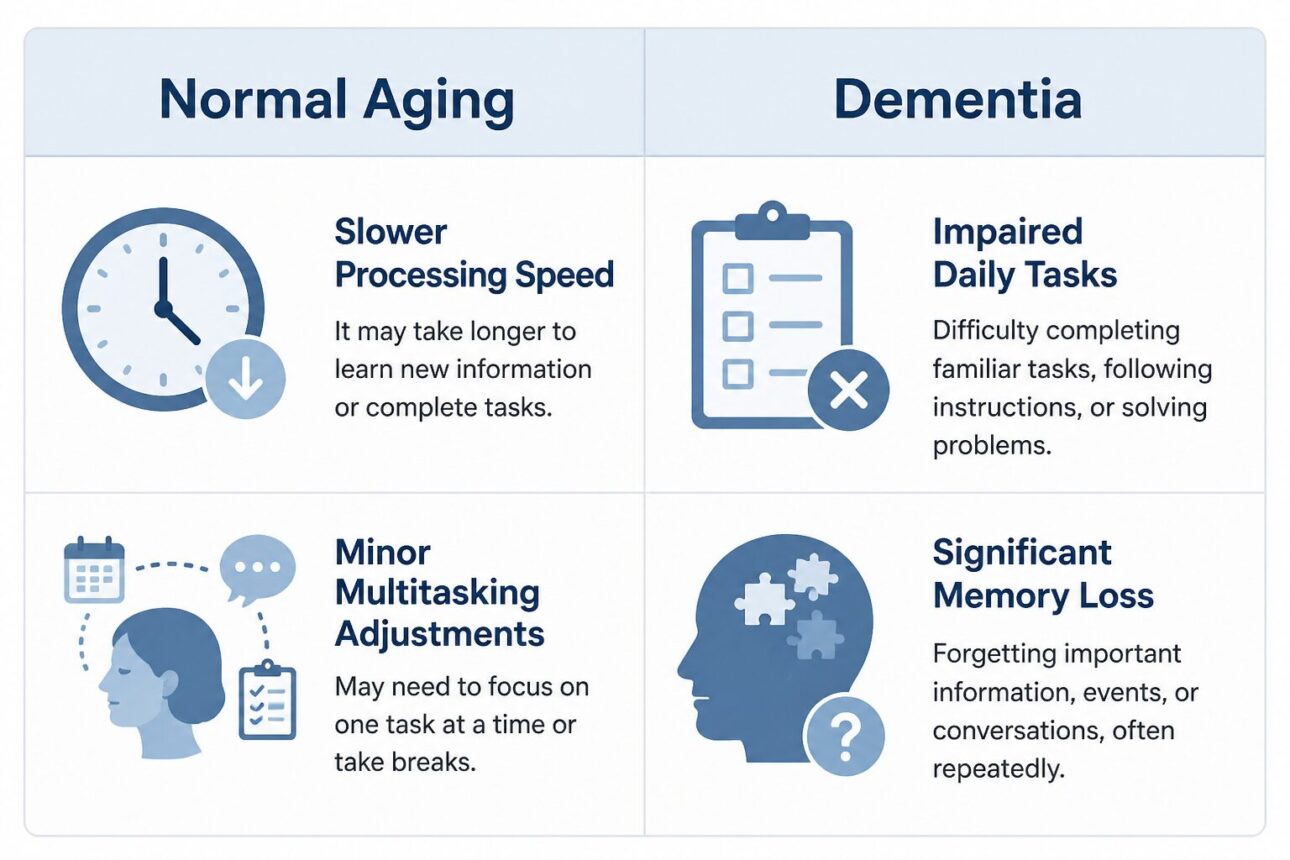
Answer: Normal aging can include slower processing speed, trouble multitasking, and occasionally misplacing items like keys. UCSF and Northwestern Medicine say routine memory, skills, and knowledge are usually stable, and these changes should not disrupt independent daily life.
Question: How can you tell dementia from normal forgetfulness?
Answer: The key difference is impact on daily function. Mayo Clinic Connect and UCSF say normal forgetfulness does not usually prevent someone from managing routine tasks, while dementia causes persistent problems with cooking, navigating, paying bills, or following instructions.
Key Takeaways
Almost 40% of people experience some form of memory loss after age 65, which is often a standard part of the aging process.
The World Health Organization estimates that only 5% to 8% of people over age 60 will live with dementia at some point.
Routine memory, general knowledge, and professional skills often remain stable well into late adulthood.
Functional independence is the primary indicator that cognitive changes are within the range of healthy aging.
Many cognitive symptoms that mimic dementia, such as confusion, may actually result from reversible conditions like thyroid imbalances or vitamin deficiencies.
Dementia and Aging: Understanding the Clinical Reality
Dementia is defined as a syndrome rather than a single specific disease. It acts as an umbrella term for conditions that block a person’s ability to remember, think clearly, or make sound daily decisions, according to the Centers for Disease Control and Prevention. While hearing the term might cause anxiety, it is vital to remember that dementia is not an inevitable consequence of the aging process. The majority of older adults live their entire lives without developing these clinical symptoms.
When you look at the research, the distinction becomes clear. Age-associated memory impairment is generally considered a separate, manageable phenomenon. It differs from neurodegenerative illness in both its presentation and severity. Just as we might study Lyme disease origins to understand health risks, we should view cognitive health as a complex system that requires careful observation, not fear-based assumptions.
Distinguishing Normal Cognitive Aging From Decline
Typical age-related declines manifest as subtle shifts. The UCSF Memory and Aging Center notes that these changes primarily affect thought processing speed and the ability to focus on multiple tasks at once. You might notice it takes a few more seconds to recall a word or that you have to write more things down to stay organized.
However, core mental assets often tell a different story. Professionals at Northwestern Medicine report that routine memory, general knowledge, and professional skills frequently remain rock-solid throughout life. In some cases, these areas might even show improvement as we lean into years of experience. Occasional lapses—like misplacing your keys or struggling to master a new software update on your phone—remain firmly in the category of normal aging, provided these incidents do not prevent you from maintaining your independence.
The Crucial Role of Functional Impact
The most reliable way to separate normal aging from something more serious is by examining your functional independence. Can you still manage your finances? Are you capable of preparing meals or navigating the route to a common grocery store? If these activities become obstacles, the situation changes.
If you find that your dietary needs are becoming difficult to manage, looking for resources such as advice on should Crohn’s patients eat avocado can feel overwhelming if cognitive challenges are present. If forgetfulness begins to interrupt your daily schedule or your ability to handle basic personal responsibilities, Ohio State Health recommends reaching out to a healthcare provider. This is not because you have a diagnosis, but simply because you need to rule out reversible causes.
Mild Cognitive Impairment: The Biological Borderland
Clinicians often refer to Mild Cognitive Impairment (MCI) as a transitional state or a “borderland” between typical aging and dementia. In this phase, cognitive test results might be slightly lower than what is expected for your specific age group. Yet, you remain entirely capable of looking after yourself.
According to research published in the National Library of Medicine, this stage sits right in the middle. You may feel that your memory is not what it used to be, but your functional independence remains intact. It is a critical period that deserves attention, but it is not a guaranteed path toward dementia. Monitoring this state allows you to catch potential issues early, which is exactly why regular check-ins with your doctor are so useful.
When to See a Healthcare Provider
Proactive medical consultation serves to identify factors that look like dementia but are actually treatable. Clinicians frequently screen for vitamin deficiencies, thyroid hormone imbalances, or even clinical depression. Many of these conditions mimic memory loss quite accurately.
If you or a family member suspects trouble, track the frequency and the specific impact of the behavior. Are you struggling to follow a recipe you have used for decades? Or are you just having a bad day? As with managing external health threats—such as learning what disease do armadillos carry to protect your physical safety—knowing the specific signs of brain health allows you to take charge. Doctors care about the “functional impact,” meaning they want to know if these lapses are stopping you from living your life.
Feature
Normal Aging
Mild Cognitive Impairment
Dementia
Memory
Occasional lapses
Noticeable decline
Persistent, progressive loss
Daily Tasks
Independent
Independent
Dependence starts
Independence
Fully maintained
Maintained
Compromised
Cause
Normal brain changes
Transitional decline
Underlying disease
FAQ
Q: What are the main types of dementia?
Dementia is a syndrome caused by several diseases rather than one single illness. Common categories include Alzheimer’s disease, vascular dementia, Lewy body dementia, and frontotemporal dementia. Each of these manifests in slightly different ways, but all involve progressive damage to the brain that eventually impacts how a person thinks and functions in their daily life.
Q: Why does dementia happen in older adults?
Dementia happens because specific diseases damage brain cells and impair cognitive function over time. While age is the primary risk factor, aging itself does not cause the condition. Research consistently emphasizes that the syndrome results from underlying biological pathology rather than the normal wear and tear of growing older.
Q: Can mild cognitive impairment be normal?
Mild cognitive impairment is not the same as normal, healthy aging. It is a middle-ground state where an individual experiences cognitive decline greater than what is expected for their age. Despite this decline, they usually retain the ability to perform everyday tasks like cooking, shopping, or driving without the need for constant assistance.
Q: When should memory loss be checked by a doctor?
You should consult a professional if memory loss begins to occur frequently, shows a progressive pattern, or starts to interfere with your daily routine and responsibilities. It is important to discuss these patterns with a healthcare provider because the root cause might be a temporary or reversible health concern that requires timely treatment.
Q: Are there reversible causes that look like dementia?
Yes. Clinical evaluations often rule out several non-dementia contributors first. Conditions such as severe vitamin deficiencies, thyroid gland imbalances, and even untreated depression can create symptoms that mimic cognitive decline. Identifying these issues early is a standard part of a thorough medical assessment.
Q: Does getting older always lead to dementia?
No. Growing older does not mean you are destined to develop dementia. Statistics show that the majority of people live their entire lives without experiencing this syndrome. While the statistical risk does climb with age, the specific clinical symptoms associated with dementia remain the exception rather than the rule.
Q: What early signs suggest dementia instead of aging?
Warning signs include the constant repetition of memory lapses that disrupt daily routines, increasing difficulty navigating previously familiar locations, and struggling to use household appliances you have known for years. The key indicator is that a third party, such as a family member, begins to observe a sustained, noticeable drop in your ability to manage your day-to-day life.
My Experience With Is Dementia Normal? A Complete Guide to Aging and Cognitive Health
I used to panic every time I forgot where I left my reading glasses. It is a very human reaction, right? We live in a culture that treats every memory slip as an early warning sign of something dire. Through my research, I have learned to distinguish between “I need more sleep” moments and actual warning signs of cognitive decline. There is a strange, quiet comfort in knowing that forgetting a brand-new neighbor’s name is just life, while forgetting how to use my stove is where the clinical boundary starts.
My biggest takeaway is that we often conflate “being older” with “being broken.” That is a harmful error. The human brain is a resilient organ, and sometimes it just needs a break from the constant multitasking we demand of it. If you suspect your memory is fading, start by checking your B12 levels or talking to your doctor about your stress levels before jumping to the worst-case scenario. It is easy to obsess over the “what-ifs,” but data shows most of us do just fine. How do you manage your own “brain fog” when life starts to get a little too crowded?
Conclusion
Understanding the distinction between normal aging and dementia empowers you to make informed decisions about your health. While aging may bring subtle shifts in how we process information, it does not necessarily mean our cognitive independence is at risk. By paying attention to functional changes rather than just occasional lapses in memory, you can better monitor your health and determine when professional guidance is needed. Staying active, seeking medical advice for persistent symptoms, and keeping a positive perspective are your strongest tools for maintaining long-term clarity.
References
Alzheimer Society of Canada. (2026). The differences between normal aging and dementia. Alzheimer Society of Canada. https://alzheimer.ca/en/about-dementia/do-i-have-dementia/differences-between-normal-aging-dementia
Centers for Disease Control and Prevention. (2024). Signs and Symptoms of Dementia. CDC. https://www.cdc.gov/alzheimers-dementia/signs-symptoms/index.html
Northwestern Medicine. (2021, March 11). Is it dementia or normal aging?. Feinberg School of Medicine. https://www.brain.northwestern.edu/about/_news-articles/20210311-aging.html
Ohio State University Wexner Medical Center. (n.d.). Normal aging versus dementia: Know the difference. Ohio State Health. https://health.osu.edu/health/brain-and-spine/normal-aging-versus-dementia
Mayo Clinic Connect. (n.d.). Normal aging vs. dementia, What’s the difference?. Mayo Clinic. https://connect.mayoclinic.org/blog/dementia-hub/newsfeed-post/normal-aging-vs-dementia-whats-the-difference/
UCSF Memory and Aging Center. (n.d.). Healthy Aging. University of California, San Francisco. https://memory.ucsf.edu/brain-health/healthy-aging
Roberts, R. O., & Knopman, D. S. (2013). The borderland between normal aging and dementia. National Library of Medicine. https://pmc.ncbi.nlm.nih.gov/articles/PMC5509201/
Care.com. (n.d.). Is dementia a normal part of aging? How to tell the difference. Care.com. https://www.care.com/c/normal-aging-vs-dementia/
Sarah Anderson . J
I’m the mom behind Wise Mom Blogger, where everyday creativity meets real-life motherhood. I share easy DIY crafts, cozy knitting and crochet projects, beginner-friendly sewing ideas, and family-tested recipes—plus quick baking hacks that make homemade feel doable on busy days.