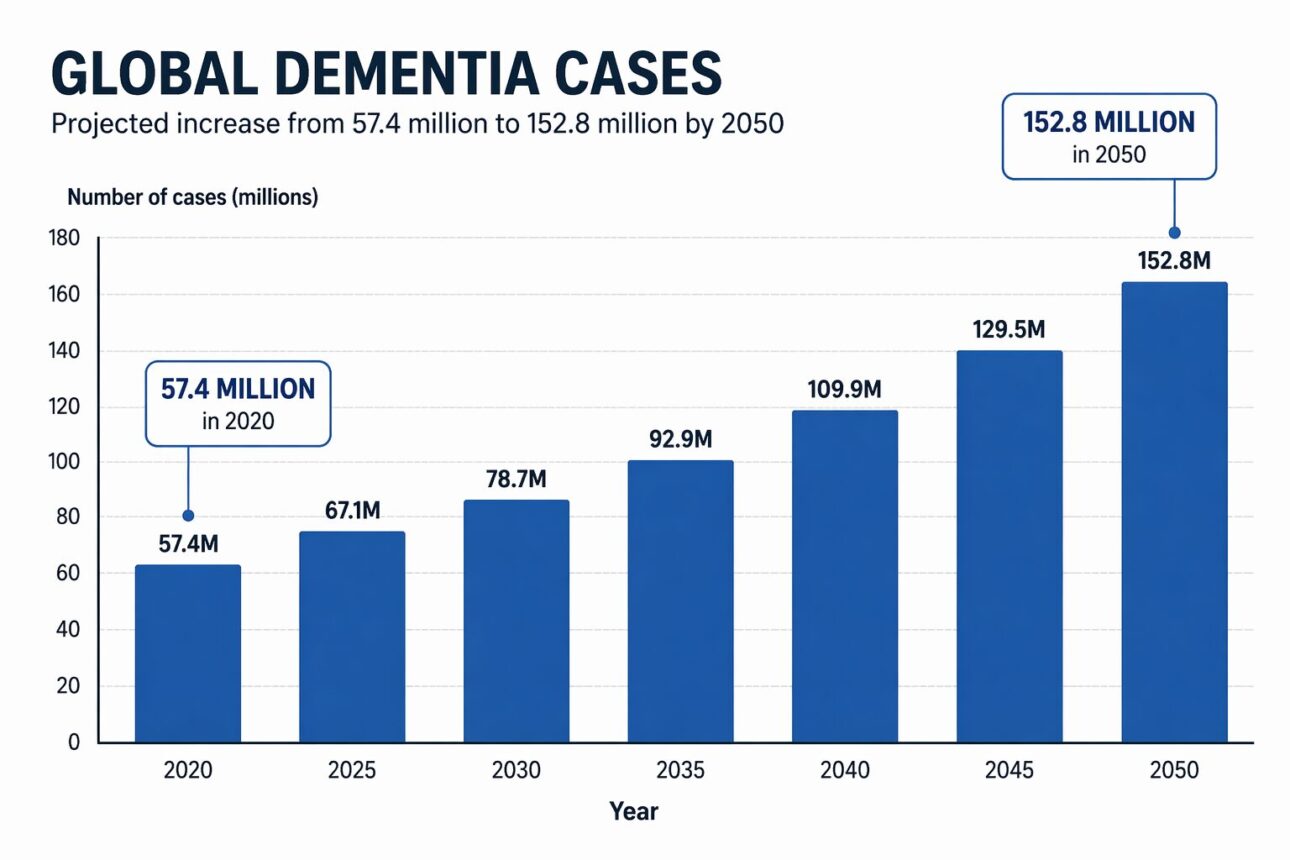
Dementia is projected to become one of the world’s most pressing health emergencies, yet most people don’t understand what scientists can actually accomplish in the next 25 years. The numbers are stark: global cases will likely triple from 57.4 million today to 152.8 million by 2050. But does that mean we’re helpless? Not quite. The honest answer is more nuanced than a simple yes or no—and understanding the gap between what’s possible and what’s promised matters if you or someone you care about faces this disease.
Quick Questions and Answers
Question: Can science cure dementia by 2050?
Answer: The sources here do not support a claim that science will fully cure dementia by 2050. Current evidence points to partial progress: some drugs can slow decline, and prevention research may reduce population-level risk, but no source says dementia can already be halted or reversed. The most defensible forecast is substantial improvement, not eradication.
Question: Why is dementia expected to increase by 2050?
Answer: The main drivers are population aging and population growth, which increase the number of people at risk. The Lancet forecast projects global cases rising from 57.4 million in 2019 to 152.8 million in 2050. Risk-factor changes such as smoking, BMI, and blood sugar also contribute, but they do not offset the demographic trend.
Question: What are the main causes of dementia?
Answer: Dementia has multiple causes, including Alzheimer’s disease, vascular disease, and other neurodegenerative conditions. The sources also emphasize modifiable risk factors such as hypertension, diabetes, smoking, physical inactivity, alcohol use, hearing loss, vision loss, social isolation, and low education. Age remains the biggest non-modifiable risk factor.
The Rising Prevalence of Dementia
The numbers tell the real story. According to the Lancet Public Health forecast00249-8/fulltext), dementia cases are expected to climb from 57.4 million in 2019 to 83.2 million in 2030, then 116.0 million in 2040, and finally 152.8 million by 2050. That’s a 166% increase over three decades.
Population aging is the culprit. As people live longer, more reach the ages where dementia becomes common. This isn’t because we’ve suddenly become worse at brain health—it’s pure demographics. The majority of dementia cases occur in people over 65, and that population is expanding globally.
The United States faces its own surge. Harvard Gazette reports that US Alzheimer’s cases alone will jump from about 7.2 million in 2025 to 18.8 million in 2050. That’s a 160% increase for a single country, straining healthcare systems that already struggle to cope.
But here’s what makes this forecast tricky: it’s not entirely fixed. Education trends could actually reduce global prevalence by 6.2 million cases by 2050. That’s real progress on a population level. However, negative shifts in smoking rates, body weight, and blood sugar control could add back 6.8 million cases, nearly wiping out those education gains. The demographic tsunami overwhelms all of this anyway.
Experts across institutions now call dementia the 21st century’s greatest health challenge. The World Dementia Council frames it bluntly: a disease that currently cannot be prevented or effectively treated. That’s the starting point for understanding what science can and cannot do by 2050.
Modifiable Risk Factors and Prevention Potential
Here’s where optimism meets reality. The 2024 Lancet Commission, as summarized by Nature, identified 14 modifiable risk factors for dementia. These aren’t theoretical—they’re things people can actually change.
The list includes hypertension, diabetes, smoking, physical inactivity, depression, social isolation, hearing loss, vision loss, low education, alcohol use, air pollution, head injury, and cognitive inactivity. Some of these surprise people. Hearing loss? Yes—untreated hearing loss correlates with cognitive decline. Social isolation? The loneliness effect on the brain is real. Low education doesn’t mean low intelligence; it correlates with fewer cognitive reserves to draw on when brain changes occur.
The tantalizing claim is that addressing these 14 factors could theoretically prevent up to 45% of global dementia cases at a population level. That’s a massive number. But the word “theoretically” matters. It assumes widespread behavior change across billions of people—quitting smoking, controlling blood pressure, exercising regularly, staying socially engaged. Nature’s analysis makes clear there are no guarantees for any individual. The 45% is a population-level projection, not a promise to you.
Intensive prevention programs have been tested. Nature notes they’ve shown only modest memory benefits and have not yet proven they actually reduce dementia incidence in real studies. People who exercise, eat well, stay socially active, and keep learning do tend to age better cognitively. But that’s not the same as preventing disease. The brain still changes. Plaques and tangles still accumulate.
Education is the low-hanging fruit. Better education attainment globally could prevent 6.2 million dementia cases by 2050 according to AAIC researchers. Why? More education means a larger cognitive reserve—more brain connections that can compensate if disease starts. It’s not that learning prevents the underlying pathology; it’s that your brain can handle more damage before symptoms show up.
Conversely, negative trends are working against prevention. Rising obesity, continued smoking in some regions, and increasing diabetes prevalence could add 6.8 million cases by 2050. These aren’t unavoidable—they’re driven by policy and behavior. But they show that even as prevention science improves, societal trends can undermine it.
Therapeutic Progress: Current Capabilities and Limitations
This is where the headlines often mislead. In 2023 and 2024, FDA-approved drugs targeting amyloid (a protein that accumulates in Alzheimer’s brains) made headlines as a breakthrough. They are progress. But they are not a cure.
According to Harvard Gazette, these amyloid-targeting drugs slow cognitive decline by about 30 percent. That means someone who would lose, say, 10 points on a cognitive test over 18 months might lose 7 instead. It’s a real benefit for some patients—it delays symptoms. For people in early stages, that’s meaningful extra time with clearer thinking.
But here’s the crucial limitation: these drugs do not halt or reverse Alzheimer’s disease. The underlying brain damage keeps happening. The disease isn’t stopped; it’s slowed. And these medications work best when given early, before substantial damage has occurred. Once someone is in moderate or advanced dementia, they’re less likely to benefit.
The Lancet Neurology commission stated plainly back in 2016 that “no treatment is yet available to halt or reverse the underlying pathology of established Alzheimer’s disease.” We’re now in 2026, and that statement still holds. The amyloid drugs are a step forward, but not the breakthrough that defeats dementia.
Clinical trials themselves are evolving in ways that could speed discovery. Researchers are using “trial-ready registries”—pre-enrolled volunteers who can quickly jump into studies when a new drug appears. Instead of spending years recruiting, trials can launch in months. Nature points out this infrastructure matters as much as the science itself. Faster trials mean faster answers about what works and what doesn’t.
Modifiable Risk Factors and Prevention: A Deeper Look
Reducing the big risk factors by even modest amounts could make a real dent. The Lancet Neurology commission calculated that cutting high-risk factors by 10–20% per decade could reduce global Alzheimer’s prevalence in 2050 by 8–15%—equal to about 8.8 to 16.2 million cases. That’s not trivial.
But it requires systemic change, not just personal effort. Getting 10–20% of the global population to exercise more, manage blood pressure better, quit smoking, and reduce alcohol use simultaneously is a policy challenge, not just a health-behavior one. It requires better healthcare access, workplace support, urban design that encourages walking, and cultural shifts around aging. Science can identify the targets; policy and society have to hit them.
The most encouraging part is that prevention science is becoming specific. Instead of vague advice to “stay mentally active,” research now points to particular risk factors and population-level impact estimates. That lets governments and health systems prioritize. Instead of spreading resources thin across everything, they can focus on hearing loss screening, blood-pressure management, or education access—interventions with clearer evidence.
Future Research Horizons
The pipeline of experimental approaches shows where hope lies—and where uncertainty remains. Harvard Gazette mentions a lithium-deficiency hypothesis being explored, suggesting that inadequate lithium intake might contribute to neurodegeneration in some people. It’s speculative, but it opens a new biological door. If true, a simple dietary intervention could help a subset of people. But it’s still under investigation.
Blood-based biomarkers are advancing rapidly. Instead of requiring a PET scan or lumbar puncture to detect brain changes, researchers can now measure certain proteins in blood samples that reflect Alzheimer’s pathology. This matters because early detection becomes feasible on a scale. If millions can be screened affordably, at-risk people can be identified decades before symptoms. Then prevention or early treatment becomes possible.
AI and machine learning are being applied to dementia research. Algorithms can scan genetic data, brain imaging, and patient histories to spot patterns humans might miss. AI can also help drug discovery by predicting which molecular compounds are most likely to work, narrowing down the search space. These aren’t cures themselves, but they’re tools that could accelerate the search.
Real-time brain monitoring is another frontier. Wearable devices and sensors that track brain activity, sleep patterns, and neural markers could provide early warning signs. If someone’s cognitive patterns start shifting, intervention could happen before full decline takes hold. It’s invasive and expensive now, but technology tends to get cheaper and smaller.
None of these—lithium, blood tests, AI, brain monitoring—represent a defeat of dementia by 2050. They represent incremental improvements in the battle. Combined with better prevention strategies and continued drug development, they might slow the burden’s growth or shift more cases into mild stages. But they don’t end the disease as a major health problem.
The Reality Check: What Experts Actually Expect
Science cannot currently guarantee the prevention of dementia. There is no known cure that reverses the damage of established Alzheimer’s disease or other dementias. That’s the honest assessment from the sources driving this article.
What’s realistic by 2050? Progress on several fronts simultaneously. Better identification of people at risk. Drugs that slow decline in early stages. Reduced risk-factor prevalence through education and public health. Faster clinical trials because of improved infrastructure. Earlier diagnosis through blood tests and imaging. Combination therapies that attack multiple biological pathways instead of one target.
Will these eliminate dementia? No. Will they reduce suffering and delay decline for millions? Probably. The World Dementia Council’s framing is instructive: it calls for stronger clinical trials, better diagnostics, and more research funding—not because a silver bullet is in sight, but because these systems changes would accelerate whatever breakthroughs do come.
The gap between “science will solve this by 2050” and “science is making progress” is enormous. One offers false hope. The other is realistic and still encouraging.
My Experience With Can Science Defeat Dementia by 2050?
I spent weeks digging through forecasts and clinical trial data while writing this, and the thing that struck me most was how the numbers don’t match the headlines. The media often frames emerging drugs or biomarkers as game-changers, and in a narrow sense they are—a 30% slowing of decline matters to someone getting it. But in a global health context, with 150 million people projected to have dementia by 2050, a 30% slowing is incremental, not transformative.
The honest insight from reading all these sources is that dementia defeat isn’t a science problem alone—it’s a policy and public-health infrastructure problem. You can have the best drugs in the world, but if people don’t have access, if blood-pressure screening doesn’t reach rural areas, if education gaps persist, the global burden still climbs. The 45% prevention estimate assumes a level of coordinated global action that hasn’t happened for any major health issue.
That said, I’m not pessimistic. The specificity of modern dementia research is real. We’re not fishing in the dark anymore. We know which 14 factors matter, which brain proteins to target, which populations benefit from early intervention. That clarity matters enormously. It just means expecting a cure by 2050 is unrealistic, while expecting measurable progress isn’t.
What’s your biggest worry about dementia—prevention, treatment, or access to care if it does happen?
FAQ
Q: How much dementia could be prevented?
Nature’s summary of the 2024 Lancet Commission says that 45% of global dementia cases could theoretically be prevented at the population level. That figure does not mean every individual can cut their risk by 45%; it reflects what could happen if modifiable risks were reduced across societies. It is an estimate based on epidemiological modeling, not a guarantee.
Q: Do current Alzheimer’s drugs stop dementia progression?
No. Harvard Gazette reports that FDA-approved amyloid-targeting drugs slow cognitive decline by about 30%, but they do not halt or reverse Alzheimer’s disease. That makes them useful for some patients in early stages, but they are not a cure or a defeat of dementia.
Q: What research breakthroughs matter most for dementia?
The most important breakthroughs mentioned in the sources are better biomarkers, AI-based discovery, real-time brain monitoring, and faster trial infrastructure. These tools can help researchers identify disease earlier and test drugs more efficiently. They do not yet prove that dementia will be defeated by 2050.
Q: Are lifestyle changes enough to prevent dementia?
Lifestyle changes can reduce risk, but they are not enough to guarantee prevention. Nature notes that healthy diet, exercise, and social or cognitive engagement are associated with lower risk, yet intensive programs have only shown modest memory benefits and have not proven a reduction in dementia incidence. The evidence supports risk reduction, not certainty.
Q: Which type of dementia is most common?
Alzheimer’s disease is the most prevalent form of dementia in the sources provided. Several pages treat Alzheimer’s as the main contributor to the broader dementia burden and the main focus of drug development. That is why many forecasts and treatment updates center on Alzheimer’s research.
Q: What are the biggest drawbacks of dementia research?
The biggest drawbacks are the slow pace of clinical success, the complexity of brain disease, and the gap between biomarker improvement and real patient outcomes. The sources note that no treatment has yet proven it can halt or reverse established disease. Research is also expensive and difficult to scale into large, definitive trials.
Q: Will better diagnostics help defeat dementia?
Better diagnostics should help, but they are not enough by themselves. The sources say blood tests, AI, and other new tools may improve early detection and trial design, which can speed research. However, diagnosis alone does not stop neurodegeneration, so treatment and prevention advances still have to follow.
Conclusion
The question “Can science defeat dementia by 2050?” has a straightforward answer: no. The disease will remain a major global health burden in 2050, affecting well over 150 million people. Demographics alone guarantee that.
But that doesn’t mean 25 years of research are wasted. Incremental progress—slower decline from better drugs, earlier detection from blood tests, reduced risk-factor prevalence from education and public health—adds up. A world where dementia is delayed by years instead of months, where more cases are caught at mild stages, where fewer people develop it at all, is not a world where dementia is “defeated.” It is a world where the burden is managed better.
The real work isn’t just scientific. It’s policy, infrastructure, access, and behavior change across billions of people. Science can illuminate the path. Only societies acting on that knowledge can walk it.
References
Estimation of the global prevalence of dementia in 2019 and forecast to 2050. (2021). The Lancet Public Health. https://www.thelancet.com/journals/lanpub/article/PIIS2468-2667(21)00249-8/fulltext
Alzheimer’s Association International Conference. (2021). Global dementia cases forecasted to triple by 2050. https://aaic.alz.org/releases_2021/global-prevalence.asp
Callaway, E. (2026). How to avoid dementia — what the science really says. Nature. https://www.nature.com/articles/d41586-026-02098-z
Science Media Centre. (2021). Expert reaction to forecasts of global prevalence of dementia by 2050. https://www.sciencemediacentre.org/expert-reaction-to-forecasts-of-global-prevalence-of-dementia-by-2050/
World Dementia Council. (2018). Defeating dementia: the road to 2025. https://www.worlddementiacouncil.org/sites/default/files/2018-12/Defeating%20Dementia%20Report.pdf
Sohail, S. (2025). Making real gains in war on Alzheimer’s. Harvard Gazette. https://news.harvard.edu/gazette/story/2025/09/making-real-gains-in-war-on-alzheimers/
Nuland, S. B. (2017). How to defeat dementia. Nature. https://www.nature.com/articles/539156a
Prince, M., Wimo, A., Guerchet, M., Ali, G. C., Wu, Y. T., & Prina, M. (2016). Defeating Alzheimer’s disease and other dementias: priority for the 2016 decade of action. The Lancet Neurology. https://www.alzheimer.dk/media/ppefhfjg/lancet-neurology-comm-paper_april2016_p455_532.pdf
Sarah Anderson . J
I’m the mom behind Wise Mom Blogger, where everyday creativity meets real-life motherhood. I share easy DIY crafts, cozy knitting and crochet projects, beginner-friendly sewing ideas, and family-tested recipes—plus quick baking hacks that make homemade feel doable on busy days.