JEV is a new AI model that hit the news this month. It comes from a startup called TypeSafe AI and launched on September 15, 2026. Here is the odd part: you can’t chat with it. It doesn’t write emails, code, or stories. It reads a block of information, answers quick questions about it, and attaches a confidence score to each answer. Think “Is this a billing problem?” or “How urgent is this?” This guide covers what JEV is, what the name means, how fast it runs, and where it slips. Most of the big numbers come from the company itself, so I say so each time.
Quick Answer
JEV is an AI model from TypeSafe AI that returns fast decisions with confidence scores instead of written text. TypeSafe calls it a System One model. It launched in early access on September 15, 2026, and the name honors the economist William Stanley Jevons.
Fact
Detail
Model type
System One model
Made by
TypeSafe AI
Launch date
September 15, 2026
What it returns
Typed decisions and probabilities
Response time
70 to 500 milliseconds
Input price
$0.042 per million tokens
Output price
Free
Access
Early access waitlist
Speed and cost claims
Reported by the company
Good for
Routing, scoring, guardrails
Not for
Chat, code, writing
Average time per decision case, in seconds
JEV
0.4 s
GPT-5.6 Terra
10.1 s
GPT-5.6 Sol
23.3 s
Claude Opus 5
37.8 s
Source: TypeSafe’s own four-workflow tests, as reported by DataCamp (2026). These are company-reported figures.
What does JEV mean?
The name Jev honors William Stanley Jevons, an economist. TypeSafe explains this in the FAQ of its launch post. The link is coal. When steam engines became more efficient, people burned more coal instead of less. TypeSafe expects AI to follow the same path. Each big drop in the cost of intelligence should open up far more uses, so cheap, fast decisions could turn up everywhere.
The other name in play, System One, comes from a different place. It is a nod to Thinking, Fast and Slow by Daniel Kahneman. In that book, System 1 is quick gut-feeling thought and System 2 is slow, careful thought. Chat models that think for many seconds sit closer to System 2. JEV is built to act like System 1.
Some write-ups run the two origins together. TypeSafe’s own FAQ is the cleanest source, so I follow it. Read JEV as a name with a story behind it, not as letters that stand for something.
What is a System One model?
A System One model is an AI that returns typed decisions with confidence scores instead of text. You hand it a block of information, which TypeSafe calls state. You also hand it a list of questions. It answers every question at once.
The questions come in a few types. Some ask it to pick from a list, like billing, technical, or sales. Others ask for a score in a set range, like urgency from 0 to 100. A third kind asks a yes or no question and returns a probability. The possible answers are written down before the call. So the reply always fits the shape your software expects.
Picture a multiple choice test with a small dial next to each answer, showing how sure the test taker feels. That is close to what JEV hands back. A program can read it right away, with nothing to clean up.
Who made JEV?
TypeSafe AI made JEV, and founder Diogo Almeida leads the company. Almeida worked at OpenAI first. In the launch post he says he helped build the methods that made language models good at following instructions, and that work became the research behind ChatGPT. The heise report describes TypeSafe as a startup co-founded by a former OpenAI researcher.
DEV Community reports that the launch came with $40 million in funding led by DCVC. TypeSafe says it spent two years in stealth before showing anything. One source spells his first name Diego, but the company’s own posts use Diogo.
A team with that background gets a close look from developers. The results still need outside testing, which I cover below.
How does JEV work?
JEV reads your information and answers all your questions in one pass. Regular chat models write one small piece of text, called a token, at a time, and each piece depends on the last. TypeSafe built a parallel sampler instead, so every output comes out in a single query.
It also trained JEV with a method it calls Reinforcement Learning for Calibrated Decisions, or RLCD. The goal is honest probabilities. When JEV says 90%, that number should match how often it is right.
MindStudio tried it on a support message about a duplicate charge. The customer asked for money back and said the site was fine. JEV sent it to billing, put the refund chance at 98%, and rated urgency at 11%. Those are sensible answers, and they came with numbers a program can act on.
For a developer, the plan is easy. Set a confidence line. Let the code act on answers above it, and send shaky ones to a person or a bigger model.
How fast and cheap is JEV?
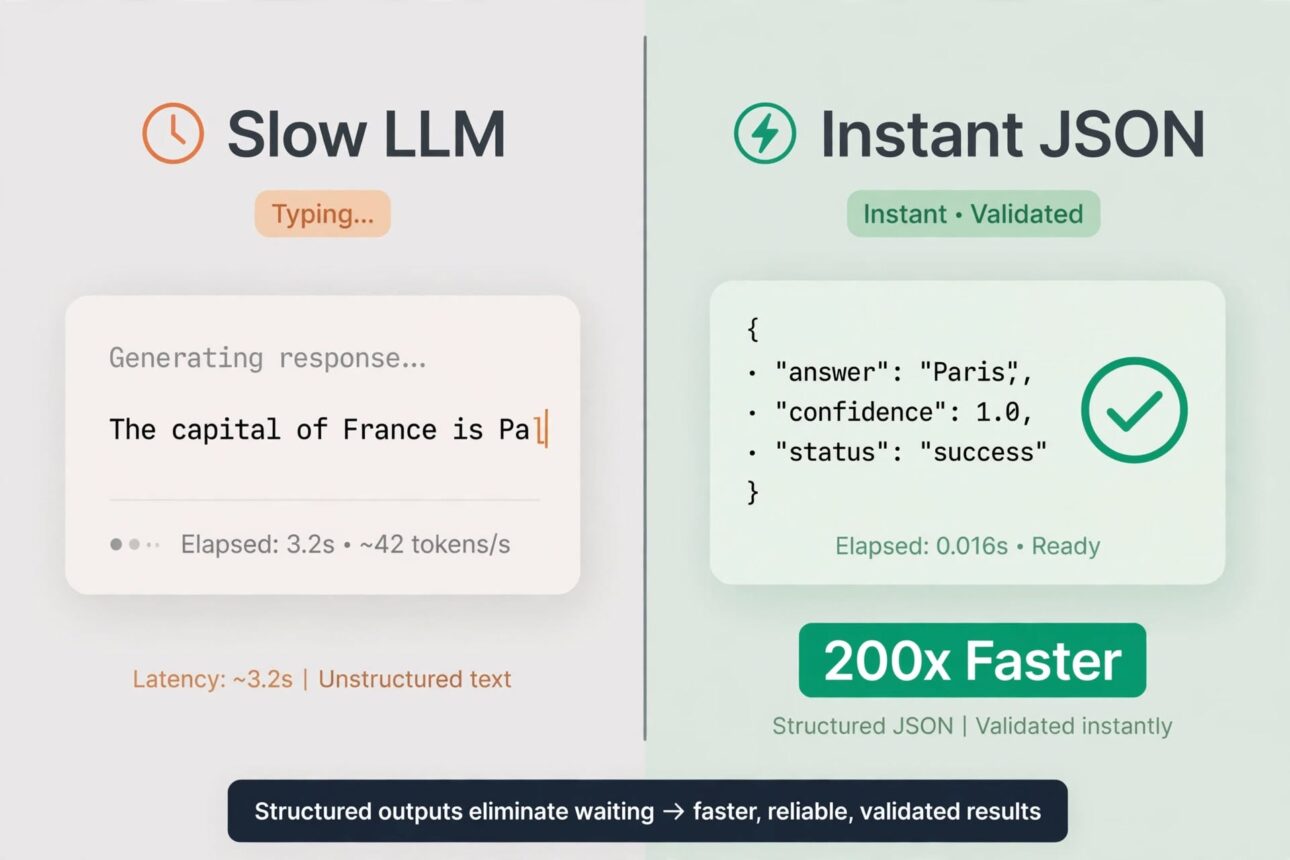
TypeSafe says JEV answers in 70 to 500 milliseconds and costs $0.042 per million input tokens, with output free. The company sets that against 3 to 329 seconds for frontier chat models. Its launch post claims JEV runs 40 to 200 times faster on the right kind of task.
The home page numbers are bigger: 193.6 times faster and 444.6 times cheaper. TypeSafe itself says those sit at the high end of what people should expect in real life.
Per decision, the reported figures are about $0.0004 and 0.4 seconds for JEV in TypeSafe’s four workflow tests. DataCamp’s table of the same tests puts GPT-5.6 Terra at $0.0304 and 10.1 seconds. Claude Opus 5 lands at $0.1761 and 37.8 seconds.
Cost only matters at scale. Sort ten tickets a day and you will never notice. Sort ten million and the gap decides everything. TypeSafe admits it can’t prove the price isn’t subsidized, though it expects prices to go down over time.
How accurate is JEV?
JEV matched the reference answers 67.8% of the time in TypeSafe’s own tests. That is about the same as GPT-5.6 Terra at 67.9%. It sits a few points under GPT-5.6 Sol at 74.1% and Claude Opus 5 at 73.1%, according to DataCamp.
The tests covered four jobs: security incident response, agent trace checking, invoice processing, and customer service, as Anthony Maio describes them. The reference answers were the average of GPT-6 Astra and Claude Fable 5.1, per heise.
TypeSafe’s launch post lists its own biases. Its model team built the workflows. And the reference models come from OpenAI and Anthropic, which may make JEV look worse than it is. As far as I found, no neutral group has repeated the tests yet. So call 68% promising, not proven.
For routing work, matching a mid-level model at a tiny price is a great deal. For a single call where one mistake costs a lot, it is a poor fit.
Can JEV hallucinate?
JEV can’t invent an answer outside the options you give it, but it can still pick the wrong option. TypeSafe says schema matching is guaranteed, so it reports 0% type errors. It even points out that one counter-example would break the claim. A guaranteed shape does not mean a guaranteed truth, and Mehul Gupta’s Medium write-up makes the same point.
MindStudio tested this. A question about when the cafeteria closes got a correct “other” answer when “other” was on the menu. With only billing, technical, and sales to pick from, JEV chose sales, with a low score of 0.31. Nothing was made up. The right answer just wasn’t offered.
The fix is cheap. Always add an “other” choice, and treat low scores as a cue to hand the case off.
How is JEV different from ChatGPT or Claude?
ChatGPT and Claude write text, and JEV returns decisions. Chat models can explain a plan, draft an email, or write code. JEV does none of that, and it can’t tell you why it gave a score.
Developer Sean Goedecke wrote about JEV recently. He says it isn’t far from a regular model set to give structured output, but he likes the way you talk to it and hopes the style spreads. He would also like the big labs to build their own versions.
LangChain’s guide treats JEV as a teammate. Use a chat model for open-ended thinking and JEV for the quick decisions along the way. One example is model routing. JEV reads a request, then picks a cheap model for an easy job or a strong model for a hard one.
What can you use JEV for?
JEV fits any job where software must pick from a known set of answers, and fast. TypeSafe and the press coverage point to a few clear uses:
Routing support tickets to the right team, which was heise’s example.
Choosing the right tool for an AI agent from a catalog of tools.
Checking the inputs and outputs of other AI models for safety.
Scoring rows in a huge data set, one decision per row.
Real-time apps. TypeSafe’s Doom demo makes about 10 queries a second for roughly $7 an hour.
The pattern is the same each time. The answers are known ahead of time, and there are a lot of decisions to make.
What are the limits of JEV?
JEV can’t chat, write, code, or explain itself. DataCamp flags the missing explanation as a real problem for audits and other work where someone must know why a score came out the way it did.
It also needs a bounded list of answers. TypeSafe says JEV handles up to 255 choices in one question. Bigger lists need a two-step method, which slows things down.
Access is still limited to early access. The benchmarks come from the company. And TypeSafe says the long run will have to show whether its price holds up.
Use JEV as one part of a system. Let it handle the fast sorting, and let a chat model or a person handle the rest.
Is JEV the same as the virus or the rapper?
No, they only share the same letters. In medicine, JEV stands for Japanese encephalitis virus, a mosquito-spread virus that the World Health Organization says is related to dengue and West Nile. In music, jev. is a Canadian rapper who went viral in 2022. Neither has anything to do with TypeSafe’s model.
If your search results look mixed up, add “TypeSafe” or “System One” to your query.
How can you try JEV?
You join the TypeSafe waitlist, because JEV is in early access. TypeSafe says it is letting developers in as fast as it can.
Once you are in, you call an HTTP endpoint at api.typesafe.ai/v1/systemone and name the model jev-latest, according to DataCamp. TypeSafe also offers Python and JavaScript kits. You describe your state and your questions, and you get typed answers with probabilities.
DataCamp found no free credit program in the launch materials. Check TypeSafe’s docs before you build anything, since early access details can change.
Frequently Asked Questions
What is JEV in AI?
JEV is an AI model from TypeSafe AI that returns fast, typed decisions with confidence scores instead of text. It launched in early access on September 15, 2026.
What does JEV mean?
JEV is a name, not an acronym. TypeSafe named it after the economist William Stanley Jevons, and the “System One” label comes from Daniel Kahneman’s book Thinking, Fast and Slow.
Is JEV a chatbot?
No, JEV does not write any text. It answers set questions with choices, scores, or yes and no probabilities.
Who created JEV?
TypeSafe AI created JEV. Its founder, Diogo Almeida, is a former OpenAI researcher.
How much does JEV cost?
TypeSafe lists $0.042 per million input tokens, and output is free. The company says it can’t yet prove that price will last.
Can I use JEV today?
Yes, once you get off the waitlist. JEV is in early access, and TypeSafe is letting developers in over time.
References
TypeSafe AI, “Introducing System One Models & Jev” (2026)
DataCamp, “Jev: TypeSafe’s System One Model That Never Hallucinates” (2026)
heise online, “AI model Jev to make machines decide faster” (2026)
MindStudio, “Jev AI Tested: A Fast System One Model for Structured Decisions” (2026)
LangChain, “What Is Jev? A Guide to TypeSafe AI’s System One Model” (2026)
Sean Goedecke, “Jev means structured output is interesting again” (2026)
Anthony Maio, “Jev: The Language Model That Won’t Talk” (2026)
DEV Community, “How to Use Jev: A practical guide to TypeSafe’s System One model” (2026)
Data Science in Your Pocket (Medium), “What is Jev AI?” (2026)
World Health Organization, “Japanese encephalitis” (2024)
Sarah Anderson . J
I’m the mom behind Wise Mom Blogger, where everyday creativity meets real-life motherhood. I share easy DIY crafts, cozy knitting and crochet projects, beginner-friendly sewing ideas, and family-tested recipes—plus quick baking hacks that make homemade feel doable on busy days.