Does brain health improve when you practice intermittent fasting or switch to a calorie-restricted lifestyle? Many people look toward various fasting protocols while planning a holiday feast or preparing for a new season, wondering if skipping a meal might provide a sharp mental edge. Science suggests that brain health and fasting have a complex relationship, marked by a clear divide between promising lab findings and the more modest, often neutral, outcomes observed in human trials. Whether you are curious about memory maintenance or simply mapping out your health goals, distinguishing between biological theory and concrete, reliable evidence is vital.
Quick Questions and Answers
Question: Does fasting improve brain health and memory?
Answer: Research does not show a consistent short-term cognitive boost from fasting in healthy adults. A 2021 review found no clear evidence of a positive short-term effect, while a 2025 meta-analysis found fasting and eating states were similar overall. Some longer or repeated fasting protocols show possible benefits in selected groups, especially people with cognitive impairment, but the evidence is mixed.
Question: Can intermittent fasting hurt cognition or concentration?
Answer: Yes, it can in some contexts, especially with longer fasting intervals or in certain tasks. The 2025 APA meta-analysis found modest reductions in performance with longer fasts and in younger participants. Other reviews report possible impairments in cognitive flexibility and psychomotor speed, so the effect depends on the fasting pattern and the person.
Question: What does science say about fasting and the brain?
Answer: Science suggests fasting can change brain metabolism, inflammation, and signaling pathways such as BDNF, but human cognitive results are inconsistent. Animal studies are often more positive than human studies, and reviews repeatedly note that human evidence is limited. The strongest signal so far is that short-term fasting is usually neutral overall, not clearly beneficial or harmful.
Key Takeaways
Animal models often demonstrate improved memory and alertness, but these findings do not guarantee the same effects in humans.
Human cognitive performance during short-term fasting typically remains stable; it neither significantly helps nor hinders the average adult.
Long-term intermittent fasting may offer specific advantages for those with cognitive conditions, though medical supervision is often required.
Consistent patterns of fasting carry risks like digestive discomfort or headaches, making personalized planning essential.
Brain Health and Fasting: The Current Scientific Landscape
Researchers often see a significant gap between preclinical animal models and human clinical trials when studying brain health. In lab settings, animal subjects frequently show enhanced memory, improved alertness, and better synaptic function during periods of nutrient deprivation. However, these results do not translate directly to people. As noted by BrainFacts, the field is still maturing, and human studies remain sparse.
Most existing human research relies on short-term data, which makes long-term health conclusions difficult to draw. A review published in PMC emphasizes that there is no clear evidence of a positive short-term effect of intermittent fasting on cognition in healthy adults. When you read about “fasting for the brain,” it is important to check if the findings come from a controlled human study or observational data. Standardizing these trials is the next necessary step for scientists to confirm whether specific protocols actually provide a lasting advantage.
The Mechanisms: How Fasting May Impact the Brain
Fasting forces the body to undergo a metabolic shift, moving from glucose utilization to a reliance on ketones. This metabolic efficiency helps the brain maintain stability even when external energy sources are limited. It is a biological survival mechanism that likely evolved to keep us alert while searching for food.
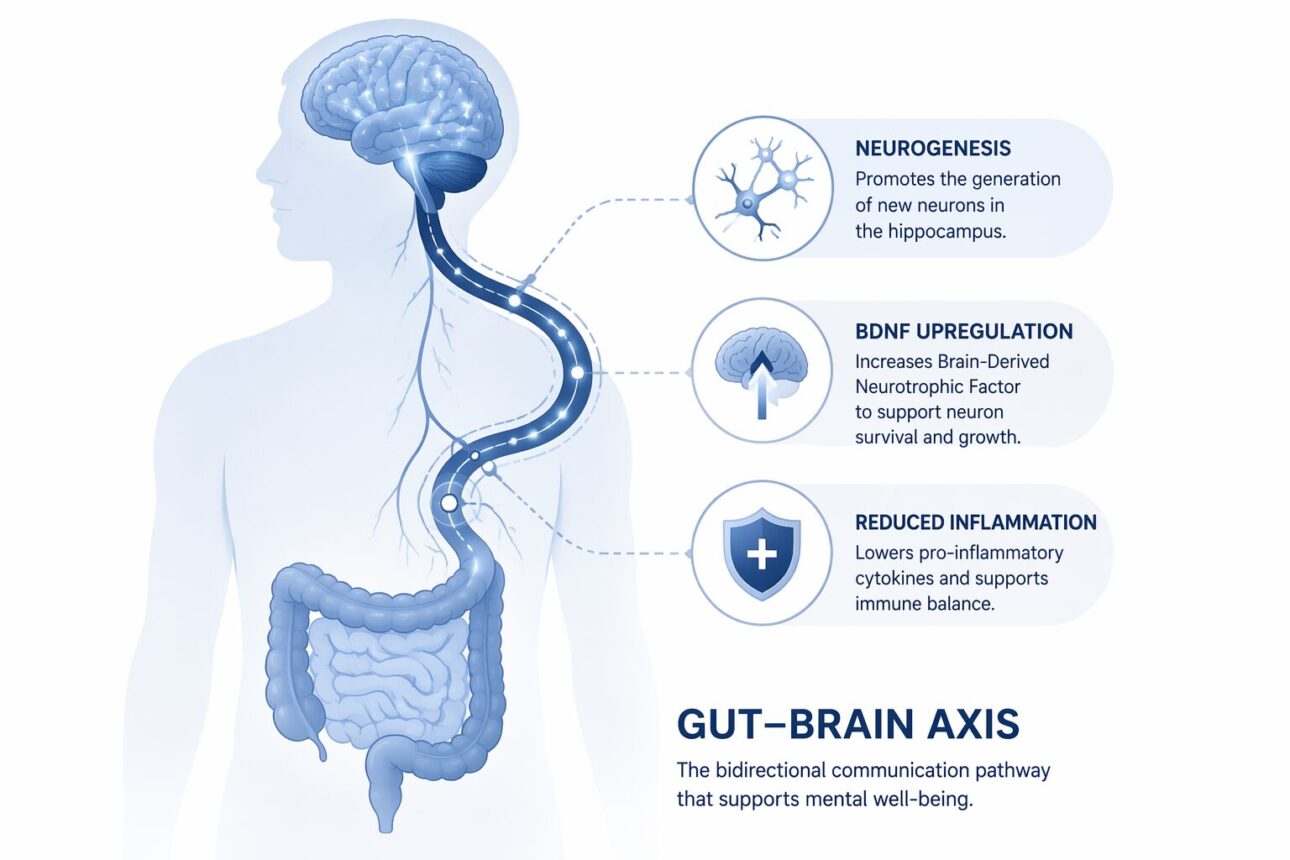
Beyond simple energy efficiency, fasting may trigger molecular changes. Preclinical data suggests that it enhances hippocampal neurogenesis and synaptic plasticity. This process typically involves the upregulation of BDNF, or Brain-Derived Neurotrophic Factor, and CREB signaling pathways. These elements are the building blocks of how the brain learns and adapts.
Emerging science also points to the gut-brain axis. Research mentions that fasting can enrich good bacteria, reduce systemic neuroinflammation, and restore the integrity of the intestinal barrier. When the gut is balanced, the brain reflects that stability. Interestingly, some clinical evidence links intermittent fasting to a reduction in β-amyloid burden in Alzheimer’s disease models, suggesting that these pathways might eventually play a role in managing complex neurocognitive issues. If you want to know more about the distinctions between types of decline, it helps to understand Dementia vs Alzheimer’s: Complete Guide to Understanding the Difference.
Cognitive Outcomes: What the Data Shows
When analyzing human mental performance, the data is far less dramatic than the popular narrative suggests. A 2025 meta-analysis conducted by the American Psychological Association pooled results from multiple studies and found an effect size of g = 0.02. In practical terms, this indicates that fasting neither enhances nor impairs mental performance overall in the short term.
Age and duration of the fast also weigh heavily on the results. The 2025 APA meta-analysis noted that younger participants and those who followed longer fasting intervals sometimes experienced modest drops in concentration. Additionally, a systematic review in Nutrition Reviews identified 33 separate human studies, with 23 showing significant cognitive changes. While some participants saw benefits in working memory and inhibition, others struggled with cognitive flexibility and psychomotor speed.
Fasting Metric
Outcome in Healthy Adults
Key Observation
Short-term Fasting
Neutral
Performance remains comparable to satiated states
Long-term Fasting
Mixed
Potential impairment in cognitive flexibility
Calorie Restriction
Variable
May boost inhibition and processing speed
Potential Benefits for Vulnerable Populations
While healthy adults might see little change, the picture shifts slightly for populations dealing with cognitive decline. A 3-year study looking at older adults with mild cognitive impairment found that those following time-restricted eating patterns achieved higher scores on standardized testing, including the MoCA and RAVLT. Researchers suspect that for this group, the metabolic stability provided by structured eating windows might offer a protective edge.
Further support comes from a pilot study by Johns Hopkins. The researchers compared an intermittent fasting group to a “healthy living diet” group. The intermittent fasting cohort showed a 20% greater improvement in executive function and memory. This serves as a blueprint for how nutrition interventions might eventually assist with aging, though there is still much to learn regarding whether Is Dementia Normal? A Complete Guide to Aging and Cognitive Health is a question of lifestyle or biology.
Risks, Tolerability, and Safety Considerations
Fasting is not a low-risk intervention for everyone. The 2024 pilot study reported that participants occasionally dealt with digestive issues like constipation and loose stools, along with common headaches. These side effects are often enough to make people abandon a routine before they see any long-term benefit.
Professionals caution that individuals with specific medical histories, such as type 1 diabetes or eating disorders, should avoid fasting. The biological stress of a restricted diet can exacerbate existing health issues rather than solving them. Always consult a health care practitioner to ensure your plan does not lead to unwanted nutrient deficiencies. We are still in the early stages of the “science of aging,” and finding out if Can Science Defeat Dementia by 2050? remains a core goal for researchers globally.
FAQ
Q: Who should avoid intermittent fasting for brain health?
People with type 1 diabetes, eating disorders, or other underlying conditions that make nutrient restriction dangerous should avoid these protocols. Medical supervision is vital, especially for older adults or those with existing neurological diseases, as the safety data for these specific groups remains limited. It is never a good idea to guess when it comes to long-term neurological health.
Q: Why do some studies show fasting helps cognition?
Certain studies suggest that fasting may increase ketone use, improve insulin sensitivity, and dial back inflammation in the brain. Beyond metabolism, researchers often note that fasting helps stimulate neuroplasticity and creates a more efficient gut-brain axis. While these pathways are biologically plausible, they do not guarantee that every person will see a measurable boost in daily cognitive tests.
Q: Is short-term fasting bad for memory or attention?
Current evidence suggests that it is not generally harmful for memory or focus. A large 2025 meta-analysis proved that people who fast perform similarly to those who have recently eaten. While some studies suggest minor dips in speed or flexibility during longer fasts, the average person is unlikely to notice a sharp decline in their cognitive capability from an occasional missed meal.
Q: Does fasting help Alzheimer’s disease or dementia?
There is encouraging, though not yet definitive, evidence that fasting might help those with mild cognitive impairment. Several reviews highlight improvements in older adults and point toward promising results in animal models. Despite these findings, researchers insist that more human, randomized clinical trials are required before we can call this a standard treatment for neurocognitive disorders.
Q: How long does it take fasting to affect the brain?
Biological shifts occur during a single fast, but long-term cognitive improvements appear to result from months or years of consistent practice. Short-term fasting might change the way your body uses energy, but it rarely produces a “brain boost” overnight. Because every study uses a different schedule, no universal timeline exists for when you might notice a change.
Q: What are the risks of fasting for older adults?
Older adults might be more prone to dizziness, fatigue, and headaches if their fast is poorly planned or too prolonged. Because this demographic often manages multiple medications and has fluctuating nutritional needs, a sudden shift in eating patterns can backfire. Medical oversight is needed to prevent nutrient deficiencies that might hurt cognition rather than improve it.
Q: Which fasting type is most studied for brain health?
Intermittent fasting, specifically time-restricted eating, appears most frequently in scientific literature. Continuous calorie restriction also shows up in some reviews, but results remain protocol-dependent. Research currently favors clear cycles of fasting and eating over extreme or extended water-only fasts, as these patterns are easier to maintain for the long durations required to study brain health.
My Experience With Brain Health and Fasting: Cognitive Effects, Risks, and What Science Shows
I once tried a strict 16:8 fasting schedule, thinking I would turn my brain into a high-performance machine. I lasted exactly four days. By hour 14, my ability to focus on complex reports vanished—replaced by a singular, intense desire to eat a bagel. That’s the reality of the “fasting gap”: what the theory promises versus the biological hunger that keeps us human.
Through my research, I’ve realized that my experience wasn’t a failure so much as a mismatch of expectations. Most of the cognitive “gains” people talk about are more rooted in animal studies than in the reality of a busy person’s workday. When you look at the 2025 APA meta-analysis data, it’s clear: keeping your glucose levels stable and eating a balanced diet usually keeps your brain sharper than any complex fasting regimen ever could. There is deep value in recognizing that our brains are incredibly protective of their energy supply. They don’t want us to starve; they want us to thrive. So, tell me, have you ever felt that “brain fog” sets in once the hunger hits, or do you have a routine that actually seems to work?
References
American Psychological Association. (2025). Acute effects of fasting on cognitive performance. APA. https://www.apa.org/pubs/journals/releases/bul-bul0000492.pdf
BrainFacts. (2018, July 13). How does fasting affect the brain?. BrainFacts. https://www.brainfacts.org/thinking-sensing-and-behaving/diet-and-lifestyle/2018/how-does-fasting-affect-the-brain-071318
Frontiers. (2025). Effects of intermittent fasting on brain health via the gut–brain axis. Frontiers in Nutrition. https://www.frontiersin.org/journals/nutrition/articles/10.3389/fnut.2025.1696733/full
Johns Hopkins Medicine. (2024, June). Pilot study provides ‘blueprint’ for evaluating diet’s effect on brain health. Johns Hopkins. https://www.hopkinsmedicine.org/news/newsroom/news-releases/2024/06/pilot-study-provides-blueprint-for-evaluating-diets-effect-on-brain-health
Nutrition Reviews. (2025). The impact of continuous calorie restriction and fasting on cognition in humans: A systematic review. Academic Oxford. https://academic.oup.com/nutritionreviews/article/83/1/146/7585919
PMC. (n.d.). The effects of intermittent fasting on brain and cognitive function. PMC. https://pmc.ncbi.nlm.nih.gov/articles/PMC8470960/
PMC. (n.d.). Intermittent fasting and neurocognitive disorders. PMC. https://pmc.ncbi.nlm.nih.gov/articles/PMC12180010/
Brainkind. (n.d.). Benefits of fasting for the brain: Truth or myth?. Brainkind. https://brainkind.org/benefits-of-fasting-on-the-brain-truth-or-myth/
Sarah Anderson . J
I’m the mom behind Wise Mom Blogger, where everyday creativity meets real-life motherhood. I share easy DIY crafts, cozy knitting and crochet projects, beginner-friendly sewing ideas, and family-tested recipes—plus quick baking hacks that make homemade feel doable on busy days.