

What makes AI detection systems fail so often that innocent students get accused of cheating they never committed? A University of Reading study involving 33 fictitious students revealed something troubling: AI detectors miss cheating regularly while falsely flagging honest work. This creates a double bind where real plagiarism slips through unnoticed and hardworking students face academic misconduct investigations they don’t deserve. False accusations of AI use can tank grades, trigger disciplinary hearings, and damage academic records permanently. Whether you’re a student submitting papers, a parent watching this unfold, or an educator trying to maintain integrity, the stakes are real.
Quick Questions and Answers
Question: Why are students failing because of AI detection errors? Students can be penalized when AI detectors wrongly label human writing as machine-generated. The New York Times cites a University of Maryland study of 12 detectors that found an average false-positive rate of about 6.8%, which means innocent work can be flagged. That creates academic misconduct investigations, grade penalties, and a burden on students to prove authorship.
Question: Can AI detectors falsely accuse honest students? Yes. The Markup reported that seven detectors flagged non-native speakers’ writing as AI-generated 61% of the time, and about 20% of papers were unanimously misclassified. The University of San Diego Law Library also notes that false positives can seriously damage a student’s academic record.
Question: How accurate are AI detectors in schools? Accuracy is inconsistent and depends on the tool, the text, and the writing style. The New York Times reported an average 6.8% false-positive rate across 12 services in one University of Maryland study, while BBC reported that 94% of AI-generated submissions in a Reading University experiment were not flagged. Those two findings show that detectors can miss AI work and also wrongly accuse humans.
Key Takeaways
- AI detectors have false-positive rates between 4–10%, meaning they regularly flag human work as machine-generated.
- Non-native English speakers face disproportionate flagging rates (61% misidentification) because detectors associate simpler sentence structures with AI.
- Neurodivergent students and those with disabilities may trigger false accusations due to variations in writing style.
- Even major platforms like Turnitin miss roughly 15% of actual AI-generated text, creating a gap where real cheating goes undetected.
- Students wrongly accused face the burden of proving innocence through drafts, revision history, and timestamps.
- Several major universities, including Vanderbilt and Cornell, have disabled AI detection tools due to unreliability and equity concerns.
- The risk affects you whether you’re a student submitting work, an educator grading papers, or an administrator setting policy.
AI Detection and Academic Integrity: What the Research Actually Shows
Universities rushed to adopt AI detection software after generative AI tools became mainstream. The logic seemed sound: catch students using ChatGPT, GPT-4, or other language models and prevent academic dishonesty. But the rollout created a new problem that may be worse than the one it was meant to solve.
The New York Times describes this as “a new headache for honest students” who must now prove they didn’t use AI. Research reported by major publications shows the software is fundamentally unreliable. It produces both false positives—accusing humans of cheating—and false negatives, allowing AI-generated work to pass undetected.
The core problem is technical. AI detectors try to identify statistical patterns they believe are unique to machine writing: word frequency distributions, sentence length consistency, or vocabulary predictability. But human writing varies wildly. A tired student writes differently than a focused one. Someone writing in their third language produces patterns similar to AI output. A neurodivergent writer may use repetitive phrases or unconventional structure. These detectors can’t distinguish between human variation and machine generation because the boundary is much blurrier than anyone expected.
A Real-World Case: The Professor Who Caught 32 of 35 Students With One Hidden Word

While automated detectors misfire in both directions, one recent case shows how a low-tech trick can expose AI misuse far more reliably than software ever could. Dr. Jason Gibson, a history professor at Alcorn State University in Mississippi, discovered that the vast majority of his students had used AI to complete a midterm discussion post on the Industrial Revolution, not through a detection algorithm, but through a simple planted trap.
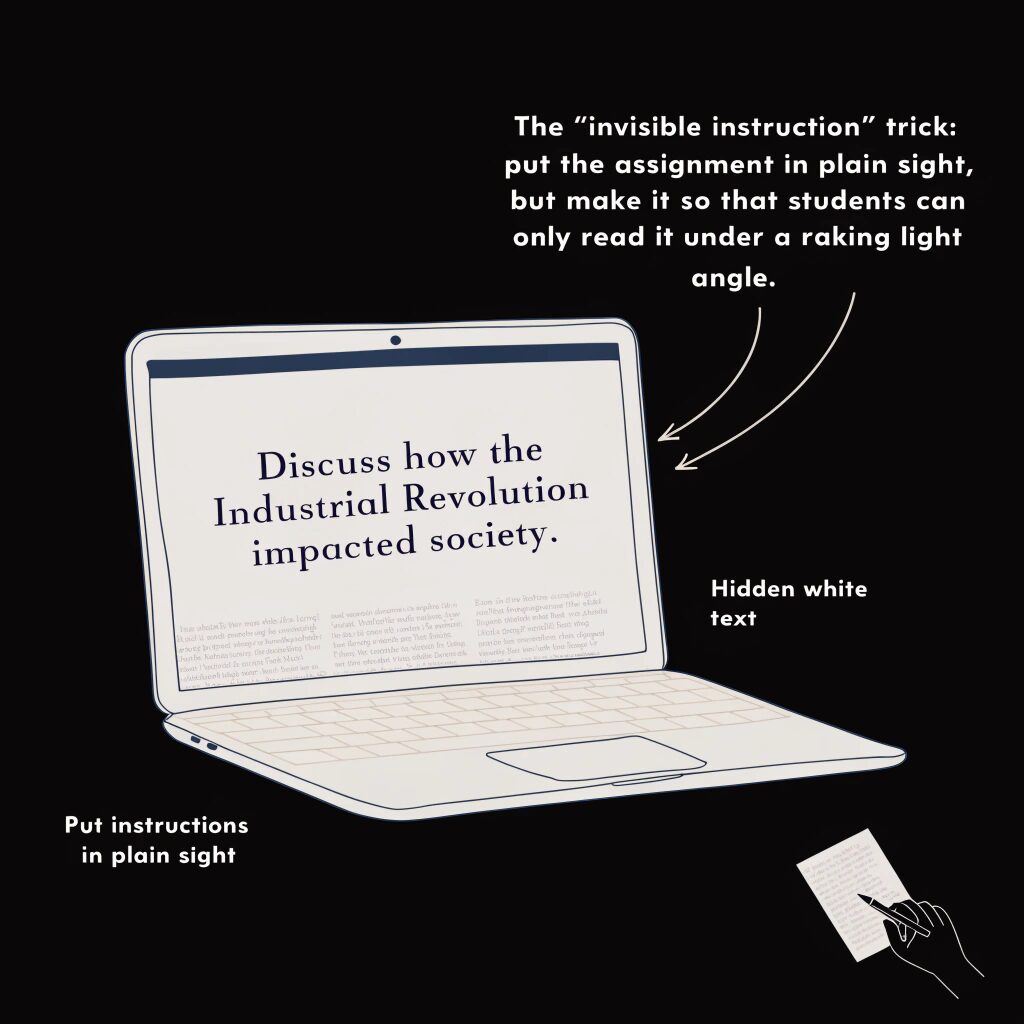
Gibson embedded an invisible instruction in his assignment prompt, written in white font that blended into the page background. The instruction was invisible to a student reading the prompt normally, but fully readable to any AI tool the text was pasted into. It told the AI to work the word “Madagascar” into the response in a way that made no sense, a term with zero connection to the Industrial Revolution. Any submission containing a random, out-of-place reference to Madagascar was effectively a confession that the student had copied the prompt into an AI chatbot and pasted the output straight back without reading it.
The results were stark: 32 of his 35 students across two classes failed that portion of the midterm. Only one student successfully contested the grade, explaining that their screen was set to dark mode, which happened to render the hidden white text visible in a uniform color and inadvertently gave away the trick before they submitted. Gibson’s video about the incident went viral, racking up nearly 10 million views after it was reshared.
This case is a useful contrast to the statistical false-positive and false-negative problems discussed above. Gibson’s method didn’t rely on a probabilistic AI-detection tool at all. It produced direct, unambiguous evidence of copy-paste AI use, sidestepping the accuracy problems that plague commercial detectors entirely. It also illustrates the flip side of the fairness debate: while automated detectors can wrongly punish honest students, a well-designed human-crafted trap can catch real cheating without any of the bias or false-positive risk baked into algorithmic tools.
The Problem of False Positives: Why Innocent Students Get Flagged
A false positive means the detector says AI was used when it wasn’t. This happens more often than institutions want to admit.
According to the University of Maryland study cited by The New York Times, 12 different AI-detection services falsely flagged human-written text as AI-generated about 6.8% of the time on average. That sounds small until you do the math. At a school with 10,000 students submitting 5 papers per semester, a 6.8% error rate means roughly 3,400 false accusations per term. Even at smaller schools, dozens of innocent students face misconduct hearings.
But the damage isn’t evenly distributed. Non-native English speakers are hit disproportionately hard. The Markup found that seven major AI detectors flagged writing by non-native speakers as AI-generated 61% of the time, nearly 10 times higher than the average false-positive rate. Why? Because detectors pick up on patterns that are normal for English learners: simpler sentence construction, predictable word choices, less idiomatic phrasing. These same patterns overlap with how AI models often write. The detector can’t tell the difference.
The Markup’s research also found that about 20% of papers analyzed received a unanimous incorrect assessment across multiple detectors. Twenty percent. That means one in five flagged submissions was wrong, and all seven tools agreed on the same false accusation.
The University of San Diego Law Library emphasizes that AI detectors are “neither accurate nor reliable.” The guide also notes that students with dyslexia, ADHD, or autism often trigger false positives because their natural writing style, which might include repetitive phrasing, shorter sentences, or unconventional structure, gets flagged as machine-generated. Neurodivergent students face an extra burden: their brains work differently, and that difference can look suspicious to a detector trained on neurotypical writing.
Real Consequences of False Accusations
When a detector flags your work, you don’t automatically fail. But you do enter an academic misconduct investigation. That process can take weeks or months. You must meet with professors and administrators. You provide drafts, revision history, and timestamps to prove you wrote the paper. Even after you’re cleared, the accusation stays in institutional records.
Some students face worse outcomes. False flagging has led to failing grades, suspension, and even expulsion before appeals happen. The burden of proof flips: instead of the school proving you cheated, you must prove you didn’t. That’s the opposite of how justice normally works.
The Failure of Detection: Why Cheating Often Goes Unseen
Here’s the paradox: while detectors wrongly accuse honest students, they also miss actual AI-generated work at alarming rates.
BBC reported on a University of Reading study that tested this directly. Researchers created 33 fictitious student accounts and submitted ChatGPT-generated answers for an undergraduate psychology degree. The AI essays were described as “verging on being undetectable.” When human markers graded these papers, 94% did not raise any concerns. Only 6% of AI submissions triggered detection, which is worse than random guessing.
The study also found that AI-generated submissions scored, on average, half a grade boundary higher than work produced by real students. So cheaters using AI not only avoided detection, they got better grades than honest students. That creates a system where dishonesty is both invisible and rewarded.
Turnitin, the market leader in detection software, openly admits to missing roughly 15% of AI-generated text. The company also won’t flag a document as AI-generated unless at least 20% of the text matches its detection criteria. This threshold is intentional. According to reporting from GradPilot citing Inside Higher Ed, Turnitin is “comfortable with that since we do not want to highlight human-written text as AI text.” In other words, the company has chosen to prioritize avoiding false positives over catching actual cheating. The result is that genuine AI work slips through regularly.
Informal classroom experiments show just how easy it is to bypass detection. One study found that 100% of 17-year-olds in a test group completely avoided triggering AI detectors, even when submitting obvious AI-generated text. Younger students also bypassed detection: 50% of 12-year-olds and 38% of 13-year-olds got their AI work flagged. But the older students, the ones in college, had no problem at all.
Why Detectors Miss AI
Detection failures happen for several reasons. AI text varies depending on the prompt, the model, and the refinements made to the output. A student might run ChatGPT output through a grammar checker, rewrite sections manually, or paraphrase key ideas. These small changes disrupt the statistical patterns the detector is looking for. By the time the essay reaches a grader, it may look indistinguishable from human writing.
Also, many detectors use thresholds. If only 15% of a paper appears AI-written, most tools won’t flag it. A student can mix a small amount of AI help with their own writing and pass through undetected. The detector sees partial human work and gives it a pass.
Human markers also play a role. In the Reading study, even when papers were definitively AI-generated, markers didn’t catch them because they weren’t looking for the signs. AI work can sound coherent, organized, and intelligent. It often exceeds what a typical undergraduate produces. Markers, used to grading human work with flaws and quirks, don’t expect to see polished AI prose and sometimes don’t notice when they do.
Systemic Risks and Academic Consequences
The combination of false positives and false negatives creates a broken system. Students who cheat with AI can succeed while innocent students face ruin.
Vanderbilt University projected the scale of the problem. Even assuming a 1% false-positive rate, the university calculated that around 750 student papers could be incorrectly labeled as AI-generated in a single semester. At a large school, that’s hundreds of innocent students pulled into misconduct investigations. Multiply that across all universities using detection software, and the number of wrongly accused students reaches into the thousands every semester.
Vendor accuracy claims have proven unreliable. Turnitin initially claimed a 1% false-positive rate but revised that to 4% after real-world deployment. GPTZero claimed 1–2% false positives internally but was observed producing 10% false-positive rates in independent testing. When companies revise their accuracy upward after tools are already in schools, it signals they didn’t fully understand their own systems before deploying them to millions of students.
Several major universities have responded by disabling or suspending AI detection. Vanderbilt, Cornell, University of Pittsburgh, and University of Iowa all moved away from automated detection systems due to unreliability and equity concerns. These schools recognized that the risk to innocent students outweighed the benefit of catching cheaters. They’re now investigating suspected cases individually rather than relying on automated flagging.
| Detection Tool | Claimed Accuracy | Revised Accuracy | False-Positive Rate | Miss Rate |
|---|---|---|---|---|
| Turnitin (mainstream) | 1% false positives | 4% false positives | 4% | ~15% |
| GPTZero | 1–2% false positives | Observed at 10% | 10% | Unknown |
| Average across 12 services | — | — | 6.8% | Unknown |
| University of Reading markers | — | — | N/A | 94% (6% catch rate) |
The table above shows why schools face a dilemma. No detector reliably separates AI from human work. Some miss most cheating. Others accuse too many innocents. The choice is between under-detection (letting cheaters pass) and over-detection (punishing honest students).
Who’s Most at Risk of Being Wrongly Flagged
Not all students face equal risk. Certain groups are disproportionately vulnerable to false accusations.
Non-native English speakers top the list. As noted earlier, seven detectors flagged non-native writers 61% of the time. This isn’t because these students cheat more, it’s because their writing patterns match what detectors have learned to flag as AI. Simpler syntax, less idiomatic language, and predictable word choice are normal for English learners but suspicious to an algorithm.
Neurodivergent students also face higher flagging rates. Autism, ADHD, and dyslexia can influence how someone writes. Repetitive phrasing, unconventional punctuation, or atypical sentence structure can trigger detectors. A student with dyslexia who uses a text-to-speech tool to compose might produce text that looks statistically unusual. An autistic student who writes in a direct, literal style may be flagged simply for being consistent and clear.
Students writing under time pressure or in states of fatigue produce different work than usual. A stressed all-nighter paper might have simpler sentences and less variation than the student’s normal writing. The detector sees the change and flags it.
Students using assistive technology, dictation software, grammar tools, or accessibility features, may have their work flagged because these tools alter writing patterns in ways detectors don’t understand.
You don’t have to be in one of these groups to be at risk. The 6.8% false-positive rate means any student submitting any paper could be wrongly flagged. The randomness is part of what makes the system so unfair.
Practical Steps If You’re Flagged (Or Want to Avoid It)
If a detector flags your work, don’t panic. A false positive is not proof. Document everything: save your drafts, notes, and revision history. If you used dictation software, grammar checkers, or other tools, note that. If you wrote over multiple sessions, keep timestamps. This evidence is what you’ll use to clear your name.
Request a meeting with your instructor before escalating to formal misconduct proceedings if possible. Many false flags get resolved at this level when you show your process. Bring your drafts and revision history. Explain your writing process. Many professors will drop the accusation immediately once they see evidence of authentic work.
If the accusation reaches formal proceedings, you can explore resources on understanding how AI detects speech-to-text conversions and other accessibility tools, since using assistive technology shouldn’t be held against you. Some universities have policies protecting students who use accessibility software from being flagged.
To reduce risk while writing:
- Write in multiple sessions and save drafts showing your progress.
- Use your own voice and style. Don’t try to sound like an academic journal, write as you normally would.
- If you’re a non-native English speaker, don’t worry about sounding “native-like.” Your authentic voice is what instructors want to see.
- Use tools that show revision history (Google Docs, Word online). These create a record of your writing process.
- If you use grammar or style tools, use them transparently. Tell your professor you used them. These tools are not cheating.
- Avoid copying large blocks from sources without heavily paraphrasing in your own words. This is good practice regardless of AI detection.
Why Universities Are Reconsidering AI Detection
More institutions are stepping back from automated detection. The math is simple: the cost of wrongly accusing innocent students outweighs the benefit of catching some cheaters.
Fairness is the core issue. When detection disproportionately flags non-native speakers, neurodivergent students, and others, it becomes a tool that punishes certain groups while protecting others. That violates basic principles of academic integrity, which is supposed to be about honest evaluation, not about whose writing style matches an algorithm’s expectations.
Schools are also recognizing that detection creates a false sense of security. Administrators believe the tools are catching cheating, but the evidence shows they’re not. Cheaters adapt. They mix AI with their own work. They use newer models that detectors haven’t been trained on. They paraphrase carefully. Meanwhile, honest students get caught in the crossfire.
Some universities have moved to honor systems, increased emphasis on authentic assessment (essays written and revised in class), or direct evidence-based investigations when cheating is suspected. These approaches take more time and money but produce fairer outcomes.
FAQ
Q: Do AI detectors work on non-native English writing?
They often perform worse on that group. The Markup reported that seven detectors flagged non-native speakers’ writing as AI-generated 61% of the time, likely because detectors associate simpler or more predictable wording with AI. This can make English learners especially vulnerable to false accusations.
Q: Which students are most likely to get flagged by AI detectors?
Students whose writing style differs from the detector’s expected pattern are at higher risk. The University of San Diego Law Library says neurodivergent students and students for whom English is a second language are flagged more often, and The Markup reports disproportionate flagging of non-native speakers. That means style, not cheating, can drive suspicion.
Q: How can AI-generated work go undetected?
BBC reported that in a University of Reading experiment, 94% of AI-generated answers did not raise concerns with markers. The study suggests AI text can be strong enough to resemble authentic student writing, and some systems are only configured to flag a paper when a large portion appears AI-written. That combination can let cheating slip through.
Q: Are AI detectors better at catching ChatGPT or human writing?
They are imperfect at both. The New York Times cited a University of Maryland study showing human text was falsely flagged about 6.8% of the time on average, while BBC reported that most AI-generated submissions in a Reading experiment went unnoticed. The result is a system that can accuse the wrong student and still miss actual AI use.
Q: Why do colleges use AI detection if it is unreliable?
Schools use detectors because they want a quick way to protect academic integrity and respond to the rise of generative AI. But the reporting shows the tradeoff is serious: detectors can misclassify human writing, especially for marginalized students, and they can still miss AI-generated submissions. That is why some institutions have reconsidered or disabled the tools.
Q: What happens if a detector says I used AI?
A false detection can trigger an academic integrity inquiry, a failing grade, or other disciplinary action. The New York Times and The Markup both show that students may then have to prove authorship through drafts, writing history, or other evidence. The key risk is that the detector’s output may be treated as suspicion rather than proof.
Q: Should students worry about AI detection in 2026?
Yes, especially in classes that use automated screening or allow high-stakes submissions. The reporting shows that detectors still produce false positives, can be biased against some writing styles, and can also miss AI-generated work. So the risk is both being wrongly accused and being caught in a system that is not fully reliable.
My Experience With Why Are 33 Students Failing Over AI Detection—And Could It Happen to You?
I spent months researching this topic because the injustice of it genuinely bothered me. Watching intelligent, hardworking students get dragged into misconduct proceedings because a detector misread their writing felt wrong. What struck me most was how avoidable these situations are. Universities know these tools fail. The research is clear. Yet institutions keep using them anyway, often because they’re cheap and feel like a solution.
The University of Reading study with 33 fictitious students stuck with me. That wasn’t a theoretical problem, it was a concrete proof that cheating is easier to hide than honest work is to protect. And here’s the part that actually matters: no software fix solves this. Better detection algorithms won’t work because the fundamental problem isn’t technical. It’s that human and machine writing can be indistinguishable when you’re only looking at statistical patterns.
The real risk isn’t whether you might be wrongly flagged someday (you might). It’s that your school might rely on a flagging as proof rather than using it as a starting point for investigation. That shifts the burden from the accuser to the accused, and that’s backwards.
Have you or someone you know been wrongly flagged by an AI detector, and how did you handle it?
Conclusion
The 33 students in the University of Reading study weren’t real. They were invented test cases. But the problem they represent is very real: AI detection systems are failing students on both fronts. They’re catching some cheaters while letting others sail through. They’re also accusing innocent people at rates high enough to derail academic careers.
The evidence from The New York Times, BBC, The Markup, and academic institutions is unambiguous. These tools are unreliable. They disproportionately harm non-native speakers, neurodivergent students, and others whose writing style doesn’t fit the detector’s narrow definition of “human.” They also miss substantial amounts of actual AI-generated work, creating a false security around academic integrity.
The smart move for schools is to stop relying on automated detection as proof. Use it as one signal among many. Investigate cases individually. Protect students who are accused. Build systems that reward authentic learning rather than punishing the unfortunate few whose algorithms misfires.
For students and parents, the lesson is clear: if you’re flagged, you have options. Document your process. Push back politely but firmly. Demand evidence, not just an algorithm’s suspicion. And if your school refuses to reconsider after you’ve provided proof of your work, escalate to higher administration. The burden should never be on you to prove you’re innocent.
References
- The New York Times. (2025, May 17). A new headache for honest students: proving they didn’t use AI. https://www.nytimes.com/2025/05/17/style/ai-chatgpt-turnitin-students-cheating.html
- BBC. (2025). AI can beat university students, study suggests. https://www.bbc.co.uk/news/articles/cqqqln0eg65o
- BBC. (2025). Reading university: AI exam submissions can go undetected. https://www.bbc.com/news/articles/cevvw98q7wvo
- The Markup. (2023, August 14). AI detection tools falsely accuse international students of cheating. https://themarkup.org/machine-learning/2023/08/14/ai-detection-tools-falsely-accuse-international-students-of-cheating
- University of San Diego Law Library. (n.d.). The problems with AI detectors: False positives and false negatives. https://lawlibguides.sandiego.edu/c.php?g=1443311&p=10721367
- Litero.ai. (2026). False positives in AI detection are hitting students hard. https://litero.ai/blog/visual-breakdown-false-positives-in-ai-detection-are-hitting-students-hard/
- GradPilot. (2026). Turnitin’s 15% AI miss rate — Why colleges are switching. https://gradpilot.com/news/turnitin-failed-admissions-pangram-replacement
- ECM Tutors. (2026). Why AI detection doesn’t work: Insights from a classroom experiment. https://ecmtutors.com/why-ai-detection-doesnt-work-insights-from-a-classroom-experiment/
- Yahoo/BroBible/Daily Dot/Upworthy/The Quintessential Gentleman. (2026, July). Professor uses clever text trick to catch 32 students who used AI to cheat on their midterms.

Sarah Anderson . J
I’m the mom behind Wise Mom Blogger, where everyday creativity meets real-life motherhood. I share easy DIY crafts, cozy knitting and crochet projects, beginner-friendly sewing ideas, and family-tested recipes—plus quick baking hacks that make homemade feel doable on busy days.