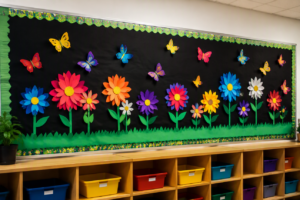

What makes a truly great middle school bulletin board stand out from the bare walls most classrooms settle for? The answer isn’t complicated—it’s about purpose, student voice, and design that actually works. Whether you’re decorating a new classroom or refreshing one that’s been up all year, bulletin boards can transform from forgotten decorations into spaces where learning happens, community builds, and students feel seen. These 10 ideas blend function with creativity, giving you bulletin board ideas that middle schoolers will actually notice and use. From interactive displays to sticky-note walls packed with ambition, here’s how to make your classroom walls work harder for your students.
Quick Questions and Answers
Question: Why should middle school teachers use fabric backdrops instead of traditional paper rolls? Fabric backdrops are highly recommended for middle school classrooms because they are more durable than paper. They resist fading over time, do not tear as easily, and effectively hide unsightly staple holes. This makes them a cost-effective and long-lasting choice for high-traffic bulletin boards that you intend to keep up for the entire school year.
Question: Can interactive bulletin boards help improve student engagement in middle school classrooms? Yes, interactive bulletin boards significantly boost student engagement by moving away from static displays toward hands-on participation. Ideas like giant Sudoku puzzles, QR code scavenger hunts, and kindness buckets encourage students to physically interact with the space. These designs transform walls into active learning tools that support community building and critical thinking rather than just serving as passive room decor.
Question: Do I need to organize middle school bulletin boards for specific functional purposes? Yes, successful bulletin boards should always serve a clear purpose, such as supporting instructional goals, organizing classroom procedures, or showcasing student work. Before designing, decide whether the board will be used as a reference for writing processes, a word wall, or a community-building space. Keeping the function obvious and uncluttered helps middle schoolers use the resource effectively without feeling overwhelmed by extra visual information.
1. Best Streaming Queue Reading Display
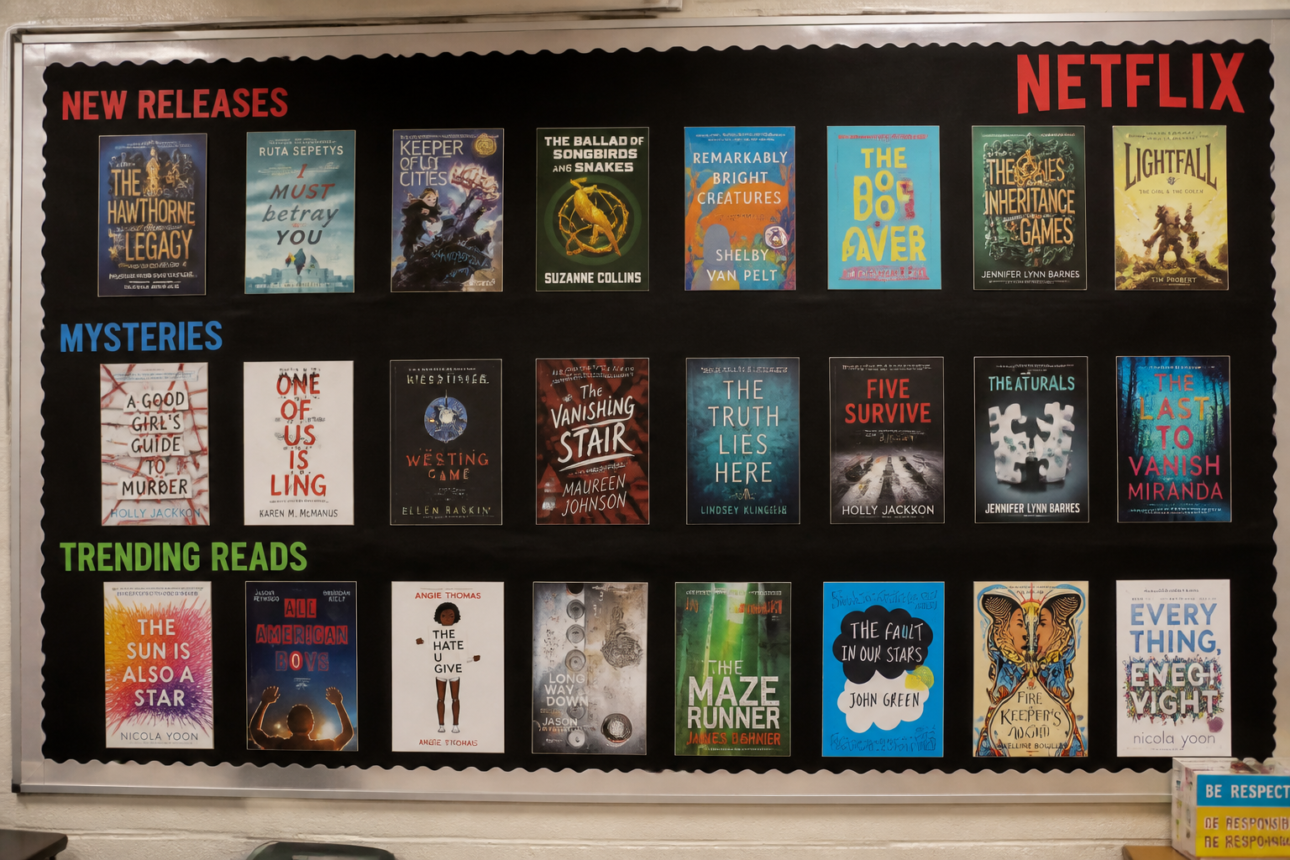
Imagine walking into a middle school classroom and seeing a bulletin board that looks exactly like the interface of Netflix or Hulu—except instead of shows, it’s filled with book covers. That’s the streaming queue reading display, and it works because middle schoolers already know how to navigate those platforms. They’re comfortable scrolling through categories, and translating that familiar experience to physical books removes a major barrier to independent reading.
The setup is straightforward. Arrange book covers horizontally across the board in labeled rows like “New Releases,” “Mysteries,” “Fantasy Adventures,” “Trending Reads,” and “Staff Picks.” Each category gets its own section, and students can see at a glance what’s available without hunting through shelves. According to Now Spark Creativity’s guide to ELA bulletin boards, organizing books by category and mood helps students easily browse titles that appeal to their specific interests, effectively increasing independent reading participation.
The real magic happens when you update it regularly. Add new titles every few weeks, rotate the categories with the seasons, and let students nominate books for the board. This isn’t just decoration—it’s an active recommendation engine that feels modern and accessible. Middle schoolers who wouldn’t normally pick up a book might grab one because it caught their eye in a format they already love.
2. Easy Writing Process Roadmap
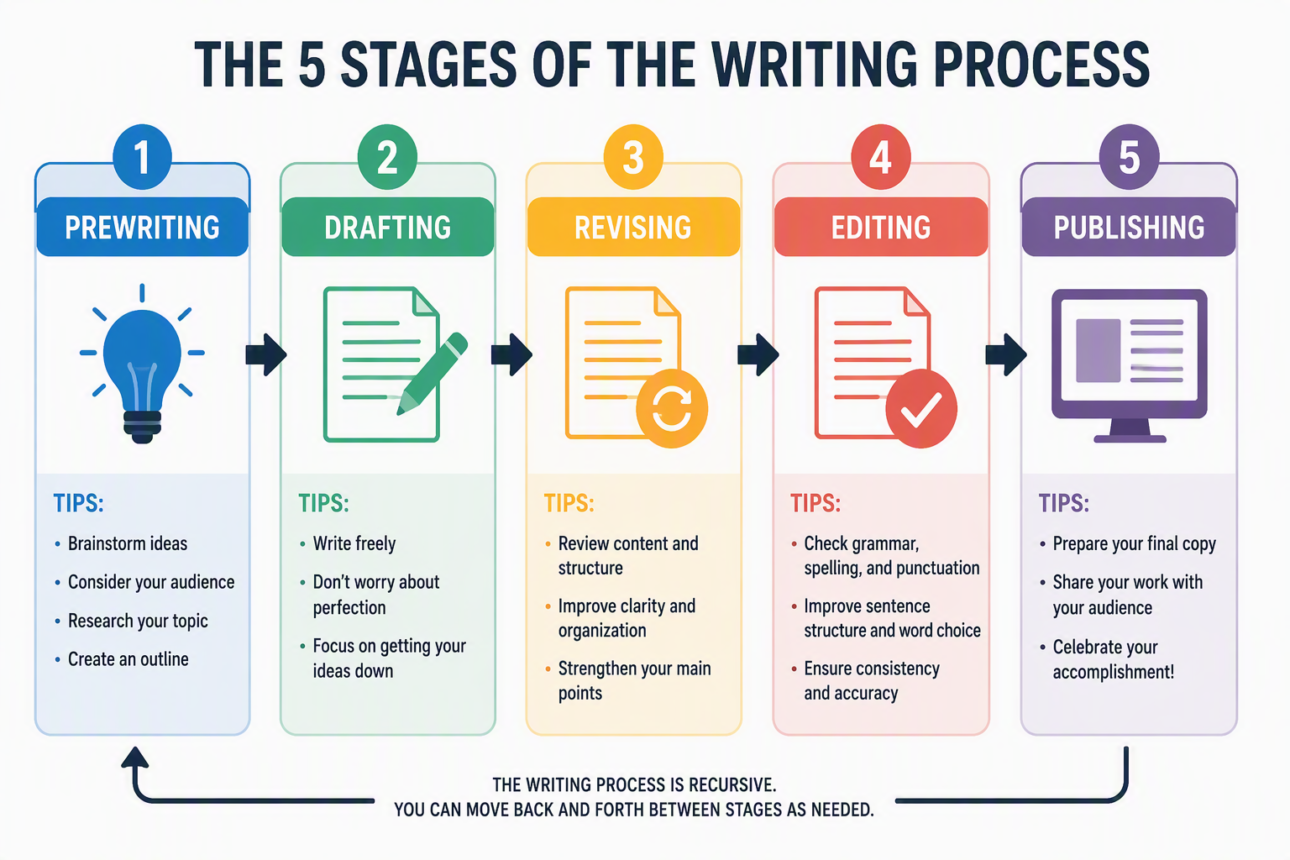
Writing can feel like wandering through fog for middle schoolers. They know they’re supposed to write, but the steps blur together, and they often jump straight from thinking to submitting without stopping for revision. A writing process roadmap board fixes that by turning the invisible process into something visual and trackable.
The board displays five clear stages: Prewriting, Drafting, Revising, Editing, and Publishing. Under each heading, include specific questions or tips that guide students through that step. Prewriting might say “What’s your main idea? Who’s your audience?” Revising might ask “Does every sentence support your main point? Can you move paragraphs around?” These prompts act as a self-editing guide that students can reference independently during writing workshops.
Placing this board at eye level near the writing workspace means students check their progress without raising their hand to ask what comes next. It reduces teacher load and builds student confidence because they can self-direct their work. As one teacher noted in Now Spark Creativity’s roundup, writing the steps of the writing process like a roadmap gives students a clear visual guide they can follow at their own pace.
3. Genius Sticky-Note Goal Wall
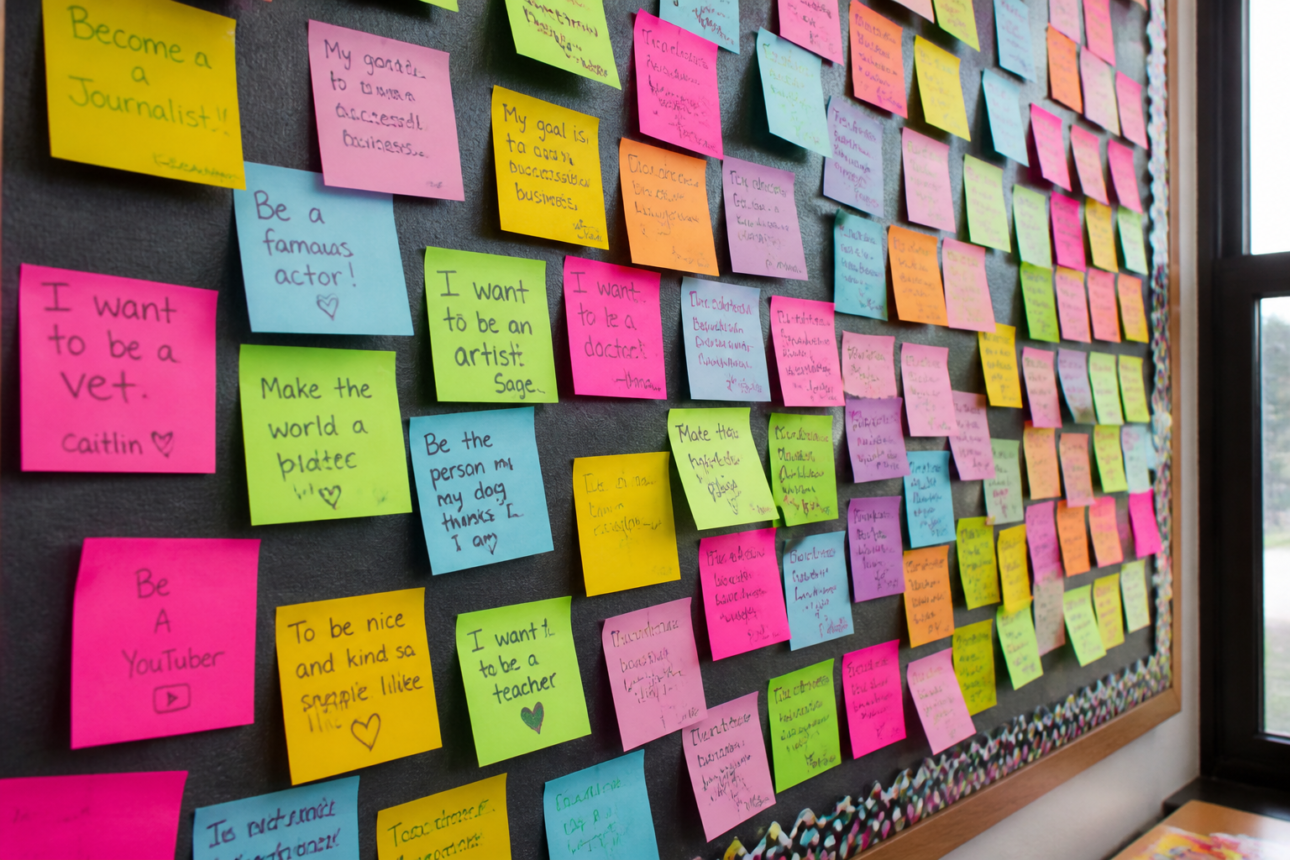
Back-to-school time is the sweet spot for a sticky-note goal wall, though this board works any time you want to build community and surface student voice. Here’s how it functions: give each student a sticky note and ask them to write one personal goal, academic goal, or something they want to learn this year. They post it on the board with their name.
What happens next is magic. Students wander over and read each other’s goals. They see classmates aiming for better grades, trying out for sports, learning to draw, standing up to bullying, or finally understanding algebra. Suddenly, the classroom feels less like a place where everyone’s competing in isolation and more like a team working toward something together. Students also see goals similar to their own and gain courage from knowing they’re not alone.
This board works especially well during the first weeks of school because it personalizes the classroom instantly and helps students connect across social groups. According to research featured in We Are Teachers’ back-to-school collection, sticky-note goal walls are highly effective at helping students surface personal aspirations and connect with peer voices. Leave the board up all year, and students can watch their progress and celebrate when goals get crossed off.
4. Cozy Student of the Month Spotlight
Recognizing students for who they are—not just grades—matters enormously at this age. A Student of the Month spotlight dedicates rotating board space to celebrate one student for their unique contributions. This could be academic excellence, but it could also be kindness, humor, artistic talent, leadership, resilience, or just being a good friend.
Set it up with a framed photo (or a printed photo on colorful cardstock), a short written interview, and space for classmates to write sticky notes of appreciation. Ask the spotlighted student questions like “What’s your favorite book?” “Who inspires you?” “What do you want to be known for?” Their answers make them feel seen in a way that a simple “nice job” doesn’t. Changing the focus monthly ensures a diverse range of students—the quieter kids, the athletes, the artists, the class clowns—get their turn feeling celebrated.
This board has staying power because middle schoolers crave recognition and belonging. It also subtly teaches peers to notice strengths beyond the obvious ones. When the shy artist gets spotlighted, other students start seeing that skill as valuable. When the funny kid gets recognized for making people feel included, kindness gets framed as strength.
5. Modern Fabric Backgrounds
This one isn’t flashy, but it’s fundamental. Swap paper backgrounds for fabric, and you’ve solved half your bulletin board problems before you even start designing. Paper tears, fades, and collects staple holes that look unprofessional. Fabric resists all three.
Choose neutral colors—gray, cream, soft blue, or black—or simple patterns that won’t compete with your content. Avoid busy prints because they create visual clutter and make text hard to read. The fabric stays up for months, which means less rebuilding and more time spent on actually engaging students. According to Reflex’s guide to middle school bulletin boards, fabric backgrounds do not fade or tear easily and can hide staple holes, making them a cost-effective and long-lasting choice for high-traffic bulletin boards.
One bonus: fabric is washable. If someone spills something or the board gets grimy (and it will), you can wipe it down without worrying about ripping paper or removing staples one by one. Yes, fabric costs more upfront, but it’s an investment that pays dividends across an entire school year.
| Board Type | Durability | Maintenance | Best For | Cost |
|---|---|---|---|---|
| Paper Rolls | Low—tears and fades quickly | High—frequent replacement | Short-term themes or monthly rotations | Low |
| Fabric Backdrops | High—lasts entire school year | Low—wipe clean, no replacement | Permanent boards or frequently updated content | Medium |
| Butcher Paper | Medium—resists tearing but fades | Medium—replaceable but time-intensive | Classroom procedures and word walls | Low |
| Bulletin Board Paint | Very High—permanent and durable | Very Low—never needs replacing | Semi-permanent boards (seasonal or unit-based) | High |
6. Smart Giant Logic Puzzle Station
Middle schoolers have downtime. Someone finishes their work early. Two students are waiting for group time to start. Three more are between lessons and need something to do. A giant logic puzzle board fills that gap perfectly while keeping brains engaged.
Create a massive Sudoku grid, a sprawling word search, a giant crossword, or a logic reasoning puzzle on the board. Use large print so it’s visible from across the room, and laminate a section or use dry-erase markers so students can write and erase their answers repeatedly. Leave pencils or markers nearby so the barrier to entry is zero.
This serves multiple purposes at once. It keeps early finishers productively occupied. It gives anxious students something to do with their hands during transitions. It rewards students who think logically or love word games. And it builds community because students will work together, helping each other spot words or figure out numbers. According to Moss & Twine’s interactive bulletin board collection, giant game boards such as Sudoku encourage students to interact with the wall during downtime or as bell-ringer warm-up activities, keeping the classroom environment stimulating.
Change the puzzle weekly so it stays fresh. Students will actually look forward to Monday mornings to see what puzzle is on the board.
7. Amazing Hallway of Fame Display
While Student of the Month focuses on classroom behavior and character, the Hallway of Fame celebrates achievements beyond the classroom walls. Did a student place in a robotics competition? Win the district art show? Get cast in the school play? Make the soccer team? Learn to play a new instrument? This board is where you celebrate it.
Section the board using colorful borders to distinguish between different types of accomplishments—academics, athletics, arts, competitions, performances. Include photos when possible, along with a brief description of what the student achieved. The visual variety makes the board feel dynamic and gives students from all backgrounds a reason to see themselves represented.
This board works because middle schoolers are developing their identities and beginning to specialize their interests. Showcasing achievements outside the classroom tells students that school values the whole person, not just test scores and homework completion. It also builds pride in individual students and creates positive peer culture around celebrating each other’s wins rather than competing destructively.
8. Useful Classroom Procedure Sections
Every classroom needs a place where students can quickly find the answers to routine questions: What time does lunch start? When is that project due? What do I do if I finish early? A well-organized procedure board reduces hand-raising for repetitive questions and helps middle schoolers develop independence.
Divide a large board into clearly labeled sections using borders. One section for the day’s schedule or bell schedule, another for upcoming due dates, another for supply lists or what to bring for the next field trip, another for classroom routines like bathroom procedures. Use consistent fonts and colors so the board feels organized rather than chaotic. According to Reflex’s bulletin board guide, large boards can be sectioned into halves or even quarters using borders, keeping information uncluttered and easy to identify.
Update this board weekly or as needed. Remove information once it’s outdated so the board stays relevant. A procedure board that hasn’t been updated since September becomes invisible—students stop checking it because they’ve learned (correctly) that the information is stale. Treat it as a living document, and it becomes invaluable.
9. Interactive QR Code Hub
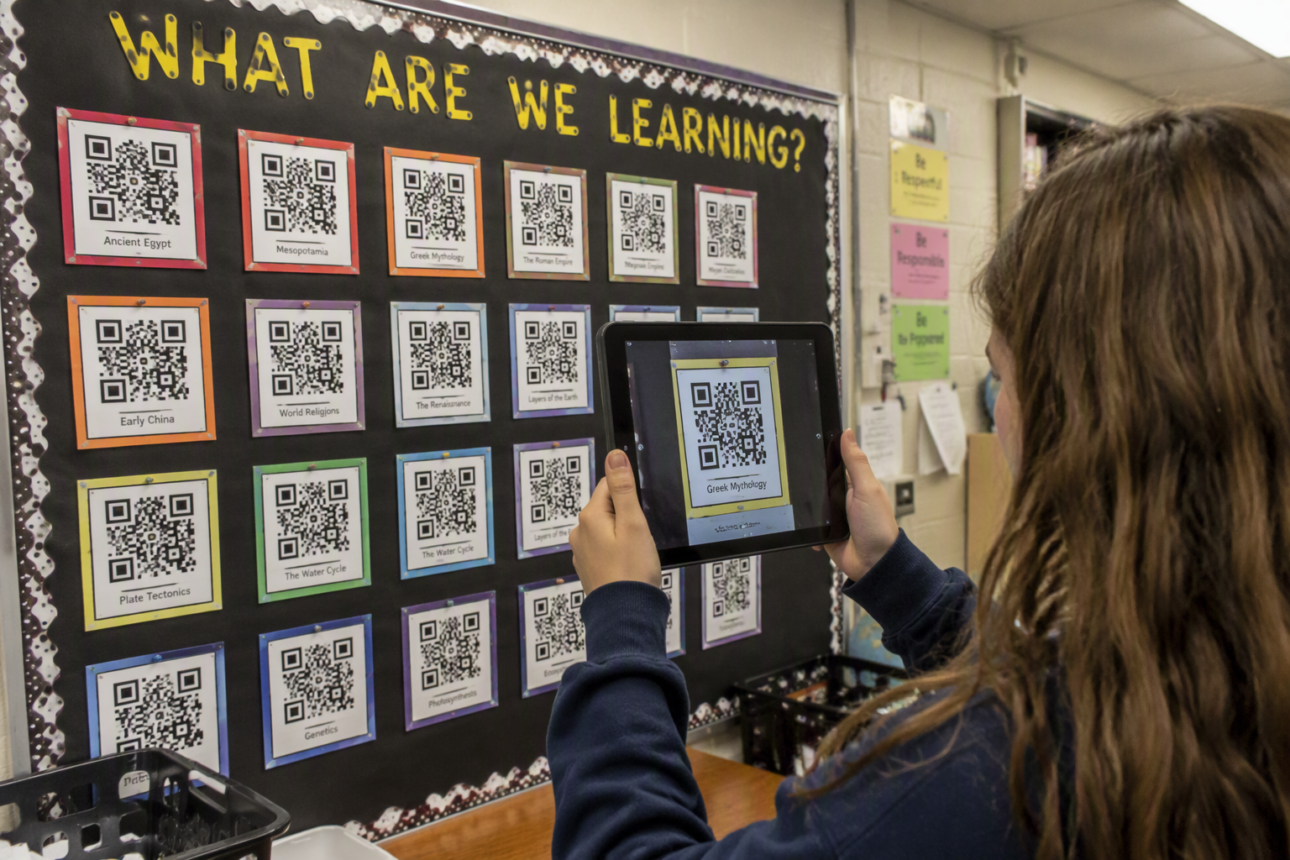
If your school has 1:1 technology or allows students to use devices regularly, a QR code bulletin board bridges the physical classroom and digital learning seamlessly. Print QR codes, mount them on colorful cardstock, and laminate them so they hold up to frequent scanning.
Code each QR link to something meaningful: a video explaining a grammar concept, an audio recording of a poem, a digital worksheet, a research database, a virtual tour related to your current unit, or even a playlist students voted on during class. Students scan during downtime, or as part of a lesson, and access the linked content instantly.
This works because it makes the board active and responsive. It also accommodates different learning styles—some students process better through video, others through audio, others through text. A single bulletin board becomes a multi-modal learning station. According to Moss & Twine’s collection of interactive boards, QR-code-linked boards integrate digital learning by allowing students to scan elements on the board to access videos, audio, or additional educational resources, creating a bridge between classroom walls and online content.
Update the codes regularly to keep content fresh and relevant to what you’re teaching.
10. Giant Word Wall or “This Not That” Language Display
Language is slippery for middle schoolers. They’re learning formal academic vocabulary, but they’re also figuring out tone, word choice, and how to write for different audiences. A word wall or a “This Not That” display makes language instruction visible and accessible.
For a word wall, mount vocabulary terms with definitions and visual supports. Update it each unit so the words relate to what students are studying. For a “This Not That” display, create a two-column board: one side shows casual or incorrect language, the other shows academic or correct alternatives. “Stuff happens” becomes “The event occurred.” “It was cool” becomes “The design was innovative.” Include visual reminders about common grammar mistakes or word confusions (their/there/they’re, affect/effect, loose/lose).
This kind of board works as both instruction and reference. Students see language modeled correctly repeatedly. They can check themselves during writing. And the board itself communicates that word choice matters and that writing more formally is a learnable skill, not a mysterious talent only some kids have.
Common Mistakes
Don’t let your bulletin boards become invisible. A board that hasn’t changed in three months stops registering in students’ brains—they walk past it every day without actually seeing it. Commit to updating every 2-4 weeks minimum, even if you’re just rotating which student is spotlighted or changing the logic puzzle.
Avoid cramming too much information into one space. Cluttered boards confuse rather than clarify. If you’re using the board to display classroom procedures, stick to procedures. If it’s a celebration board, celebrate. Let each board do one job well rather than trying to do everything.
Don’t forget to let students help. Middle schoolers can design borders, update displays, write content, and take ownership of board maintenance. When they’re involved, they actually pay attention and take pride in the space.
Skip boards that are purely decorative with no function. A board of vines and butterflies looks nice for about a week, then becomes wallpaper. Choose designs that serve a purpose—learning support, student recognition, community building, or organization.
FAQ
Q: Are there creative ways to display reading books for middle school students?
One popular method is to organize a classroom reading area to look like a modern streaming service queue. This approach makes finding a new book feel familiar and exciting for students accustomed to digital platforms. You can categorize books by genre or mood to help students easily browse titles that appeal to their specific interests, effectively increasing independent reading participation.
Q: How can teachers create a writing process roadmap for their middle school students?
A writing process roadmap displays the essential stages of writing—prewriting, drafting, revising, editing, and publishing—as a clear visual guide. By mapping these steps out on a bulletin board, you provide a consistent reference for students during drafting sessions. It helps them track their progress and serves as a reminder of what the next logical step should be in their writing workflow.
Q: Does a goal-setting board really motivate middle school students during the school year?
Goal-setting boards, especially those featuring sticky notes with student names and personal ambitions, are excellent for fostering identity and motivation. They provide a visible reminder of personal growth and help build a supportive classroom culture. When students see their goals displayed publicly, it encourages them to hold themselves accountable and provides a welcoming atmosphere that celebrates individual achievement.
Q: Will using student-centered art displays help build community in a middle school classroom?
Yes, showcasing student art, writing, or achievements in a ‘Hallway of Fame’ or student gallery builds confidence and belonging. These displays demonstrate that you value the work students produce, which encourages peer appreciation and pride. When the community sees their efforts celebrated on the walls, it fosters a positive environment where students feel comfortable expressing their voices and creativity.
Q: When is the best time to rotate bulletin board displays for middle school students?
The best time to rotate displays is at the start of a new unit or term to ensure the content remains relevant to the current curriculum. Static boards can become ‘invisible’ to students after a few weeks, so refreshing the content keeps their attention. Use seasonal themes or changing academic objectives to keep the classroom environment dynamic and aligned with what students are currently studying.
Q: Is it possible to integrate STEM learning into a standard classroom bulletin board?
STEM spotlight boards are a fantastic way to bring science, technology, engineering, and math concepts into your daily classroom visual space. You can include challenging logic puzzles, math-themed art projects, or information about STEM careers related to current units. These additions highlight the practical application of school subjects and can serve as early-finisher activities that keep students productively engaged while waiting for other tasks.
Q: What elements make a bulletin board effective for teaching language and vocabulary skills?
Effective language boards often include a word wall or ‘This Not That’ displays that highlight correct language usage and synonyms. By clearly labeling areas and keeping the information uncluttered, you create a functional reference tool that students can use during independent work. Visualizing tricky grammar rules or key vocabulary helps reinforce instruction and provides students with a quick, accessible guide during writing assignments.
My Experience With 10 Creative Middle School Bulletin Board Ideas for Teens
I’ve watched classrooms transform when teachers stop treating bulletin boards like obligation and start treating them like real estate—literally investing in the space. The streaming queue reading display was honestly my skepticism breaking point. I thought it sounded gimmicky. Then I saw a middle schooler genuinely excited to find a book because it was displayed like it mattered, positioned like it was trending. That shifted something.
The one insight that keeps landing for me: successful bulletin boards aren’t about decoration. They’re infrastructure. A procedure board that actually gets checked saves dozens of “Can I go to the bathroom?” questions. A writing process roadmap means students don’t freeze mid-paragraph wondering what comes next. These are the boards that earn wall space because they’re doing work.
The fabric backdrop investment pays off faster than you’d expect. One teacher told me she spent fifty dollars on quality fabric in August and didn’t replace the background once the entire year. Meanwhile, her colleague was rebuilding a paper-backed board every month. Do the math. Beyond the cost, there’s something professional about a board that doesn’t look battered and hole-ridden by October—it signals to students that this space matters.
The stickiest insight (pun intended): interactive boards keep engagement alive. Static displays go invisible within weeks. A giant Sudoku that changes weekly or a goal wall students actually check? Those stay active all year because there’s always something new to discover or update. That’s the sweet spot—purposeful, interactive, and frequently refreshed.
What’s your biggest challenge with classroom bulletin boards right now—time to update them, getting students to actually use them, or something else?
References
- Reflex. (n.d.). Bulletin board ideas for middle school. Explorelearning. https://reflex.explorelearning.com/resources/insights/middle-school-bulletin-boards
- Now Spark Creativity. (2024, September). 10 creative ELA bulletin boards for middle and high school. https://nowsparkcreativity.com/2024/09/10-creative-ela-bulletin-boards-for-middle-and-high-school.html
- PPFocus. (2024). 50+ bulletin board ideas for middle school students: Fun ways to engage and inspire your classroom community. https://ppfocus.com/a/middle-school-bulletin-boards.html
- We Are Teachers. (2024). 38 back-to-school bulletin board ideas from creative teachers. https://www.weareteachers.com/back-to-school-bulletin-board-ideas/
- Moss & Twine. (2024). 18+ creative bulletin board ideas for middle school. https://mossandtwine.com/blog/bulletin-board-ideas-middle-school/
- Bored Teachers. (n.d.). 42 awesome interactive bulletin board ideas for your classroom. https://www.boredteachers.com/post/interactive-bulletin-boards

Sarah Anderson . J
I’m the mom behind Wise Mom Blogger, where everyday creativity meets real-life motherhood. I share easy DIY crafts, cozy knitting and crochet projects, beginner-friendly sewing ideas, and family-tested recipes—plus quick baking hacks that make homemade feel doable on busy days.