When someone you care about gets diagnosed with dementia or Alzheimer’s disease, the terminology can feel overwhelming. People often use these terms interchangeably, but they mean very different things—and understanding the distinction matters for caregiving, treatment decisions, and long-term planning. Dementia is an umbrella term describing a set of symptoms affecting memory, thinking, and daily functioning, while Alzheimer’s is a specific brain disease that causes those symptoms. This guide breaks down exactly what sets them apart, why it matters, and what you need to know to navigate conversations with doctors and plan ahead.
Quick Questions and Answers
Question: What is the main difference between dementia and Alzheimer’s?
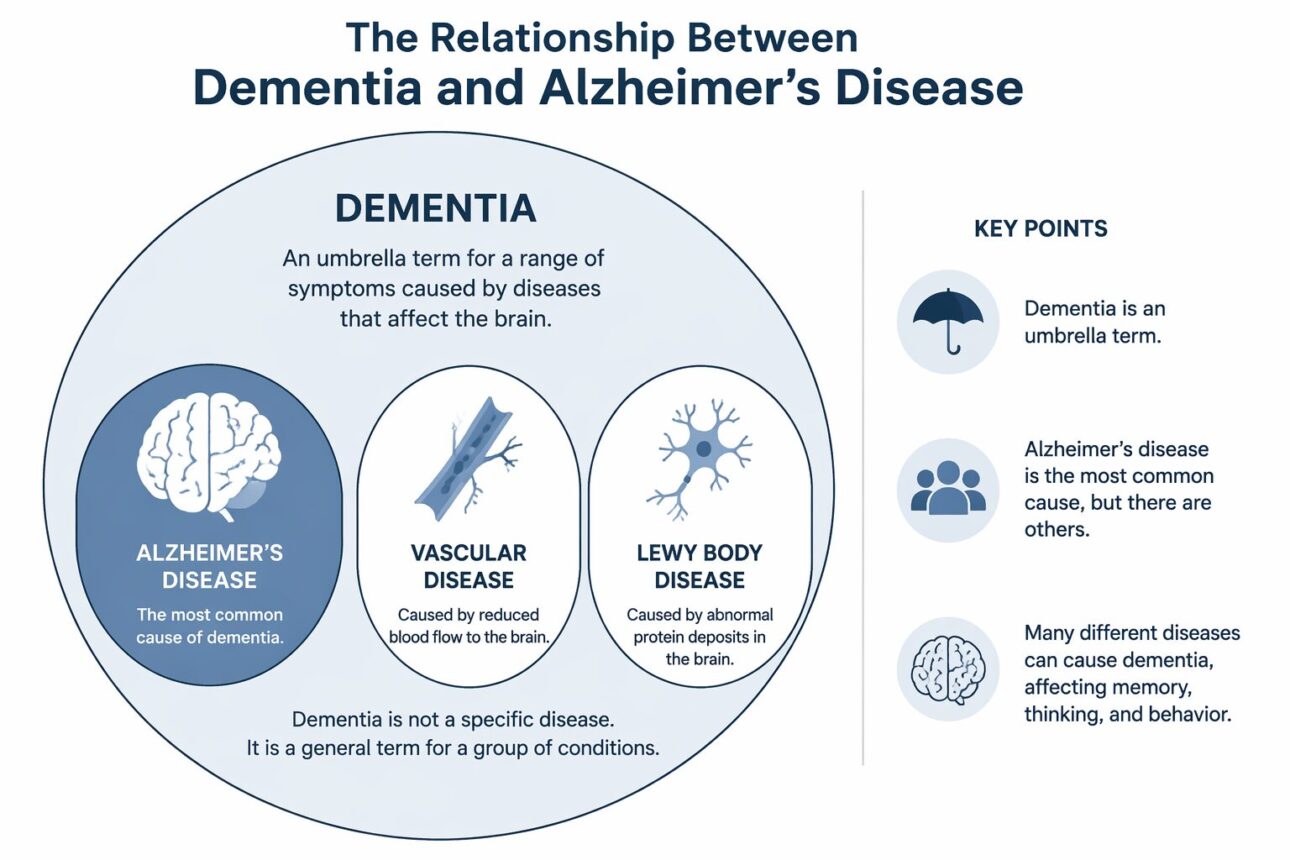
Dementia is an umbrella term for symptoms that affect memory, thinking, behavior, and daily functioning, while Alzheimer’s disease is a specific brain disease that can cause those symptoms. Alzheimer’s is the most common cause of dementia, but it is not the only one. Major health organizations describe the distinction in the same way.
Question: Is Alzheimer’s the same thing as dementia?
No. Alzheimer’s is one type of dementia, not a separate synonym for all dementia. Dementia describes a syndrome of cognitive decline that can come from different diseases, including Alzheimer’s, vascular disease, Lewy body disease, and frontotemporal degeneration.
Question: What causes dementia besides Alzheimer’s disease?
Several diseases can cause dementia, including vascular disease, Lewy body disease, and frontotemporal degeneration. Some people have mixed dementia, meaning more than one type of brain change is present at the same time. The exact cause depends on the underlying disease process.
Dementia vs. Alzheimer’s: Defining the Core Concepts
Alzheimer’s disease is the opposite—it’s a specific, progressive brain condition with a defined biological process. The disease causes physical changes in the brain: plaques made of beta-amyloid fragments and tangles made of twisted tau fibers accumulate and damage brain cells. Alzheimer’s is progressive, meaning it worsens predictably over time.
The simplest way to understand the relationship: dementia is what you see (the symptoms), and Alzheimer’s is one common reason you see it (the disease). A person with Alzheimer’s will develop dementia, but a person with dementia may or may not have Alzheimer’s.
Establishing the Difference Between Symptoms and Causes
Not all dementia is Alzheimer’s. This is critical because the cause shapes treatment options, prognosis, and what caregivers should expect.
Several distinct diseases can cause dementia symptoms:
Vascular dementia results from reduced blood flow to the brain, often after strokes or cardiovascular disease
Lewy body disease involves abnormal protein deposits called Lewy bodies in brain cells
Frontotemporal degeneration causes breakdown in the brain’s frontal and temporal lobes, often affecting personality and behavior first
Mixed dementia occurs when a person’s brain shows changes from more than one type of disease simultaneously
A person might have physical evidence of Alzheimer’s plaques and tangles alongside vascular damage from previous strokes, for example. This overlap complicates diagnosis and treatment because multiple disease processes are at work.
Alzheimer’s disease accounts for 60% to 80% of all dementia cases, making it by far the most common cause. But that also means 20% to 40% of dementia cases stem from other causes entirely.
Primary Features of Alzheimer’s Disease
What makes Alzheimer’s different from other causes of dementia are its specific biological hallmarks. Under a microscope, an Alzheimer’s brain shows two distinctive features: plaques and tangles. Plaques are sticky clumps of beta-amyloid protein that accumulate between nerve cells and disrupt communication. Tangles are twisted fibers of tau protein that form inside cells and block nutrients from traveling through the cell.
These plaques and tangles don’t appear overnight. Research shows they can begin accumulating in the brain years or even decades before a person notices any symptoms. This means someone might have active Alzheimer’s disease in their brain without realizing it. Once symptoms do appear, the disease is already established.
Alzheimer’s is relentlessly progressive. Early stages typically affect memory, especially recall of new information. As the disease advances, it damages broader regions of the brain, eventually impairing speech, coordination, and the ability to swallow. In advanced stages, a person may lose the ability to recognize family members, communicate, or perform basic self-care tasks like dressing or bathing. The disease ultimately affects survival functions—this is why advanced Alzheimer’s requires full-time care.
There is currently no cure for Alzheimer’s disease. Some medications can temporarily slow cognitive decline in early to moderate stages, but they don’t stop the underlying disease process.
Recognizing Symptoms in Daily Life
Dementia symptoms vary depending on which brain regions are affected and what disease is causing the damage. Common dementia symptoms include memory loss, difficulty concentrating, poor judgment or decision-making, problems with language and communication, visual or spatial confusion, and personality or behavior changes.
With Alzheimer’s specifically, trouble remembering new information is typically the earliest sign. This happens because Alzheimer’s usually begins in the hippocampus, the brain region responsible for forming new memories. A person might forget a conversation from yesterday or repeatedly ask the same question within minutes. They may misplace items or struggle to recall recently learned information.
As Alzheimer’s progresses, other symptoms emerge. Someone might become confused about time or place, struggle to complete familiar tasks, experience mood swings or unusual behavior, or withdraw socially. In later stages, speech becomes difficult or limited, and physical coordination declines.
One important distinction: brain pathology and clinical symptoms develop on different timelines. A person can have significant Alzheimer’s changes in their brain yet still function normally—they just haven’t crossed the threshold where damage affects daily life enough to be noticeable. This is why some people who undergo brain imaging or autopsy are found to have Alzheimer’s pathology even though they never developed dementia symptoms during life.
Key Differences: A Side-by-Side Comparison
Aspect
Dementia
Alzheimer’s Disease
Definition
Umbrella term for a collection of cognitive and behavioral symptoms
Specific progressive brain disease
What it is
A syndrome; a set of symptoms
A disease with identified biological causes
Diagnosis
Requires decline in at least two cognitive/behavioral domains severe enough to interfere with daily life
Confirmed by brain changes visible on imaging or at autopsy; no definitive test while alive
Causes
Multiple diseases can cause dementia: Alzheimer’s, vascular disease, Lewy body disease, frontotemporal degeneration, and others
Beta-amyloid plaques and tau tangles accumulate in the brain
Prevalence as cause
N/A (dementia is the outcome, not the cause)
Accounts for 60–80% of all dementia cases
Progression
Variable; depends on the underlying disease
Progressive and ultimately fatal; worsens predictably over time
Current treatment
Treat underlying disease; manage symptoms
Some medications slow early decline; no cure
Examples of life impact
Memory loss, confusion, difficulty with bills or grooming, behavior changes
Early: forgetting new information; Later: loss of speech, swallowing, mobility
Other Conditions That Cause Dementia
Understanding that dementia has multiple causes helps explain why two people with a dementia diagnosis can have very different experiences and prognosis.
Vascular dementia is the second most common cause after Alzheimer’s. It develops when blood vessels in the brain become damaged, usually from strokes or cardiovascular disease. Unlike Alzheimer’s, which progresses gradually, vascular dementia can worsen in sudden steps if another stroke occurs. Someone with vascular dementia might have memory problems, but they may retain other abilities longer than someone with Alzheimer’s.
Lewy body disease causes abnormal alpha-synuclein proteins to accumulate in brain cells. People with this form of dementia often experience visual hallucinations (seeing things that aren’t there) and movement problems similar to Parkinson’s disease. The pattern of symptoms differs significantly from Alzheimer’s.
Frontotemporal degeneration, sometimes called frontotemporal dementia, typically appears earlier in life than Alzheimer’s—often in people in their 50s or 60s. It damages the frontal and temporal lobes, so behavior and personality changes often come before memory loss. Someone with frontotemporal degeneration might become uncharacteristically aggressive, impulsive, or emotionally withdrawn.
Mixed dementia deserves special attention because it’s more common than many people realize. Someone might have both Alzheimer’s pathology and vascular damage, or Alzheimer’s combined with Lewy body changes. When multiple disease processes overlap, symptoms can be unpredictable and harder to manage. A person might experience the memory problems typical of Alzheimer’s alongside the hallucinations associated with Lewy body disease, or the behavioral changes of frontotemporal degeneration plus the vascular changes from strokes.
My Experience With Dementia vs Alzheimer’s: Complete Guide to Understanding the Difference
I’ve spent years reading research on this topic, and the single most useful insight I’ve gained is this: the word “dementia” terrifies people partly because it sounds like a diagnosis when it’s really just a description of what’s happening, not why. That shift in thinking—from “I have dementia” to “I have a disease that’s causing dementia symptoms”—changes how families approach everything from medical decisions to caregiving arrangements.
The confusion between these terms is understandable. Doctors use them interchangeably in casual conversation, families default to “Alzheimer’s” as shorthand even when the actual diagnosis is different, and media coverage doesn’t always make the distinction clear. But the precision matters. Knowing whether someone has Alzheimer’s, vascular dementia, or Lewy body disease tells you something concrete about what will likely happen next and what treatments might help.
I’ve noticed that people often feel relief once they grasp the relationship. Dementia isn’t a mystery diagnosis—it’s a symptom category. Alzheimer’s isn’t synonymous with all dementia—it’s just the most common cause. That clarity, strange as it sounds, makes the conversation with doctors feel less like you’re searching in the dark and more like you’re working with actual information.
Have you noticed differences in how doctors or family members talk about dementia versus Alzheimer’s in your own experience? The language people use often reflects their understanding.
FAQ
Q: Can you have dementia without Alzheimer’s?
Yes. Dementia is a symptom syndrome, so it can occur from conditions other than Alzheimer’s disease. The CDC and Alzheimer’s Association both state that each form of dementia has a different cause. Vascular disease, Lewy body disease, and frontotemporal degeneration are all capable of producing dementia without any Alzheimer’s pathology present.
Q: How do doctors diagnose dementia?
A diagnosis generally requires decline that is severe enough to interfere with daily life and affects more than one cognitive or behavioral area. AARP cites clinicians noting that a doctor must find decline in at least two areas such as memory, reasoning, or behavior before confirming a dementia diagnosis. Testing typically includes cognitive assessments, brain imaging, and medical history evaluation.
Q: What are the early signs of Alzheimer’s disease?
A common early sign is trouble remembering new information. The Alzheimer’s Association says Alzheimer’s typically affects the part of the brain associated with learning first, so memory for recent events is often impacted early. Someone might forget conversations, repeat the same questions, or misplace familiar items repeatedly.
Q: Is dementia a normal part of aging?
No. Major sources state that dementia is not a normal part of aging. It is caused by disease-related damage to brain cells or other brain changes that interfere with thinking and daily life. While some memory changes are normal with age, dementia involves significant cognitive decline that disrupts functioning.
Q: What does mixed dementia mean?
Mixed dementia means brain changes from more than one type of dementia occur at the same time. The Alzheimer’s Association uses the term for overlapping disease processes, which can make symptoms and diagnosis more complex. For example, a person might have both Alzheimer’s plaques and vascular damage from previous strokes affecting the brain simultaneously.
Q: How common is Alzheimer’s compared with other dementias?
Alzheimer’s is the most common cause of dementia and is estimated to account for about 60% to 80% of cases. That makes it the leading single disease behind dementia, even though many other conditions can also cause it. The remaining 20–40% of dementia cases come from vascular disease, Lewy body disease, frontotemporal degeneration, and mixed causes.
Q: Can dementia get worse over time?
Yes. Many dementias are progressive, meaning symptoms worsen over time. Alzheimer’s is specifically described as a progressive brain disease, and advanced stages can affect speech, swallowing, walking, and the ability to do basic daily tasks. The rate of progression varies depending on the person and the underlying disease process.
Conclusion
Dementia and Alzheimer’s are not the same thing, and that distinction shapes everything from medical conversations to care planning. Dementia is a collection of cognitive and behavioral symptoms caused by disease-related damage to the brain. Alzheimer’s disease is one specific cause of those symptoms—the most common one, accounting for 60% to 80% of dementia cases, but not the only one.
Understanding this difference helps you ask better questions of doctors, understand what to expect, and find appropriate resources and support. If someone you know receives a dementia diagnosis, the next crucial step is identifying the underlying cause. That diagnosis determines treatment options, likely progression, and what kind of support will be most effective.
For anyone navigating this personally—whether as a patient, family member, or caregiver—clarity about terminology and disease processes can reduce fear and improve decision-making. The information is available, the questions are legitimate, and getting precise answers about which disease process is at work makes all the difference.
References
Alzheimer’s Association. (n.d.). Dementia vs. Alzheimer’s Disease: What Is the Difference? https://www.alz.org/alzheimers-dementia/difference-between-dementia-and-alzheimer-s
Alzheimer’s Society. (n.d.). What is the difference between dementia and Alzheimer’s disease? https://www.alzheimers.org.uk/blog/difference-between-dementia-alzheimers-disease
Cleveland Clinic. (n.d.). Dementia vs. Alzheimer’s: The Difference. https://health.clevelandclinic.org/dementia-vs-alzheimers
AARP. (n.d.). Dementia vs. Alzheimer’s: Key Differences Explained. https://www.aarp.org/health/conditions-treatments/difference-between-dementia-alzheimers/
CDC. (n.d.). About Dementia | Alzheimer’s Disease and Healthy Aging. https://www.cdc.gov/alzheimers-dementia/about/index.html
WebMD. (n.d.). What Is the Difference Between Alzheimer’s and Dementia? https://www.webmd.com/alzheimers/alzheimers-and-dementia-whats-the-difference
Alzheimer’s Association. (n.d.). Understanding Alzheimer’s and Dementia [PDF]. https://www.alz.org/getmedia/6710cb3e-3045-4a2f-b955-66249f6e80e4/alzheimers-dementia-understanding-alzheimers-and-dementia_ts.pdf
Harvard Health. (n.d.). Alzheimer’s disease versus other types of dementia – Understanding the Differences. https://www.health.harvard.edu/brain-health/alzheimers-disease-versus-other-types-of-dementia-understanding-the-differences
Sarah Anderson . J
I’m the mom behind Wise Mom Blogger, where everyday creativity meets real-life motherhood. I share easy DIY crafts, cozy knitting and crochet projects, beginner-friendly sewing ideas, and family-tested recipes—plus quick baking hacks that make homemade feel doable on busy days.