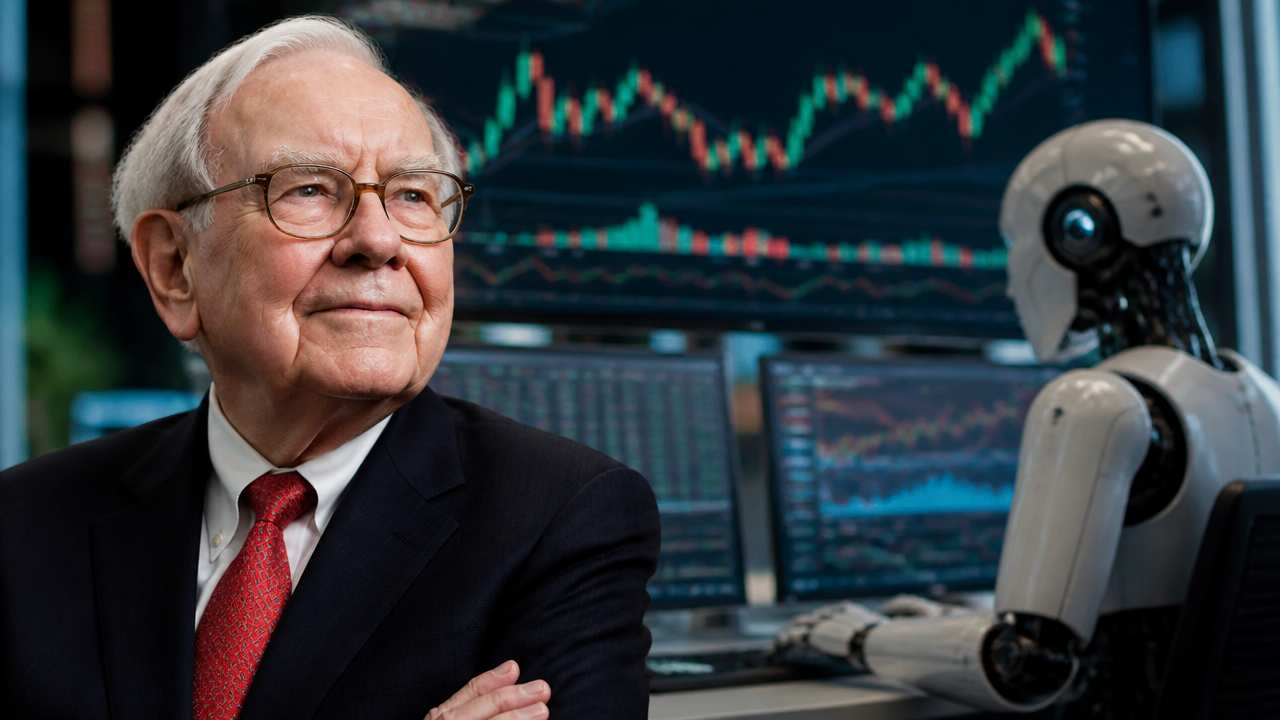
What separates a shrewd investor from someone gambling with borrowed confidence? Warren Buffett’s skepticism about AI market speculation offers a sharp answer. As valuations for artificial intelligence companies climb to stratospheric levels, Buffett maintains his decades-long discipline: invest only in what you understand, at prices that make sense. His stance on AI investing isn’t contrarian for its own sake—it’s grounded in a specific principle about market psychology, capital allocation, and the recurring patterns of speculative bubbles. Understanding his position requires separating the noise of AI hype from the reality of how Berkshire Hathaway actually deploys capital in tech-adjacent companies.
Quick Questions and Answers
Question: Why is Warren Buffett worried about the AI market?
Buffett warns that massive AI spending is creating reckless speculation, with valuations driven by hope rather than actual performance or profitability. He notes trillions are invested while returns remain modest, creating a bubble similar to the dot-com era.
Question: Can Warren Buffett predict if the AI bubble will burst?
Buffett hasn’t explicitly declared a bubble will burst, but his record $382 billion cash pile and caution on valuations signal he sees overvaluation risks. He advises avoiding individual speculative AI stocks entirely due to unjustified prices.
Question: Does Warren Buffett own any AI stocks in his portfolio?
Buffett invested in Alphabet (Google), which is now a nearly $31 billion holding for Berkshire Hathaway, but he avoids direct bets on speculative AI companies. He prefers investing in AI firms with durable competitive advantages at reasonable prices.
The Core Philosophy: Why Buffett Avoids Speculative Trends
Buffett’s reluctance to chase AI stocks stems from a principle he’s maintained for over 60 years: stick to your circle of competence. He doesn’t invest in industries he cannot fully grasp or explain to shareholders in straightforward terms. Artificial intelligence, with its rapid iterations, opaque algorithms, and speculative valuations, falls squarely outside that circle.
Back in his 2000 shareholder letter, Buffett captured the psychological danger of market excess perfectly: according to Investing.com, he warned that “nothing sedates rationality like large doses of effortless money.” That observation, made during the internet bubble collapse, remains relevant today. When capital flows freely and FOMO grips the market, even intelligent people make reckless decisions.
The comparison to internet stocks in 1996 is direct. Buffett approached that period with extreme caution, watching as retail investors and institutions alike bid up companies with no earnings, no clear path to profitability, and business models built on narratives rather than fundamentals. Today’s AI mania echoes that era: companies trade at monster valuations primarily because they’ve added “AI” to their pitch deck or product line.
Buffett’s approach is the tortoise, not the hare. He prefers slow, disciplined compounding over the volatile swings of speculative tech booms. That means missing some gains when markets run hot—but also avoiding catastrophic losses when bubbles pop. It’s a trade-off he’s willing to make.
Decoding the Berkshire Hathaway Portfolio: Indirect vs. Direct Exposure
Here’s where things get interesting: Berkshire Hathaway’s portfolio is roughly 23 to 24 percent invested in stocks with significant AI exposure, despite Buffett’s public skepticism about AI hype. That’s a seeming contradiction. The key lies in distinguishing between pure-play AI companies and established blue-chip firms that use AI as a tool within larger, profitable business ecosystems.
Berkshire holds substantial positions in Alphabet (Google), Apple, and Amazon. These companies are deeply integrated into the AI revolution—Alphabet owns DeepMind and develops its own AI models, Apple embeds machine learning across its devices, Amazon operates AWS with AI services. But none of these are “pure plays” on AI. They earn revenue from advertising, hardware sales, cloud services, and e-commerce. AI amplifies those businesses; it doesn’t define them.
That distinction matters enormously. A pure-play AI company might trade at a 40x price-to-earnings ratio (or higher) based purely on future AI potential. Alphabet, by contrast, trades on established cash flows and a dominant search advertising business. When Buffett invests in Alphabet, he’s buying a business he understands—one with a durable competitive moat—not a bet on whether transformers will eventually achieve artificial general intelligence.
According to Nasdaq’s analysis, Buffett isn’t necessarily betting on AI directly through these investments. Instead, he’s buying companies that happen to participate in AI development while maintaining strong, diversified revenue streams. That’s a fundamentally different animal from chasing a hyped-up AI startup trading at 200x revenue.
Berkshire’s discipline shows in what it doesn’t own. The portfolio contains no major position in Nvidia, the AI chip darling, despite its explosive growth. There’s no significant stake in newer AI-native companies. This isn’t oversight—it’s deliberate restraint. Buffett and his investment team examine these companies, understand their appeal, and conclude that current prices already reflect years of rosy expectations.
AI Market Dynamics: The Risks of FOMO-Based Investing
The current AI boom shares an unsettling resemblance to the internet bubble of the late 1990s. Back then, companies with no revenue, no path to profitability, and dubious business models attracted billions in investment capital. The justification? Infinite growth potential. Eventually, reality reasserted itself. The NASDAQ fell 78 percent from peak to trough. Many companies vanished entirely.
Today, the dynamics are similar but with a new coat of paint. Investors hear about transformers, large language models, and artificial general intelligence. The technology is genuinely impressive—that’s not in dispute. But impressive technology doesn’t guarantee profitable business models or reasonable valuations. Microsoft, Alphabet, and others are spending tens of billions annually on AI infrastructure with unclear returns. That spending might eventually generate enormous profits. Or it might dissipate as competitors arise and AI capabilities commoditize.
The risk of FOMO-based investing is real. Retail investors see Nvidia’s stock climbing 300 percent, feel they’re missing out, and buy in near the peak. Institutional money piles on, pushing valuations higher still. But valuations eventually must connect to earnings. When they don’t—when prices have gotten ahead of fundamentals—corrections follow. Sometimes violently.
According to Bankrate’s research on Buffett’s AI perspective, the growth potential of artificial intelligence has investors excited, bidding up stocks of AI leaders throughout 2023 and into 2024. Yet Buffett remains unmoved. He’s seen this film before.
Maintaining rationality in a frenzied market requires discipline most investors lack. It means watching others get rich on speculative bets and doing nothing. It means accepting that you might miss the top 20 percent of a bull run to avoid the bottom 40 percent of a crash. For Buffett, that trade-off has worked brilliantly over decades.
Understanding the $15.7 Trillion AI Revolution from the Sidelines
The AI market opportunity is genuinely massive—estimates put it at $15.7 trillion or more over coming decades. That scale matters. It means AI will reshape industries, create new businesses, and eliminate old ones. It means capital will flow toward AI infrastructure, applications, and talent.
But massive opportunity doesn’t equal attractive investment opportunity at current prices. A market can be huge and a terrible place to deploy capital if valuations are disconnected from reality.
Buffett’s approach is to observe the AI revolution’s integration into existing businesses rather than speculate on AI itself. When Alphabet improves search results with AI, that creates competitive advantage—Buffett captures that gain through his Alphabet position. When Amazon enhances AWS with AI services, existing AWS customers benefit, and Amazon’s cash flow improves. Buffett owns that too.
This is the “picks and shovels” strategy applied indirectly. During gold rushes, the richest returns often went to those selling shovels, not those panning for gold. Similarly, AI infrastructure companies—chip makers, cloud providers, data centers—may generate steadier, more predictable returns than AI-native software startups betting on speculative applications.
The subtle integration of AI into proven business models is where Buffett finds comfort. He doesn’t need to predict which AI startup will win. He doesn’t need to guess which large language model will dominate. He simply holds stakes in established companies that use these tools to strengthen existing competitive advantages.
What Buffett’s Massive Cash Hoard Signals About Market Valuations
Berkshire Hathaway is sitting on approximately $300 to $380 billion in cash, depending on the reporting period. That’s an extraordinary amount of dry powder—money available to deploy immediately if opportunities arise. For a manager who preaches the importance of compounding returns, holding that much uninvested capital requires exceptional conviction about one thing: prices don’t make sense across most of the market right now.
Buffett has stated explicitly that he hasn’t found enough businesses at prices that make sense, given how AI hype has skewed valuations across tech. That’s not pessimism—it’s discipline. Cash sitting idle earns nothing, but deploying it into overvalued assets earns negative real returns. He’d rather wait.
This cash position is a form of market communication. It tells shareholders, investors, and the market: we see overvaluation, and we’re prepared to act when sanity returns. Every dollar not deployed is a vote of no confidence in current prices.
History supports this stance. Buffett’s largest purchases often came during market panics—when fear dominated and prices reflected desperation, not hope. The 2008 financial crisis, the 2020 pandemic crash—these were when Berkshire deployed capital aggressively, buying at true bargain prices. In bull markets driven by speculation, he waits.
Historical Parallels: Dot-Com Bubble vs. AI Mania
The parallels between AI speculation and the dot-com bubble are so striking that ignoring them requires willful blindness. Both periods feature:
Irrational exuberance driving valuations detached from fundamentals
Retail investors piling into unfamiliar asset classes via leverage and margin
Companies adding trendy keywords to their names or pitch decks (“dot-com” in 1998, “AI” today) to capture investor attention
Narrative-based investing replacing fundamental analysis
Predictions of industry transformation and infinite growth
Warnings from skeptics dismissed as missing the obvious
In 1998 and 1999, the argument was: “You don’t understand the internet. A new paradigm has emerged. Old metrics don’t apply.” Today, it’s: “You don’t understand AI. It will transform everything. Old valuations don’t apply.”
Maybe the skeptics miss transformative potential. Or maybe they correctly recognize that even transformative technology doesn’t justify current prices. Usually, it’s both: the technology is genuinely important and the market has overestimated near-term returns and underestimated competitive dynamics.
When the dot-com bubble burst, many transformative technologies survived and thrived. Amazon, Apple, Microsoft—these benefited enormously from internet adoption and had strong business fundamentals before and after the crash. They survived because they generated revenue and profits, not just promises.
The question for today’s AI companies is similar: which ones will have genuine competitive moats and steady profits in a mature AI market? Buffett bets that identifying those winners is extremely difficult, that current prices reflect the best-case scenario, and that waiting for prices to become reasonable makes more sense than guessing correctly among hundreds of competing firms.
The Challenge of Predicting Winners in AI
One reason Buffett steers clear of pure-play AI stocks is the fundamental uncertainty about which companies will dominate. The space is crowded with competitors. OpenAI, Google, Meta, Anthropic, and dozens of startups are all developing large language models. Chip makers including Nvidia, AMD, and Intel compete for inference and training. Cloud providers (AWS, Azure, Google Cloud) race to attract AI workloads.
In nascent industries, competitive advantage is unstable. Today’s leader can become tomorrow’s cautionary tale if technology shifts, competitors innovate faster, or business models prove unsustainable. Predicting which company will win requires predicting not just technical capability but market dynamics, regulatory environments, and economic returns—an incredibly difficult task.
Buffett’s rule is simple: if you can’t confidently predict competitive winners decades ahead, don’t try. Instead, own diversified stakes in established companies with proven advantages and let their AI investments develop naturally.
This reduces the probability of catastrophic losses from picking a loser while ceding some upside from missing explosive winners. For most investors, that’s a favorable trade-off.
FAQ
Q: Are Warren Buffett’s AI warnings based on fake videos?
Yes, Buffett and Berkshire Hathaway issued a warning about AI-generated deepfake videos falsely featuring him discussing market mania. They emphasized that these fraudulent clips are spreading like a virus and are designed to mislead investors unfamiliar with his voice and actual statements.
Q: How does Warren Buffett compare AI to the dot-com bubble?
Buffett highlights that AI valuations are astronomical, retail investors are trading with leverage, and companies add “AI” to names to pump stock prices, mirroring dot-com mania. He notes AI stocks are built on expectations rather than evidence, similar to the conditions before the 2000 crash.
Q: Will Warren Buffett invest more in AI companies soon?
Buffett currently holds over $300 billion in cash because he hasn’t found enough businesses at prices that make sense, given AI hype has skewed valuations. He advises investors not to chase stocks that have already run 300 percent or more to avoid absorbing others’ risk.
Q: What warning signs does Warren Buffett see in AI stocks?
Buffett identifies sky-high price-to-earnings ratios, companies with no cash flow but massive valuations, retail fear of missing out, and tech narratives replacing fundamentals as classic bubble signs. He notes young investors are putting life savings into speculative AI stocks without understanding what they actually purchase.
Q: Is the AI bubble getting worse according to Warren Buffett?
While headlines exaggerate Buffett calling the bubble “much worse,” his caution on valuations and record cash pile reflect genuine concern over AI hype. He emphasizes that AI’s impact remains speculative, driven by emotional speculation rather than real business metrics.
Q: Which AI companies should investors buy according to Warren Buffett?
Buffett advises investing only in AI companies with strong, sustainable competitive advantages (moats) at reasonable prices, not speculative hype. He suggests focusing on “picks and shovels” businesses supplying essential technology that endure booms and busts.
Q: When did Warren Buffett first warn about AI speculation?
Buffett’s warnings on AI mania emerged prominently in interviews throughout 2024 and into 2026, where he called out gambling in markets and the costly AI buildout. His concerns about speculation setting prices have remained consistent since AI hype surged in 2023-2024.
Key Takeaways for Value-Focused Investors
Discipline beats timing. Trying to catch the exact moment a bubble peaks is impossible. Avoiding bubbles entirely through disciplined valuation standards is possible. Buffett accepts leaving money on the table during bull runs to protect capital during crashes.
Price matters more than growth potential. A company with 50 percent annual growth at a 100x earnings multiple is riskier than a company with 5 percent growth at a 10x multiple. The math of compounding means paying reasonable prices beats owning tremendous businesses at terrible prices.
Understand what you own. Buffett’s circle of competence rule exists for a reason. Investing in areas outside your expertise means relying on luck. Luck doesn’t compound. Knowledge does.
Indirect exposure to mega-trends can beat direct speculation. Owning Alphabet gives AI exposure without requiring you to predict which AI application wins. That approach trades some upside for considerably less downside risk.
Cash is optionality. Every dollar held as cash is a vote that prices don’t make sense. Building cash during bull markets isn’t pessimism—it’s preparation. It lets you act decisively when opportunities appear.
My Experience With What Does Warren Buffett Really Think About AI and Markets?
I’ve spent considerable time studying Buffett’s investment record, and one pattern jumps out immediately: his biggest gains often came from doing nothing. During the internet bubble, while others chased IPOs and speculative tech stocks, Buffett quietly accumulated cash and waited. When the crash came, he was positioned to deploy capital when prices actually reflected business value rather than sentiment.
The AI situation feels similar, though I’ll admit the technology is genuinely impressive in ways internet stocks of 1998 weren’t. Large language models produce outputs that feel almost human. That’s legitimately novel. But novelty doesn’t equal profitability, and profitability doesn’t equal justifiable valuations at current levels.
What strikes me most about Buffett’s approach is its emotional discipline. The market rewards patience less visibly than it punishes it. Missing a 200 percent gain hurts the ego. Avoiding a 70 percent loss doesn’t generate headlines. Yet compounded over decades, avoiding catastrophic losses outweighs missing some spectacular rallies.
The hardest part? Accepting that if you’re not participating in the hottest market trend, you might be wrong in the short term. Everyone around you is making money. Your portfolio lags. That pressure is real. Buffett’s track record proves it eventually resolves in your favor—but only if you have the conviction to hold through years of underperformance. Most investors don’t.
Here’s my question for you: when you see spectacular gains in an asset class you don’t fully understand, what makes you pull the trigger—fear of missing out, or something else?
Latest Updates: 2026 Market Environment
As of mid-2026, the AI market continues its rapid evolution. Valuations have cooled modestly from their 2024 peaks, but remain elevated by historical standards. Buffett’s cash position—approaching $382 billion—signals his continued belief that opportunities are limited at current prices.
Reports suggest Berkshire’s AI-adjacent holdings (primarily Alphabet, Apple, and Amazon) have continued generating strong cash flows, validating his thesis that established companies with diverse revenue streams provide more stable exposure than pure-play AI speculation.
The competitive landscape in AI has also clarified somewhat. Rather than dozens of potential winners, attention has concentrated on a smaller number of capable builders. This winnowing process validates Buffett’s caution: predicting early who would matter was genuinely difficult. Waiting for clarity has proven vindicated.
References
Investing.com. Warren Buffett’s Approach to Investing in Artificial Intelligence. https://www.investing.com/analysis/warren-buffetts-approach-to-investing-in-artificial-intelligence-200682099
CNBC. (2024, May 7). Warren Buffett on AI issue that has stumped economists for a century. https://www.cnbc.com/2024/05/07/warren-buffett-on-ai-issue-that-has-stumped-economists-for-a-century.html
Bankrate. What Warren Buffett Thinks About AI And Investing. https://www.bankrate.com/investing/warren-buffett-ai-artificial-intelligence/
Yahoo Finance. 23% of Warren Buffett’s $317 Billion Portfolio Is Invested in 3 Artificial Intelligence (AI) Stocks. https://finance.yahoo.com/news/23-warren-buffetts-317-billion-095900534.html
Nasdaq. 3 Subtle Ways Warren Buffett Is Investing in the $15.7 Trillion Artificial Intelligence (AI) Revolution. https://www.nasdaq.com/articles/3-subtle-ways-warren-buffett-investing-157-trillion-artificial-intelligence-ai-revolution
Yahoo Finance. 24% of Warren Buffett’s Portfolio is Invested in These 3 Artificial Intelligence (AI) Stocks. https://finance.yahoo.com/news/24-warren-buffetts-portfolio-invested-200900042.html
The Motley Fool. Warren Buffett Has 23% of Berkshire Hathaway’s Portfolio Invested in 3 Artificial Intelligence (AI) Stocks Heading Into 2026. https://www.fool.com/investing/2025/12/29/warren-buffett-ai-stock-portfolio-2026/
Sarah Anderson . J
I’m the mom behind Wise Mom Blogger, where everyday creativity meets real-life motherhood. I share easy DIY crafts, cozy knitting and crochet projects, beginner-friendly sewing ideas, and family-tested recipes—plus quick baking hacks that make homemade feel doable on busy days.