What does the latest Google earnings report actually tell investors about the company’s future direction and financial health? Google earnings reports offer crucial insight into how Alphabet’s core businesses—Search, YouTube, Cloud, and subscriptions—are performing quarter by quarter. Whether you’re tracking Google stock movements, researching earnings growth trends, or trying to understand what drives shareholder value, these quarterly disclosures reveal the real story behind the headlines. The 2026 earnings cycle has been particularly interesting, with unexpected strength in cloud infrastructure and sustained momentum in advertising. This guide walks through the major financial highlights, earnings figures, and what they mean for the broader tech landscape.
Quick Questions and Answers
Question: Why did Google earnings beat expectations in 2026?
Answer: Alphabet beat expectations because its core businesses kept growing, especially Google Search and Google Cloud. The company also reported strong revenue growth and higher profit margins, helped by rising demand for AI-related cloud infrastructure. Analysts noted that heavy AI investment was still supported by strong operating performance.
Question: Can Google stock move after earnings report announcements?
Answer: Yes. Google’s stock often moves sharply after earnings because investors react to revenue, profit, and guidance. If results beat or miss estimates, or if the company raises spending plans, the share price can rise or fall in after-hours trading.
Question: Do Google earnings reports include YouTube and cloud revenue?
Answer: Yes. Alphabet breaks out revenue from major segments like Google Services and Google Cloud. That includes Search, YouTube ads, subscriptions, platforms and devices, and cloud revenue, so investors can see how each business is performing.
Core Concepts of Alphabet Financial Reporting
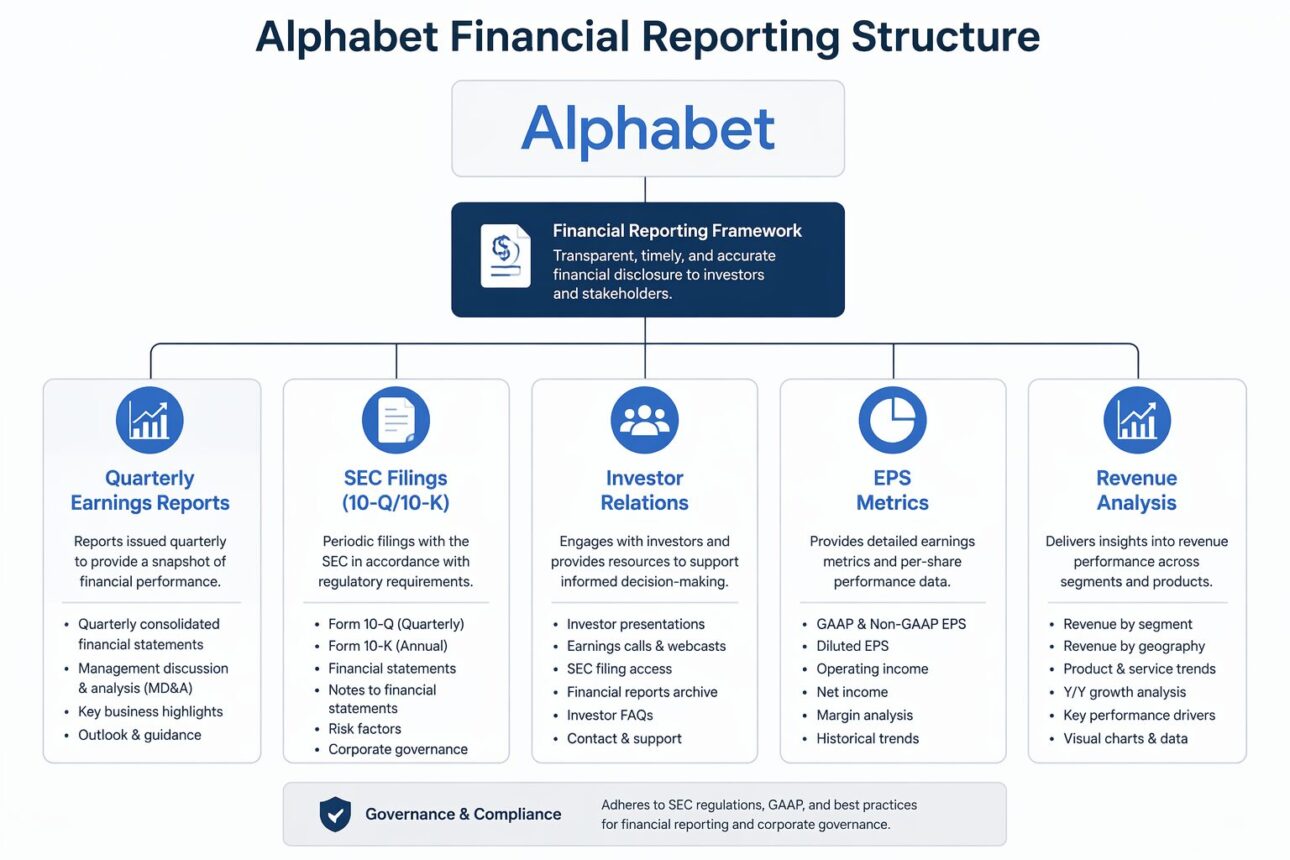
Understanding how Alphabet reports earnings requires familiarity with a few key terms and structures. Quarterly earnings reports are fiscal disclosures filed with the SEC that break down revenue, operating income, and earnings per share (EPS) for periods ending in March, June, September, and December each year. These filings appear as Form 10-Q for quarterly reports and Form 10-K for annual results.
Alphabet maintains two share classes for public trading: GOOG (Class C Capital Stock) and GOOGL (Class A Common Stock). Both classes receive the same earnings per share and dividend treatment. The main difference is voting rights—Class A shares carry 10 votes per share, while Class C shares carry one vote per share. When earnings are announced, both classes typically experience the same price movement since the underlying financial performance is identical.
The company’s Investor Relations website serves as the official source for earnings releases, SEC filings, and earnings call transcripts. These documents provide complete transparency into revenue breakdowns, operating expenses, capital expenditures, and management commentary on business trends. EPS is one of the most-watched metrics because it shows per-share profitability—investors compare actual EPS to analyst consensus forecasts to determine whether results “beat” or “missed” expectations.
Analysis of the First Quarter 2026 Financial Results
Alphabet’s first quarter 2026 results marked one of the strongest earnings surprises in recent memory. The company posted an EPS of $5.11, vastly outperforming analyst consensus estimates of $2.63—a beat of 94.30%. This massive outperformance immediately captured market attention and signaled that underlying business momentum exceeded what Wall Street had priced in.
Google Services revenue reached $89.6 billion in Q1 2026, representing 16% year-over-year growth. This segment includes the company’s largest revenue driver: Google Search and other search products. Search revenue grew 19%, underscoring the durability of search advertising demand even amid macro uncertainty. YouTube ads expanded 11%, a steady but more moderate growth rate reflecting competitive pressures in the online video advertising space. Google subscriptions, platforms, and devices—a category that includes Pixel phones, Nest products, YouTube Premium, and other consumer services—jumped 19%, indicating successful diversification beyond pure advertising.
The standout performer in Q1 was Google Cloud, which generated $20.0 billion in quarterly revenue with a remarkable 63% year-over-year growth rate. Cloud’s acceleration reflects a fundamental shift in how enterprises invest in computing infrastructure. Demand for AI-capable cloud services, data analytics platforms, and machine learning tools has driven enterprise customers to expand their spend with Google. Cloud’s growth trajectory significantly outpaces the company’s legacy advertising business, positioning it as a critical future growth engine. This segment remains smaller than Google Services in absolute terms, but its growth rate and margin profile make it strategically vital for long-term value creation.
Examination of Recent Q2 2026 Performance
The second quarter 2026 results, announced in late July, showed a different but still impressive performance profile. Q2 EPS came in at $2.85 on an adjusted basis, maintaining the profitability trend established in Q1. However, the headline that dominated coverage was Google Cloud’s 82% year-over-year growth in the quarter. This acceleration from Q1’s 63% growth rate stunned analysts and confirmed that cloud demand remained in overdrive.
Cloud’s 82% growth in Q2 represented the fastest expansion the division has achieved in recent years. The acceleration stemmed from intensified AI infrastructure demand—enterprises racing to build and deploy AI models require significant cloud computing capacity, and Google Cloud has positioned itself as a credible alternative to Amazon Web Services (AWS) and Microsoft Azure. Capital-intensive AI infrastructure expansion typically margins are under pressure from building-out compute capacity, but Alphabet’s strong profitability despite this spending revealed disciplined execution.
Despite the strong earnings beat, Alphabet’s stock declined approximately 3% in the trading session following Q2 earnings. This counterintuitive reaction reflects how market expectations work in mega-cap tech. While earnings results were strong, investors scrutinized management commentary about capital expenditure plans for AI infrastructure. Alphabet signaled it would spend substantially more on data centers and AI-related infrastructure in coming quarters to maintain competitive positioning in cloud and AI services. The prospect of higher capex, even if temporary, prompted some profit-taking despite the solid earnings surprise.
Categorization of Key Growth Drivers
Alphabet’s 2026 earnings reflect growth originating from distinct business segments, each with its own dynamics and trajectory. Understanding these drivers clarifies why the company continues to generate record revenues despite mature markets and competitive pressure.
Google Cloud has emerged as the primary growth catalyst. Enterprise customers are investing heavily in cloud migration, AI infrastructure, and data analytics. The division’s 63-82% growth rates in 2026 dwarf the growth rates of traditional advertising segments. Cloud margins remain lower than Google Search margins, but they are expanding as the business scales. Management has committed to significant capital investment to expand cloud capacity, particularly for AI workloads. This strategic bet positions Alphabet to capture a larger share of the enterprise computing market.
Google Services advertising—specifically Search and YouTube—provides the stable profit base that funds cloud expansion and other investments. Search, with its 19% Q1 growth rate, remains a cash-generative business with limited near-term disruption risks. YouTube ads face more competition from TikTok and other short-form video platforms, but the 11% growth rate shows the platform retains pricing power and engagement.
Subscriptions, platforms, and devices represent a smaller but rapidly growing contributor. The 19% growth in this category reflects successful launches of Pixel phones, increased YouTube Premium adoption, and expansion of Google One (cloud storage and productivity subscriptions). This segment diversifies Alphabet away from pure advertising and creates direct consumer relationships.
Revenue Segment
Q1 2026 Growth
Key Driver
Strategic Importance
Google Search
19%
Enterprise and consumer search queries
Core cash engine
YouTube Ads
11%
Video advertising demand
Stable revenue, margin compression risk
Google Cloud
63%
AI infrastructure, enterprise migration
Highest growth, future strategic priority
Subscriptions & Devices
19%
Pixel phones, YouTube Premium, Google One
Consumer diversification
Google Services Total
16%
Combined advertising and subs growth
Largest revenue contributor ($89.6B)
2026 Trends and Future Outlook
Several clear trends shape Alphabet’s earnings trajectory in 2026. First, cloud infrastructure investment dominance is reshaping the company’s capital allocation. Historically, Alphabet returned capital to shareholders and maintained relatively modest capex levels. In 2026, capex has surged to fund AI-capable data centers and cloud infrastructure. This shift may temporarily depress free cash flow and reduce share buyback activity, but it positions Alphabet to capture disproportionate returns from the AI infrastructure build-out.
Second, AI adoption by enterprises is accelerating faster than many analysts expected. Google Cloud’s 82% Q2 growth reflects real enterprise customers moving workloads and building new AI applications on Google’s infrastructure. Competitors like AWS are also seeing strong cloud growth, but Google’s performance suggests it has credible AI tools and services that command customer attention and budget allocation.
Third, advertising remains resilient. Despite macro uncertainty, Google Search advertising grew 19% in Q1—a reflection of the high ROI that businesses realize from search advertising and its relative immunity to macro cycles. YouTube’s slower 11% growth suggests the advertising market is becoming more selective, with budgets shifting toward proven channels like search.
Understanding how AI infrastructure affects tech valuations helps contextualize why Alphabet’s earnings surprise investors. When a mature tech giant announces accelerating cloud growth and record capex commitment, valuations often don’t move linearly with reported EPS. Investors are pricing in future earnings power, not just current quarter results.
FAQ
Q: Are Google earnings reports the same as Alphabet earnings reports?
Yes, for practical purposes. Google is the main business of Alphabet, and earnings reports are issued by Alphabet Inc., the parent company of Google. So when people say “Google earnings,” they usually mean Alphabet’s quarterly results.
Q: How often does Google release earnings reports each year?
Alphabet typically reports earnings four times a year, once after each fiscal quarter. These reports usually cover results for the three months ending in March, June, September, and December. The company also holds an earnings call to discuss the numbers and outlook.
Q: Does Google give guidance in its earnings report?
Alphabet often shares commentary on future spending and business trends, but it does not always provide detailed formal guidance like some companies. Investors usually focus on management’s remarks about advertising demand, cloud growth, capital expenditures, and AI investment plans.
Q: Will Google spend more on AI after earnings?
Alphabet has signaled very large increases in capital spending for AI infrastructure. Recent reporting said the company planned to spend far more in 2026 than analysts expected, mainly to support data centers, cloud capacity, and AI development.
Q: When is Google’s next earnings report scheduled?
For the 2026 cycle, market calendars listed Alphabet’s next report around July 22, 2026. Earnings dates can change, though, because companies sometimes announce the exact date later than expected or adjust it if needed.
Q: Is Google Cloud driving most earnings growth in 2026?
Google Cloud has been one of the fastest-growing parts of Alphabet’s business in 2026. Recent results showed strong cloud revenue growth, which helped overall earnings, though Search and other Google Services still remain the largest revenue source.
Q: What do investors watch most in Google earnings reports?
Investors usually focus on revenue growth, Google Search ad performance, YouTube ads, Google Cloud growth, operating income, and net income. They also watch AI spending plans, because those can affect future margins and cash flow.
My Experience With Google Earnings Report: Key Financial Takeaways and Trends
Following Alphabet’s earnings cycle for the past few years has taught me that the market often underestimates how quickly enterprise cloud adoption can accelerate. When I first saw Google Cloud’s 63% Q1 growth, I assumed it was an anomaly—a one-quarter spike driven by AI hype. The 82% Q2 growth proved me wrong. Real customers, real workloads, real revenue. That’s not speculation.
What strikes me most is the disconnect between strong reported earnings and stock price movement. Alphabet beat EPS expectations by 94% in Q1—a near-double—yet the stock’s path remained choppy. The lesson here is that earnings surprises matter less than capital intensity. Investors understand that explosive AI cloud growth requires massive upfront infrastructure spending, which compresses short-term free cash flow. The market rewards profitable growth, but it scrutinizes capital allocation.
The Q2 stock decline despite record cloud growth reveals something crucial: the earnings report is only half the story. Management’s commentary about capex plans, competitive positioning, and margin outlook often moves stock prices more than the headline numbers. Cloud growth at 82% is impressive, but if it comes with warnings about rising infrastructure costs or competitive intensity, investors will hedge their optimism.
One sharp insight I’ve gleaned: Alphabet’s advertising business is no longer the sole story. Google Services still generates the most revenue, but Google Cloud has become the narrative driver. Investors increasingly value Alphabet not as a search and advertising company that happens to have a cloud business, but as a cloud and AI infrastructure company with a mature advertising franchise. That reframing has profound implications for how to analyze future earnings and value the stock.
Have you noticed this shift in how tech earnings are interpreted—away from simple profitability metrics and toward capital intensity and competitive moat strength?
Conclusion
Alphabet’s 2026 earnings reports paint a picture of a company navigating a critical transition. The company remains profoundly profitable, with Search and YouTube generating billions in operating cash flow each quarter. Simultaneously, management is betting heavily on cloud and AI infrastructure as the future engines of growth. Google Cloud’s 63-82% growth rates prove the opportunity is real, not theoretical.
The key takeaway is that Alphabet’s earnings results reflect not just current business performance, but a calculated strategic shift. Capital allocation toward cloud infrastructure, even at the expense of near-term margin expansion, signals confidence in long-term cloud economics. For investors, the earnings report is both a backward-looking snapshot and a forward-looking statement about competitive positioning and capital discipline.
The 2026 earnings cycle has reinforced that Alphabet operates in a multibillion-dollar AI infrastructure arms race. Cloud growth will likely remain the dominant earnings story through the rest of the year. Traditional metrics like Search growth and YouTube ad rates matter, but they play a supporting role to the cloud narrative. Understanding this dynamic is essential for evaluating Alphabet’s earnings reports and stock valuation going forward.
I’m the mom behind Wise Mom Blogger, where everyday creativity meets real-life motherhood. I share easy DIY crafts, cozy knitting and crochet projects, beginner-friendly sewing ideas, and family-tested recipes—plus quick baking hacks that make homemade feel doable on busy days.