What makes a truly great AI-proof career stand out from every other option you’ve evaluated when worrying about job security? Choosing a resilient career path matters as much as picking a strong foundation for your long-term financial stability. Whether you are starting your professional journey or pivoting roles this spring, understanding AI automation helps you avoid vulnerable traps. You need positions where human interaction, complex judgment, and physical adaptability protect you from rapid machine learning. Let’s walk through the evidence that separates lasting opportunities from fleeting trends.
Quick Questions and Answers
Key Takeaways
Question: What is an AI-proof career in plain language?
Answer: An AI-proof career relies on skills AI struggles to replace, including physical dexterity, empathy, and complex judgment. Real-world interaction drives these jobs, making them less susceptible to full automation. While no role is absolutely immune, positions with unpredictable environments or hands-on work stay more resilient. Experts emphasize that human touch in specialized fields provides a buffer against digital replacement.
Question: Which jobs are most resistant to AI automation?
Answer: Healthcare, teaching, skilled trades, personal services, law, and public safety dominate resistance lists. Roles like nurses, plumbers, electricians, firefighters, and lawyers appear frequently because they demand trust and adaptation. These jobs require navigating the real world or managing sensitive interpersonal dynamics. Machines currently lack the capacity for the judgment and physical problem-solving these positions require daily.
Question: Why are repetitive jobs more vulnerable to AI?
Answer: AI thrives on predictable patterns, structured data, and routine workflows. Jobs built around repetitive actions face the highest replacement risk. Data entry and routine customer service frequently appear on vulnerability lists because computers execute these rules faster and without error. Roles lacking human nuance or physical complexity give machines a clear advantage to take over.
Finding an AI-Proof Career: What the Research Actually Shows
The conversation around AI and employment often misses a crucial distinction: not all work changes at the same speed. My-career-path notes that “the jobs that involve repetitive tasks, predictable patterns, or data processing are the most vulnerable.” That insight cuts through the noise. Automation targets execution of known rules. It does not easily handle ambiguity, moral trade-offs, or messy physical spaces where no two days look identical.
RedSeguridad confirms this pattern in January 2025, stating that “jobs that best resist artificial intelligence and labor automation are those that involve specifically human characteristics.” The organization singles out “social skill, emotional intelligence, and corporate interaction” as the shields that keep certain roles safe. When a job requires reading a room, negotiating with a frustrated stakeholder, or building trust with a patient, the machine hits a wall.
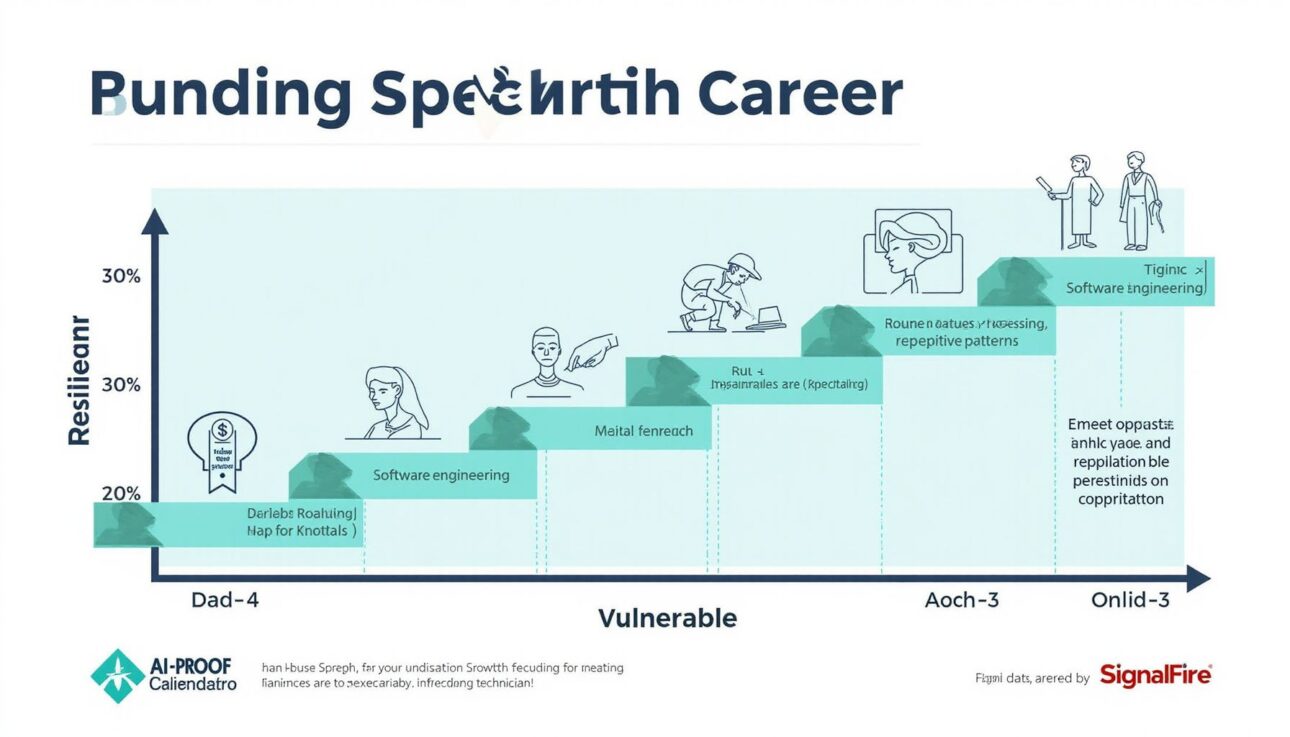
Software engineering presents a counter-intuitive case. Infobae reports that a SignalFire analysis of over 80 million companies ranked engineering as the most resilient job function during 2025. The signal here is clear. Engineering demands system architecture, integration of disparate tools, and creative problem-solving when code breaks. AI can write snippets, but it does not own the outcome. Engineers who guide the tool stay on top while those who only perform routine coding face pressure.
The shift reframes the debate. Automation does not erase jobs; it eats specific tasks. RedSeguridad points out that sectors like healthcare, teaching, artistic work, and personal services show lower exposure to computerization. These fields anchor their value in relationships and context. You cannot automate the nuance of a teacher adjusting a lesson plan because a student is struggling at home. AI might grade papers faster, but the mentorship remains human.
Understanding the Mechanics of AI Automation
To navigate career choices wisely, you need to look past marketing hype and examine how machines actually operate. Current AI models excel at pattern recognition and text generation within trained boundaries. They process millions of examples to predict the next likely token or value. This works brilliantly for content creation, basic coding, and data sorting. It falters when the task demands genuine understanding or accountability.
El Economista Mexico explains the concept of “instrument facilitation.” The publication reports that professionals should “utilize AI as a facilitating instrument, rather than a matter of complete substitution.” This framing saves careers. When you treat AI as a heavy-lifting assistant, you extend your capabilities without competing against a system you cannot beat. Writing a report with AI takes minutes instead of hours. The value then shifts to verifying the facts, injecting industry insight, and making the recommendation actionable for leadership.
The danger lies in mistaking task replacement for job replacement. A data analyst might lose the ability to pull raw tables manually, but the role evolves into interpreting trends and advising strategy. My-career-path warns that “jobs involving repetitive actions, predictable patterns, or data processing are the most vulnerable.” Workers who double down on those exact skills walk straight into the firing line. Professionals who pivot to oversight, design, and human coordination gain distance from the automation wave.
Context also matters. A tool that thrives in a controlled digital environment stumbles in the physical world. Robots can sort boxes on a conveyor belt with precision, but they choke on a cramped home renovation site. The disconnect between digital abstraction and physical reality creates a moat for trades and on-site professions. That moat keeps jobs secure even as software advances rapidly.
The Role of Essential Human Traits in Job Security
Human traits act as the primary defense against total automation. RedSeguridad highlights that the least automatable roles involve “social skill, emotional intelligence, and corporate interaction.” These are not fluffy concepts. They represent measurable friction points for machines. An AI can simulate empathy in a script, but it cannot feel the weight of a client’s distress or adjust its tone based on a micro-expression.
Business Insider España adds that AI-resistant careers depend on “empathy, ethical judgment, cultural context, and interpersonal relationships.” The publication notes that many of these roles remain in demand in 2026 precisely because their core work cannot replicate fully in a machine. When you hire a nurse, you are buying medical knowledge plus the capacity to comfort a frightened patient. The algorithm delivers the protocol; the human delivers the care.
Empathy also blocks replacement in counseling, social work, and therapy. These fields require navigating complex family dynamics, cultural sensitivity, and personal history. A chatbot might offer coping exercises, but it cannot build the therapeutic alliance that drives real change. That alliance relies on shared humanity. Clients connect with a person who understands loss, trauma, and hope. AI lacks that shared experience.
Ethical judgment creates another solid barrier. Lawyers, judges, and compliance officers make decisions that impact lives and livelihoods. Society demands accountability when things go wrong. A machine cannot be held responsible or understand the moral weight of a ruling. These professions blend technical mastery with value-based reasoning. The combination ensures human oversight remains mandatory.
Highly Resilient Career Categories
Certain sectors stand out for their built-in resistance to digital takeover. The following breakdown compares high-value roles based on their defense mechanisms and market outlook.
Category
Mechanism of Resistance
2025/2026 Resilience Data
Growth Projection
Software Engineering
Complex system architecture
Most resilient function
Stable demand
Nursing
Patient empathy + clinical judgment
Advanced nursing roles
+40.1% growth
Skilled Trades
Unpredictable physical environments
Low automation exposure
High demand
Wind-Turbine Tech
Specialized technical complexity
Emerging green sector
+49.9% growth
Public Safety
High-stakes ethical decision-making
Human accountability required
Stable demand
Healthcare continues to anchor job security. Gizmodo cites “advanced nursing” and related clinical roles as showing projected employment growth of +40.1%. The sector combines technical expertise with irreplaceable human contact. Doctors, therapists, and counselors stay safe because the work demands flexible judgment and emotionally complex interaction. Administrative tasks may automate, but patient-facing roles expand.
Skilled trades offer another fortress. The Reddit discussion highlights plumbing, electrical work, carpentry, and mechanics as resilient. The logic holds up: machines are better at abstract tasks than at navigating messy physical environments. A plumber must diagnose leaks inside finished walls, adapt to unique house layouts, and problem-solve on the fly. That physical variability keeps AI at bay.
Public safety and law round out the top tiers. Toolify lists police officers, firefighters, disaster-management officials, and lawyers among profiles that resist automation. These fields require high-stakes decision-making, rapid adaptation, and professional accountability. You cannot delegate life-or-death choices to a black-box algorithm. The human element remains central to trust and execution.
Technical leadership defies expectations. SignalFire data places software engineering at the top of resilient functions. Why? Engineering involves architecture, integration, and debugging systems that AI cannot fully own. The work demands understanding business goals, managing legacy tech, and navigating team dynamics. AI supports coding, but the architect stays in control.
Future Growth Metrics and Emerging Markets
Growth does not guarantee immunity, but strong expansion signals durable demand. Gizmodo highlights roles like wind-turbine technicians (+49.9%), advanced nursing (+40.1%), and data scientists (+33.5%) as emerging strongholds. These figures reflect real-world needs that outpace automation trends.
Wind-turbine technicians exemplify the intersection of specialized knowledge and physical demand. The green energy transition drives installation and maintenance work into remote or challenging sites. Robots cannot climb towers or perform intricate mechanical repairs in harsh weather. The skill set requires both technical training and physical agility. That mix ensures steady hiring.
Data science offers a digital example of resilience. The field shows +33.5% projected expansion. AI generates models, but data scientists define the questions, clean the data, and interpret the results for business strategy. The role demands statistical literacy combined with communication skills to translate numbers into action. AI assists the process, but the scientist drives the value.
The U.S. Bureau of Labor Statistics Occupational Outlook Handbook reinforces these trends across sectors. Growth concentrates in roles that blend technical capability with human oversight. Positions that purely execute routine tasks shrink. Roles that manage complexity, care for people, or build physical infrastructure grow. The market rewards professionals who bridge gaps between machines, data, and real-world outcomes.
Strategic Recommendations for Long-Term Employability
Building a secure career requires a hybrid approach. Gizmodo emphasizes that “the key to not being obsolete is constantly learning, updating, and using AI as an ally.” Professionals who freeze out technology miss growth. Those who ignore human skills expose themselves to risk. The sweet spot sits where domain expertise meets emotional intelligence and AI literacy.
Focus on roles that combine judgment with physical or social interaction. Teaching, nursing, skilled trades, public safety, and creative fields with strong interpersonal components stand as safer bets. Avoid careers anchored in repetitive data processing or predictable digital workflows. Machine efficiency will continue to erode the value of pure routine.
Workers evaluating flexible paths should analyze resources like [easiest remote jobs to get] to spot opportunities that blend flexibility with resilience. Remote work is not automatically safe. Some digital roles face higher automation exposure. Look for remote positions that require complex problem-solving, client communication, or strategic thinking.
Large tech distributors often list [amazon work from home jobs] where roles require supply chain judgment rather than mere data input. Roles managing vendor relations, forecasting demand, or optimizing logistics use AI as a tool while relying on human oversight for decision-making. The physical supply chain still needs human direction.
Education sectors also shift. Understanding the landscape includes noting issues like the cases where [33 students failing over AI detection] signal how institutions adapt. Teaching careers remain resilient but require teachers to guide students through new verification pressures. The educator’s role evolves into mentorship, critical thinking coaching, and ethical guidance—areas where AI cannot replace the human.
My Experience With Finding an AI-Proof Career: A Complete Guide to Job Security
I spent months tracking which roles survived the 2025 shift, and my biggest takeaway landed differently than expected. Software engineering led the resilience list, which defied the narrative that coders faced immediate replacement. Watching AI swallow routine data tasks taught me something practical though: the danger rarely touches the whole job. It attacks the repetitive fragments. I learned to audit my own workflow, flagging which hours I spent chasing predictable patterns versus solving messy problems. The moment I started treating AI as a heavy-lifting assistant rather than an opponent, the security calculus flipped. That mindset shift cost nothing but forced me to drop the “I’ll just learn Python” fantasy and double down on complex system thinking.
Humans still win where the stakes involve actual consequences, not just token generation. I remember reviewing the SignalFire data while drinking cold coffee, realizing software architects were safe while some entry-level scripters were in a different boat entirely. The divide came down to integration skills. Writing a function is easy for a machine. Connecting a function to a legacy database that hasn’t been touched since 2008? That remains a mess only humans enjoy fixing. The irony hit hard: trying to compete with AI on its home turf was the fastest way to lose. The market rewards people who can orchestrate the bot, not those who pretend to be one with better grammar. If I had to do it again, I would have invested those coding hours into understanding how different tools talk to each other and what the business actually needs in a crisis. What part of your daily work would crumble if the tools vanished tomorrow?
FAQ
Q: Can AI replace skilled trade jobs like plumbing or electrical work?
Skilled trades like plumbing and electrical work face a low risk of full replacement because they require navigating chaotic, non-standardized physical environments. Robots struggle with the unpredictable layout of residential homes or the unique challenges of on-site repairs. While AI might assist with scheduling or diagnostics, the hands-on judgment needed to fix a mess in a narrow crawlspace remains a human stronghold. These roles demand physical adaptability and real-world problem-solving that current automation simply cannot match.
Q: Do healthcare jobs really have low AI risk?
Healthcare ranks among the safest sectors due to its blend of technical knowledge with patient communication and flexible judgment. Roles such as nursing, medicine, therapy, and counseling rely heavily on building trust and reading human emotion, which machines cannot replicate. Certain administrative components within healthcare may see automation, but the core clinical and therapeutic interactions stay firmly in human territory. The sector continues to grow, reinforcing the demand for roles that prioritize compassionate care alongside medical expertise.
Q: How does AI affect creative careers?
Creative fields are not automatically immune, but they often hold ground when output depends on originality, cultural context, and human connection. Artists, writers, musicians, and journalists benefit from the nuance of taste and shared human experience that algorithms struggle to generate. AI may assist with drafting or formatting these roles rather than fully displacing the creator. The most resilient creative work involves emotional resonance and complex storytelling, which keeps human professionals central to the process even as tools evolve rapidly.
Q: What skills make a career more future-proof?
Skills that enhance human interaction drive long-term job security. Empathy, communication, leadership, and ethical judgment form the core of roles machines find difficult to emulate. Combining deep domain expertise with AI literacy also creates a powerful defense, allowing workers to direct AI as an instrument rather than competing against it. Hybrid profiles that merge analytical capability with emotional intelligence tend to stay durable. Developing the ability to adapt to changing tools while maintaining social competence keeps professionals valuable as automation advances.
Q: Are software engineers safe from AI?
Engineers face shifting terrain rather than total elimination. A 2026 report based on a SignalFire analysis indicated software engineering remained the most resilient job function during 2025. This suggests work is evolving toward architecture, integration, and complex problem-solving rather than vanishing. Routine coding tasks carry higher exposure, but higher-level engineering responsibilities stay secure. Professionals who focus on system design and managing complex tech stacks are likely to navigate these changes with their careers intact.
Q: Which careers are growing even with AI?
Several sectors show strong growth despite AI presence. Technical and healthcare roles leading this trend include wind-turbine technicians, advanced nursing, and data scientists. These positions combine specialized knowledge with steady demand, reducing the likelihood of sudden displacement. Growth signals durable need, though it does not grant absolute immunity to market shifts. Roles that solve concrete human problems or manage complex environmental systems tend to expand, offering reliable opportunities even as digital tools become more powerful.
Q: How should a beginner choose an AI-resilient career?
Beginners should prioritize paths that mix human interaction with physical-world complexity and room for skill development. Sectors like healthcare, education, skilled trades, public safety, and certain creative roles offer this mix. The safest approach involves finding work where AI can support the process without replacing the professional. Avoiding roles centered on repetitive data processing or highly predictable digital tasks helps reduce vulnerability. Focus on careers where your judgment, empathy, and hands-on ability provide clear value beyond what software can deliver.
References
Infobae. (2026, June 25). Estos son los puestos que estan resistiendo a la automatizacion del trabajo causada por la ia. Infobae. https://www.infobae.com/tecno/2026/06/25/estos-son-los-puestos-que-estan-resistiendo-a-la-automatizacion-del-trabajo-causada-por-la-ia/
Reddit. (2026). What careers are AI-resistant in the future? Reddit. https://www.reddit.com/r/careerguidance/comments/1ihiq39/what_careers_are_ai_resistant_in_the_future/
my-career-path. (n.d.). AI-proof careers: 20 jobs that will not be… my-career-path. https://my-career-path.com/es/blog/ai-proof-careers.html
RedSeguridad. (2025, January 13). Do you know which jobs are safe from artificial intelligence? RedSeguridad. https://www.redseguridad.com/actualidad/empleos-inteligencia-artificial-ia_20250113.html
Universae. (n.d.). 7 professions that will not disappear with AI. Universae. https://universae.com/blog/profesiones-que-no-desapareceran-con-la-ia/
Business Insider España. (n.d.). 5 careers with a future that AI will not be able to replace. Business Insider. https://www.businessinsider.es/economia/5-carreras-con-futuro-que-ia-no-va-poder-reemplazar_6922687_0.html
Toolify. (n.d.). Discover 15 careers resistant to AI: how to survive an AI takeover. Toolify. https://www.toolify.ai/es/ai-news-es/descubre-15-carreras-resistentes-a-la-ia-cmo-sobrevivir-a-una-toma-de-control-de-la-ai-simply-economics-2032025
Gizmodo. (n.d.). Revelan las cinco carreras que la inteligencia Artificial no podrá reemplazar. Gizmodo. https://es.gizmodo.com/revelan-las-cinco-carreras-que-la-inteligencia-artificial-no-podra-reemplazar-2000199361
El Economista Mexico. (2023). La IA y la automatización están transformando la fuerza laboral. El Economista. https://www.eleconomista.com.mx/tecnologia/La-IA-y-la-automatizacion-estan-transformando-la-fuerza-laboral-20230101-0038.html
Sarah Anderson . J
I’m the mom behind Wise Mom Blogger, where everyday creativity meets real-life motherhood. I share easy DIY crafts, cozy knitting and crochet projects, beginner-friendly sewing ideas, and family-tested recipes—plus quick baking hacks that make homemade feel doable on busy days.