Quick answer: Herod the Great built the Masada fortress we see today, mostly between 37 and 15 BC. Some earlier fortifications on the same clifftop may date back to the Hasmonean rulers, possibly Alexander Jannaeus, but the grand palaces, walls, and water system belong to Herod.
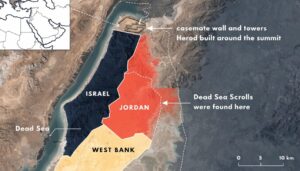
Masada sits on a rock plateau above the Dead Sea in southern Israel, and it looks almost impossible to build on. Steep cliffs drop hundreds of feet on every side. Yet someone built a full palace complex up there, complete with bathhouses, storerooms, and enough water storage to survive years of siege. This article explains who built Masada, when it was built, why it was built, and how it became one of the most famous archaeological sites in the world.
Detail
Fact
Main builder
Herod the Great
Earlier fortification
Possibly Hasmonean, unconfirmed
Main construction period
37 to 15 BC
Later famous event
Siege of Masada, 73 CE
Construction Phase
Approx. Date
What Was Built
Phase 1
Around 35 BC
Western Palace, storerooms, army barracks
Phase 2
Around 25 BC
Expanded Western Palace, storage complex, Northern Palace
Phase 3
15 BC
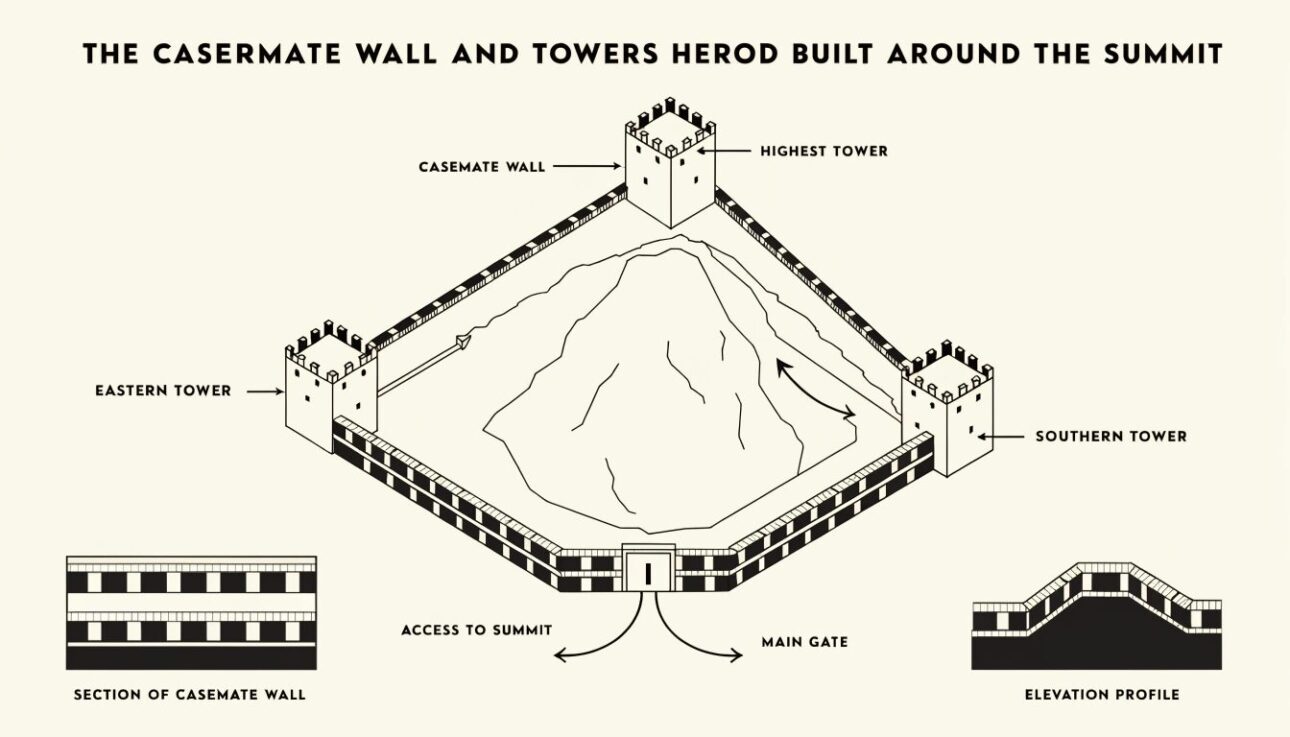
4-meter casemate wall around the summit, defensive towers
Masada casemate wall length vs. a modern comparison
Masada wall (1,300m)
10 football fields (~900m)
Who Built the Fortress at Masada?
Herod the Great built the fortress at Masada. The archaeological remains visible today were constructed by King Herod, the Roman client king of Judea, whose territory was called the Herodian kingdom. Herod is known for huge building projects across his kingdom, and Masada ranks among his most impressive.
Herod did not build everything at once. Masada saw three phases of construction during his reign, starting with the Western Palace around 35 BC, followed by an expanded palace and large storage complex in 25 BC, and finishing with a defensive wall in 15 BC. By the end, the site had grown from a simple refuge into a full royal complex.
According to UNESCO, Herod built the site as a palace complex in classical Roman imperial style, which was unusual for such a remote desert location. That style choice tells us Herod wanted more than just safety. He wanted comfort and luxury even in a place built for emergencies.
Did Anyone Build on Masada Before Herod?
Yes, most historians believe someone fortified the site before Herod arrived, though the exact builder is not fully confirmed. The site was first fortified either by Jonathan Maccabeus, who died around 143 to 142 BC, or by Alexander Jannaeus, who reigned from 103 to 76 BC, both members of the Hasmonean dynasty.
These early builders likely put up basic defensive structures, nothing close to the grand palaces Herod later added. Masada was chiefly developed by Herod, who transformed it into a full royal citadel. Think of it like a small watchtower that later got turned into a full castle. The bones may have existed before Herod, but he is the one who made it famous.
Wikipedia’s summary of the site also lists Alexander Jannaeus as a possible early builder, though it flags this with a question mark since ancient sources are not fully clear on the point. Herod’s contribution, by contrast, is well documented by the historian Josephus and confirmed by decades of archaeological excavation.
Why Did Herod Build Masada?
Herod built Masada as an emergency refuge, a place to flee to if he ever faced a revolt or an invasion. According to Josephus, Herod built a large fortress on the plateau between 37 and 31 BC as a refuge for himself in case of revolt, and he stocked it with an endless food supply.
Herod had good reason to worry. He ruled as a client king under Rome, and his position was never fully secure. Herod became especially paranoid about Cleopatra of Egypt, fearing his life would be in danger if she ever gained control of the region, so he built a line of palace fortresses along a possible escape route. Masada was one link in that chain of backup plans.
Interestingly, most historical records suggest Herod never actually needed to use Masada as a real hideout. Though Masada was the largest fortress in the world at the time, there is no record that Herod ever stayed there. He built it just in case, and the “in case” never came, at least not for him personally.
What Did Herod Actually Build at Masada?
Herod built a full royal complex, not just a simple wall. He enclosed the summit with a casemate wall and towers, and constructed storerooms, an advanced water system, bathhouses, and two elaborate palaces, one on the western side and another built across three terraces on the northern cliff.
The water system deserves special attention, since Masada sits in one of the driest regions on Earth. Herod’s engineers cut great cisterns into the base of the mountain, designed to provide water during a siege and to supply the bathhouses and pools even though almost no sustainable drinking water existed nearby. That kind of planning shows serious engineering skill for the first century BC.
The Northern Palace remains the most admired part of the site today. Built into the cliff face across multiple levels, it offered sweeping views over the desert and the Dead Sea below. Architects still study it as one of the finest surviving examples of Herodian design.
What Happened at Masada After Herod Died?
After Herod’s death, Rome took direct control of the fortress and stationed a permanent garrison there. With Herod’s death, his kingdom was annexed into the Roman Empire, and the Romans recognized Masada’s strategic importance, so they set up a permanent garrison at the site.
Decades later, the fortress became the setting for one of the most famous events in Jewish history. In 66 CE, a group of Jewish rebels known as the Sicarii overcame the Roman garrison at Masada with the help of a ruse. They held the fortress for years, even after the fall of Jerusalem in 70 CE.
The Romans eventually returned in force to retake the site. To break the siege, the Romans used a slave force of over 9,000 people to build a massive earthen ramp up the side of the cliff, then attacked with about 5,000 soldiers in the spring of 73 AD. Rather than surrender, most of the defenders chose death, which turned Masada into a lasting symbol of resistance.
Can You Still Visit Masada Today?
Yes, Masada is open to visitors and has been a UNESCO World Heritage Site since 2001. Visitors can explore the ancient mountaintop fortress in southeastern Israel, including a three-level palace, defensive towers, and aqueducts, and access is available by footpath or cable car.
The site still shows traces of both the Herodian palace and the Roman siege. Tourists can also see the winding Snake Path, a synagogue, a ritual bath, the Roman camps and siege works, and the ramp built by the Roman army to reach the summit. Few archaeological sites anywhere preserve both a royal palace and its siege in such complete detail.
Most visitors arrive from Jerusalem or the nearby Dead Sea resorts, since Masada sits close to both. Many people choose to hike the Snake Path at sunrise, when the desert heat is lower and the light over the Dead Sea is at its most dramatic.
Frequently Asked Questions
Who built Masada?
Herod the Great built the palaces, walls, and water system that make up the Masada we see today, mainly between 37 and 15 BC.
Was Masada built before Herod?
A basic fortification may have existed earlier, possibly built by Hasmonean rulers such as Alexander Jannaeus, but this is not fully confirmed. Herod is the one who turned it into a grand fortress-palace.
Why is Masada famous?
Masada is famous for the siege of 73 CE, when Jewish rebels held out against the Roman army and chose death over surrender when the fortress finally fell.
How did Herod get water to Masada?
Herod’s engineers cut large cisterns into the base of the mountain to store water for siege conditions and to supply bathhouses and pools on the summit.
I’m the mom behind Wise Mom Blogger, where everyday creativity meets real-life motherhood. I share easy DIY crafts, cozy knitting and crochet projects, beginner-friendly sewing ideas, and family-tested recipes—plus quick baking hacks that make homemade feel doable on busy days.