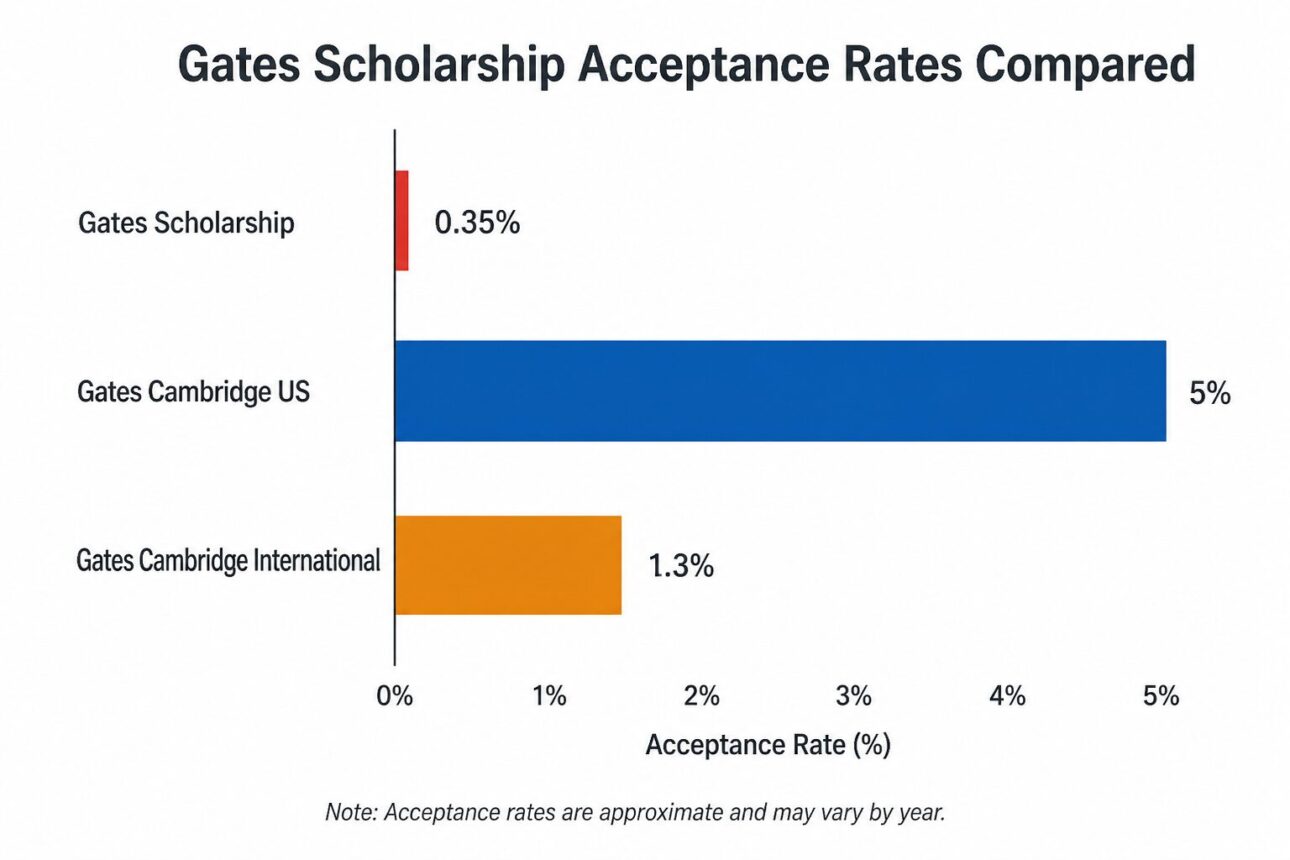
What makes a scholarship harder to win than getting into an Ivy League school? The Gates Scholarship sits at the extreme end of selectivity, with an acceptance rate that hovers around 0.3 to 0.4 percent. Only 300 students win each year from a pool exceeding 34,000 applicants. Unlike scholarships that look primarily at test scores or grades, the Gates Scholarship targets high-achieving students who also face significant financial barriers—combining academic excellence with demonstrated need. If you’re considering applying, understanding the true difficulty level helps you approach the application strategically and realistically.
Quick Questions and Answers
Question: Why is the Gates Scholarship so hard to get?
Answer: The Gates Scholarship attracts tens of thousands of applicants annually competing for roughly 300 awards, resulting in an acceptance rate below 1%. The program specifically targets high-achieving, Pell-eligible students from underrepresented backgrounds, so competition is fierce from the beginning. Selectivity is built into the program’s mission and funding structure.
Question: Can anyone apply for the Gates Scholarship?
Answer: No. Eligibility is limited to high school seniors who meet specific criteria, including Pell Grant eligibility and U.S. citizenship or permanent residency. The scholarship also prioritizes students from underrepresented groups. Many qualified students are ineligible before the competitive review even begins, which narrows the real applicant pool considerably.
Question: Do you need perfect grades to win the Gates Scholarship?
Answer: No, perfect grades are not required. A minimum GPA around 3.3 weighted is typical, but selection ultimately depends on academic achievement combined with leadership, community service, personal essays, and teacher recommendations. The scholarship uses a holistic review process rather than relying solely on grades or test scores.
The Gates Scholarship: Understanding Program Selection and Difficulty
The Gates Scholarship operates as a “last-dollar” funding model. This means the scholarship covers whatever gap remains after other financial aid packages are applied. If your school costs $60,000 annually and other aid covers $35,000, the Gates Scholarship would theoretically fill that $25,000 gap. For many recipients, this translates to near-complete coverage of remaining tuition, fees, room, and board—making it one of the most generous undergraduate awards available.
The program launched in 2017 through the Bill and Melinda Gates Foundation with a specific mandate: supporting exceptionally talented students from low-income households who might not otherwise afford top universities. This focus on both academic caliber and financial need creates the extreme competition. You can’t simply be brilliant; you also must demonstrate genuine financial hardship verified through FAFSA and other documentation.
Many applicants confuse the Gates Scholarship with the Gates Cambridge Scholarship, a separate postgraduate program for students applying to the University of Cambridge. While both carry the Gates name and are highly selective, they serve completely different audiences. The Gates Cambridge targets already-admitted graduate students pursuing advanced degrees, whereas the Gates Scholarship focuses on high school seniors heading to four-year universities anywhere in the United States. The acceptance rates differ dramatically as well, which we’ll explore next.
Acceptance Rate Realities and Statistical Trends
The acceptance rate for the Gates Scholarship remains stubbornly consistent: under 1 percent, most precisely estimated between 0.3 and 0.4 percent. To put this in perspective, the most selective Ivy League schools typically accept between 3 and 6 percent of applicants. The Gates Scholarship is roughly five to twenty times harder to win than admission to Harvard or Yale.
According to CollegeVine’s analysis, the program receives applications from over 34,000 students annually but awards scholarships to only about 300. Some years see semifinalist rounds where roughly 2,000 students advance before the pool narrows to finalists. This multi-stage filtering process means your application faces multiple rejections before reaching the ultimate decision.
The confusion between the Gates Scholarship and Gates Cambridge Scholarship creates misleading comparisons online. Gates Cambridge reports acceptance rates between 1.3 percent (international round) and 5 percent (U.S. round). When someone mentions a Gates scholarship with a 5 percent acceptance rate, they’re referring to Cambridge, not the undergraduate program. The undergraduate Gates Scholarship remains far more selective.
This extreme selectivity isn’t accidental. The Gates Foundation deliberately limits awards to maintain prestige and ensure recipients receive exceptional support. Fewer scholarships mean each dollar stretches further for each student, and the prestige factor helps graduates access elite opportunities post-college. The trade-off is that your odds of winning remain vanishingly small regardless of how strong your application becomes.
Core Eligibility and Selection Criteria
Before worrying about your competitive standing, you must clear the eligibility gates. The Gates Scholarship requires applicants to be high school seniors planning to enroll at a four-year U.S. university. You must be a U.S. citizen, national, or permanent resident. International students and those already enrolled in college are automatically ineligible.
The financial need requirement centers on Pell Grant eligibility. If you qualify for a federal Pell Grant, you meet the Gates Foundation’s definition of coming from a low-income household. This creates a clean, objective screening mechanism. Students whose families earn above Pell thresholds—roughly $62,000 annually—are ineligible regardless of other strengths. The Gates Foundation publishes that most recipients come from families earning under $40,000 per year.
Academic achievement matters substantially. Most competitive applicants maintain weighted GPAs of 3.5 or higher, though the published minimum sits around 3.3. SAT or ACT scores alone don’t determine outcomes, but scoring in the top percentiles strengthens your application. More important than any single metric is demonstrating intellectual curiosity and academic resilience.
The selection process unfolds across multiple stages. First, all applications receive initial review to confirm basic eligibility and assess transcripts and test scores. Those passing this hurdle move to a semifinalist round. Semifinalists then submit supplemental essays, updated activities lists, and teacher recommendations. A smaller group advances to finalist interviews, typically conducted regionally in-person or virtually. Final decisions come after this comprehensive evaluation.
Leadership and community involvement carry real weight. The Gates Foundation seeks students who’ve tackled challenges in their schools or communities. This doesn’t mean you need to found a nonprofit or win major awards. Genuine involvement—tutoring younger students, organizing a community event, or leading a club—demonstrates agency. Admissions readers differentiate between padding your resume and showing consistent, meaningful commitment.
Essential Differences Between Gates Scholarship Variants
Understanding which Gates program you’re actually pursuing prevents application disasters. The Gates Scholarship (sometimes called “The Gates Scholarship” officially) focuses on talented high school seniors from low-income backgrounds attending four-year universities across the United States. Awards begin the freshman year and renew through graduation, provided you maintain satisfactory academic progress.
The Gates Cambridge Scholarship serves a completely different population. You must first be admitted to the University of Cambridge for a graduate degree, then apply through Gates Cambridge’s separate process. The program accepts roughly 80 scholars annually from over 6,000 applicants globally. The U.S. round has a 5 percent acceptance rate, while international rounds drop to 1.3 percent. Because candidates must already hold Cambridge admission, this creates a different selection dynamic than the undergraduate program.
Other Gates-related scholarships exist too, including the Gates Scholarship for specific institutions and various Gates Foundation partnerships with universities. When researching, verify you’re looking at the right program. The official website for the undergraduate scholarship is thegatesscholarship.org, which clearly outlines requirements and timelines.
The confusion matters because applicants sometimes misdirect effort. Someone might see the 5 percent Gates Cambridge acceptance rate and think the undergraduate program is more feasible. In reality, it’s the opposite. Knowing this distinction helps you align expectations and focus your energy accordingly.
What Makes a Competitive Application
Competition at this level demands excellence across multiple dimensions. Your transcript shows you can handle rigorous academics. Your essays reveal who you are beyond grades and demonstrate how you think. Your recommenders provide evidence that teachers genuinely know you and believe in your potential. Your activities show you’ve invested time in something beyond school requirements.
Essays carry exceptional weight in later application stages. By the semifinalist round, nearly all applicants have strong academics. Essays differentiate. They reveal resilience, values, and self-awareness. Admissions officers read thousands of these essays; they recognize both genuine reflection and polished insincerity. Writing about overcoming a specific challenge—not vaguely, but with concrete detail—proves more effective than grand statements about changing the world.
Teacher recommendations matter more than many students realize. These letters confirm your academic engagement and reveal how you interact with adults. Strong recommendations come from teachers who can speak to specific moments—how you asked a probing question, tackled a difficult concept, or supported a struggling classmate. Generic praise registers as unhelpful. Specific observation registers as credible.
Application Component
Weight in Review
What Admissions Looks For
Common Pitfalls
GPA & Test Scores
Screening tool
Transcripts showing rigor and consistency
Padding with AP courses you barely passed
Essays
High
Authentic voice, resilience, specific examples
Generic college-essay language, vague “I want to help people” statements
Recommendations
High
Specific praise from teachers who know you well
Asking teachers who don’t know you; vague letters
Activities & Leadership
Moderate-High
Sustained commitment and demonstrated impact
Long list of clubs with minimal involvement; starting activities senior year
Understanding the timeline helps you navigate the multi-stage funnel. Applications typically open in August and close in September. You submit your initial application through the Gates Foundation’s online portal, which collects transcripts, test scores, FAFSA information, and a personal statement of roughly 500 words.
Initial screening happens in fall. By December, the foundation announces semifinalists—typically around 2,000 students. If you reach this stage, congratulations; you’ve already beaten 30,000-plus applicants. Semifinalists then complete supplemental essays, provide additional activity descriptions, and submit two teacher recommendations. This stage extends through January or February.
Finalist notifications come in spring, usually March or April. Roughly 700 to 1,000 semifinalists advance to finalist status. Finalists then participate in virtual or in-person interviews, often scheduled regionally. These interviews aren’t casual conversations. They’re structured assessments where interviewers evaluate your communication skills, values, and fit with the scholarship’s mission.
Final award notifications arrive in May, typically around the same time as college admission decisions. By then, you’ve invested months in the process. The emotional toll of such a low success rate shouldn’t be underestimated. Treat the Gates Scholarship as a meaningful goal but not your only plan.
Key Takeaways for Student Applicants
The Gates Scholarship represents one of the most competitive merit-aid awards in American higher education. An under-1-percent acceptance rate means statistically you shouldn’t expect to win, regardless of application strength. This isn’t pessimism; it’s mathematical reality. Plan accordingly.
Start early. A strong application takes time. You need high grades, solid test scores, meaningful activities, and genuinely reflective essays. Rushing these components shows. Begin your transcript-building and activity involvement freshman year, not senior fall.
Be authentic. The Gates Foundation seeks students who’ve shown resilience and character. If your background includes genuine hardship, let that inform your essays. If you’ve overcome specific obstacles, detail them concretely. Admissions readers recognize manufactured narratives. Authenticity and specificity differentiate compelling applications from forgettable ones.
Develop backup plans. Even with an excellent application, the odds remain brutal. Identify other scholarships, state programs, and universities with generous financial aid that you’re genuinely excited about. The students who survive this process psychologically are those who view the Gates Scholarship as a wonderful possibility but not their only path to college.
Latest Updates
As of 2024-2026, the Gates Scholarship continues operating under the same framework established in 2017. The acceptance rate remains stable below 1 percent. The Gates Foundation has not expanded award numbers significantly, maintaining selectivity as a core program value. Application procedures have moved increasingly online, with virtual interview options becoming standard post-pandemic.
One meaningful shift involves the foundation’s emphasis on supporting students from specific underrepresented communities. While always committed to diversity, recent cohorts have shown intentional recruitment efforts in rural and underserved urban areas. If you’re from such a background, emphasize this in your application context without making it the entire narrative.
The scholarship’s reputation continues strengthening on college campuses. Universities actively support Gates scholars, and the award opens doors for graduate programs and early-career opportunities. This prestige factor makes the scholarship valuable beyond its financial component, though the financial benefit remains the primary draw for low-income students.
My Experience With How difficult is it to get the Gates Scholarship?
Writing about this scholarship honestly means acknowledging something uncomfortable: the statistics are brutal. I’ve reviewed countless applications from genuinely exceptional students who didn’t make it past the initial screening. That’s not because their applications were weak—it’s because 34,000 other students had similarly strong profiles, and the foundation could only fund 300.
What separates competitive applicants from the finalists isn’t just grades or test scores. It’s specificity. Students who write vaguely about “wanting to help others” blend into the crowd. Students who describe exactly how they organized a voter registration drive in their neighborhood, or tutored a specific friend through algebra, or started a community garden—those details stick. Admissions readers process thousands of essays; concrete stories register.
The hardest part isn’t completing the application. It’s managing expectations. You can do everything right and still lose. I’ve seen students with 4.0 GPAs and 1550 SAT scores turned down. That’s the reality of a 0.3 percent acceptance rate. The strategic move is pursuing the Gates Scholarship seriously while simultaneously identifying schools and scholarships where your odds are better. Multiple strong options beat banking everything on one long shot.
Have you applied for the Gates Scholarship or helped a student through the process? What surprised you most about the competition level?
FAQ
Q: Are Gates Scholarship winners usually top students?
Yes, recipients are consistently high-achieving students who combine strong academic records with leadership involvement and community impact. According to College Advisor’s analysis, winners demonstrate exceptional academic achievement alongside extracurricular engagement and documented community contributions. The scholarship targets accomplished students, not just those with perfect GPAs.
Q: How many students get the Gates Scholarship each year?
Approximately 300 students receive Gates Scholarships annually. The selection process typically identifies around 2,000 semifinalists after initial review, which narrows significantly through subsequent rounds before reaching the final 300 award recipients. This ratio—300 winners from 34,000 applicants—defines the program’s extreme selectivity.
Q: Does the Gates Scholarship cover full college costs?
Yes, the Gates Scholarship functions as a last-dollar award, meaning it covers remaining tuition and living expenses after other financial aid packages are applied. For most recipients, this results in full coverage of direct college costs. The scholarship’s design ensures students graduate debt-free, which is why the award provides such transformative value for low-income families.
Q: Will a strong essay help with the Gates Scholarship?
Absolutely. Essays become critically important in semifinalist and finalist stages when most applicants have achieved comparable academics. Strong writing that demonstrates authentic voice, specific examples of resilience, and clear thinking separates competitive candidates. Teacher recommendations and updated activity lists similarly gain prominence as the process advances.
Q: When do Gates Scholarship semifinalists get chosen?
Semifinalists are typically announced in December following the application deadline in September. This gives semifinalists roughly three months to complete supplemental materials. Finalist announcements generally come in spring, usually March or April, followed by interview rounds before final decisions arrive in May.
Q: What makes a Gates Scholarship application competitive?
Competitive applications combine solid academic achievement with demonstrated financial need, evidence of leadership and community involvement, and authentic personal essays. According to the Gates Foundation, winners show both exceptional academic preparation and clear records of positive impact outside the classroom. Recommendations from teachers who know you well strengthen applications substantially.
Q: Which is harder, Gates Scholarship or QuestBridge?
The Gates Scholarship is generally considered more difficult, with an acceptance rate below 1 percent compared to QuestBridge’s varying rates depending on the specific program and stage. Some sources cite QuestBridge as highly selective but with slightly better odds than the Gates program. Both scholarships attract exceptional applicants and offer transformative financial support.
Conclusion
The Gates Scholarship remains brutally competitive, with acceptance rates that rival admission to the nation’s most selective universities. The 0.3 to 0.4 percent acceptance rate isn’t an exaggeration or marketing claim—it’s consistent reality. Over 34,000 students apply for 300 spots annually, which means statistically most applicants, regardless of strength, will not succeed.
This doesn’t make pursuing the Gates Scholarship foolish. If you meet eligibility requirements and have a genuinely compelling application, submitting takes a few hours and costs nothing. The potential payoff—full college funding with prestige attached—justifies the effort. But successful navigation requires managing expectations from the start.
Build a portfolio of options. Pursue the Gates Scholarship with genuine effort and authenticity. Simultaneously research other scholarships, state programs, and universities known for generous financial aid. This approach keeps you moving forward without tying your college aspirations to a single low-probability outcome. Many excellent students pay for college without winning ultra-elite scholarships. Excellence matters more than any single award.
I’m the mom behind Wise Mom Blogger, where everyday creativity meets real-life motherhood. I share easy DIY crafts, cozy knitting and crochet projects, beginner-friendly sewing ideas, and family-tested recipes—plus quick baking hacks that make homemade feel doable on busy days.