Have you ever considered the components of a gent model across different fields like rubber science or watch design? This term trips people up because it spans engineering, technology, and fashion. Whether you plan a winter project or a summer build, understanding the base structure helps. Variations include hyperelastic parameters, generative algorithms, or plastic case designs. I examine their architecture daily. You need to know the specific parts before starting. Let me show you how these pieces fit together in the analysis below.
Quick Questions and Answers
Question: What are the main components of a generative AI model?
Answer: The main components include foundational models like Large Language Models, orchestration frameworks, vector embeddings, document indexing, vector databases, infrastructure, observability tools, and user interfaces. Together, these enable data retrieval, processing, and generation for the system to function correctly.
Question: Why does a GAN have two components?
Answer: A GAN has two components: a generator that creates new data and a discriminator that evaluates its authenticity. This adversarial setup helps the generator improve by learning to produce more realistic outputs without explicit labels to guide the process.
Question: Do variational autoencoders use an encoder and decoder?
Answer: Yes, variational autoencoders (VAEs) use an encoder to compress input data into a latent space and a decoder to reconstruct it. This structure enables the generation of new, similar data samples based on the learned distribution patterns of the original set.
Key Takeaways
Generative AI relies on distinct layers like orchestration and vector databases.
GANs require a generator and discriminator for adversarial training.
VAEs use encoding and decoding for latent space manipulation.
Gent Model: What It Is and How It Is Defined
The Gent model serves as a mathematical framework for analyzing the hyperelastic behavior of rubber-like materials. It is grounded in phenomenological continuum mechanics, specifically focusing on the limiting chain extensibility of polymer structures. This definition separates it from generic elasticity theory. Researchers often use it as a direct, simplified alternative to the Arruda-Boyce model in structural engineering simulations.
Understanding this definition requires looking at how it treats the material’s internal chain length. Encyclopedia MDPI Gent Hyperelastic explains that the model is phenomenological rather than derived from molecular statistics. It captures the stiffening effect of long polymer chains as they reach their physical limit. This makes it useful for rubber components subjected to high strain. The framework allows engineers to predict failure points without needing to know every molecular bond. A standard application involves seals or shock absorbers. These parts experience extreme deformation daily. The Gent model describes how they resist it.
Core Components of the Swatch Gent Material Model
Swatch Gent Model Components: A Complete, Fact-Checked Breakdown
The Swatch Gent is the brand’s original, standard-sized watch model, and its component architecture — case, movement, crystal, strap, and dial — has stayed remarkably consistent since Swatch’s 1983 launch. This guide breaks down every core component of the Gent line using verified specs from Swatch’s own product pages, watch-industry retrospectives, and retailer spec sheets, so you know exactly what you’re looking at (or buying).
Badge guide: Green = standard across the Gent line, Blue = varies by specific model/edition, Red = premium or special-edition feature.
What Is the Swatch Gent, and How Is It Different From New Gent and Lady?
According to Swatch’s own collections page, the Gent is the brand’s original case shape and size, with the case size for the New Gent measuring 41mm, while the case size for the Original Gent measures 34mm. The Lady model uses the same basic case shape but is scaled down further — the case size for the Lady is 25mm, versus 34mm for the Gent. In other words, “Gent,” “New Gent,” and “Lady” aren’t separate designs so much as three sizes built on the same underlying case architecture.
What Case Material Does the Gent Use, and Why Plastic?
The Gent case is molded plastic — this was the entire point of the original Swatch concept. Per Fratello Watches’ 40th-anniversary retrospective, engineers Ernst Thomke and Jacques Müller (referred to as “Mock and Müller” in some accounts) designed a watch with a plastic single-piece case where the bottom of the case also served as the base plate for the quartz movement inside. That single design decision is why Gent watches are light, cheap to produce, and structurally different from a typical Swiss watch, where the case and movement are separate assemblies.
Newer Gent releases, like the 2022 Clear Collection, have moved to bio-sourced plastic. Per MoMA Design Store’s product listing for the Clearly Gent, the model features a clear, shiny case made from bio-sourced plastic with a clear TPU adjustable strap — an updated material, but the same fundamental molded-case approach as the 1983 original.
~51 parts (vs. 91+ in traditional quartz watches of the 1980s)
Standard
Crystal
Plastic/acrylic (some special editions: mineral or sapphire-coated)
Varies
Lug Width
17mm (common on classic Gent references)
Varies by ref.
Water Resistance
30m (3 ATM)
Standard
Strap
Plastic, silicone, or bio-sourced TPU, buckle closure
Standard
Special/Limited Editions
Aluminum/steel bezel accents, extra jewels, day-date complications
Premium
Why Does the Gent Movement Have Only ~51 Components?
This is the single most important engineering fact about any classic Swatch Gent. Per Swatch’s own Sistem51 product page, the very first quartz Swatch models in 1983 were built from 51 components, compared with the 91-or-more parts typical of a standard quartz watch at the time, as noted by both Fratello Watches and A Collected Man’s brand history. WatchTime’s retrospective explains the reasoning plainly: Swatch was roughly 80% cheaper to produce than a mechanical watch because assembly was fully automated and the part count was slashed to 51 components, with the caseback itself doubling as the movement’s main plate.
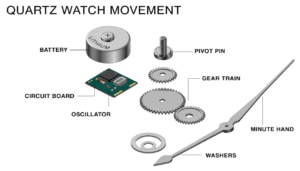
A watch-research summary on Swatch’s Gent-style construction breaks the visible/functional parts down further: an electronic module (integrated circuit, quartz crystal resonator, coil and contact system), a gear train that steps down the electronic pulse into hour/minute/second hand motion, a replaceable power cell, base plate and bridges, and basic sealing hardware for light water resistance. All of this is packaged into the same molded case that forms the watch body — there’s no separate movement housing to assemble.
Does Every Gent Model Use a Quartz Movement?
Yes, for the vast majority of Gent releases. Retailer spec listings for classic Gent references (e.g., the 1997 “Passage to Brooklyn” GJ120 and the 2000-era GN186 “Bouquet Pour Maman”) both list quartz as the movement type, and modern Clear Collection Gent models are described by aBlogtoWatch as running on Swiss quartz movements across the entire lineup, even though Swatch doesn’t publish granular caliber details for every release. Automatic mechanical Gent-adjacent models exist (the Sistem51 being the most famous, built specifically to mirror the “51 components” idea in a mechanical format), but these are distinct, clearly labeled product lines rather than standard Gent variants.
What Crystal Does the Gent Use, and How Does It Vary?
Classic Gent references typically use a plastic or acrylic crystal, consistent with the all-plastic construction philosophy. A retailer listing for the vintage GJ120 Gent model specifically records the case material as plastic and crystal, with an acrylic crystal listed among its features. This is a deliberate cost-and-repair tradeoff: acrylic is inexpensive to replace and resists shattering, though it scratches more easily than mineral or sapphire glass. Special editions and collaborations have occasionally used upgraded crystal treatments, but the base Gent spec remains simple plastic/acrylic.
How Is the Gent Strap Attached, and What Is It Made Of?
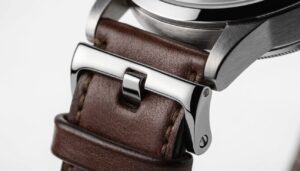
Strap materials have shifted over the decades but the attachment philosophy hasn’t: a simple two-piece strap secured with bars and a buckle closure, sized to a narrow, consistent lug width. Retailer spec sheets for classic Gent references list a 17mm lug width and buckle closure, with a plastic and rubber two-piece strap. Newer Clear Collection Gent models have moved to a clear TPU adjustable strap with a strap buckle, matching the bio-sourced case material. Because Gent cases use a narrow, brand-specific lug width and molded strap-to-case fit, generic aftermarket bands don’t always drop in cleanly — genuine Swatch replacement straps sized to the same reference are the safer match.
What Water Resistance Rating Do Gent Models Carry?
Every Gent reference checked across retailer and brand sources — from a 1997 Gent to the current Clear Collection — lists the same figure: 30 meters (3 ATM) water resistance, also confirmed for the modern Clearly Bold and Clearly Big Bold models, which come on a silicone strap and carry 30 meters of water resistance. That’s enough for rain and incidental splashes, not swimming or diving — Swatch’s dedicated Scuba and dive-oriented lines are built with different sealing and are rated well beyond the Gent’s everyday-use spec.
Case Diameter Across the Gent Family
Lady — 25mm
Original Gent — 34mm
New Gent — 41mm
Diameters sourced from Swatch’s official collections page. Bars scaled proportionally to mm, not to scale with case thickness.
What Does the Dial and Hand Design Vary Between Gent Models?
Since case size, movement type, and general construction are standardized within each Gent size tier, the overwhelming majority of design variation happens at the dial and hands. Worn & Wound’s coverage of the Clear Collection notes design touches like a silver chapter ring with painted black markers framing the movement, anchored by tri-colored hands on skeletonized models — a good example of how Swatch varies visible details (hand color, dial transparency, printed graphics) while keeping the underlying case and movement architecture constant across a given size tier.
Are Components Interchangeable Between Different Gent Model Years?
Largely yes within the same size tier (34mm Original Gent vs. 41mm New Gent are not interchangeable with each other, but references within a size tier share consistent lug width, case dimensions, and movement mounting). This is a direct consequence of Swatch’s original design goal — standardizing the case/movement package for automated, high-volume assembly — which has remained a defining trait of the line for over four decades, per Fratello Watches’ historical account of the 1983 design brief.
How Do You Verify a Gent Model’s Specs Before Buying Second-Hand?
Because Swatch has released hundreds of Gent-family references since 1983, condition and spec sheets vary by reference number rather than by “Gent” as a single blanket spec. Practical checks:
Confirm the exact reference number and cross-check its listed case size, water resistance, and movement type against a retailer spec sheet or Swatch’s archive, rather than assuming “Gent” always means 34mm.
Check whether the crystal is listed as acrylic/plastic (standard) or mineral/sapphire (typically a special edition).
Verify lug width and strap type match, since replacement straps need to be sized to the specific reference, not just “Gent” generally.
Note whether the model has any added complications (day/date), which appear on some references but are not part of the base Gent spec.
Frequently Asked Questions
What is the case size of an Original Swatch Gent?
34mm. The New Gent, a larger variant, measures 41mm, and the Lady model (same basic case shape) measures 25mm.
Why does the Swatch Gent movement have only 51 components?
Swatch’s original 1983 engineering brief reduced the standard quartz watch’s part count from 91+ down to 51 by using the plastic caseback as the movement’s main plate and fully automating assembly, cutting production cost by roughly 80% versus a mechanical watch.
Is the Swatch Gent water resistant enough to swim in?
No. Gent models are consistently rated to 30m (3 ATM) across both vintage and current references — enough for rain and splashes, not swimming or diving.
What crystal material does the Gent use?
Standard Gent references use a plastic/acrylic crystal. Some special editions use upgraded mineral or sapphire-coated crystal, but this isn’t the base spec.
Can I put any watch strap on a Swatch Gent?
Not reliably. Classic Gent references commonly use a 17mm lug width with a case-specific strap fit, so genuine Swatch straps sized to the same reference are the safest replacement.
Sources: Swatch’s official collections page (swatch.com) and Sistem51 product page; Fratello Watches’ 40th-anniversary Swatch history and 2022 Clear Collection coverage; WatchTime and Gear Patrol’s Sistem51 reviews; A Collected Man’s Swatch brand history; Worn & Wound and aBlogtoWatch’s Clear Collection coverage; MoMA Design Store’s Clearly Gent product listing; and eBay product spec sheets for vintage Gent references GJ120 and GN186.
I’m the mom behind Wise Mom Blogger, where everyday creativity meets real-life motherhood. I share easy DIY crafts, cozy knitting and crochet projects, beginner-friendly sewing ideas, and family-tested recipes—plus quick baking hacks that make homemade feel doable on busy days.