

Quick answer: The Swatch industrial patent protected the sealed, injection-molded plastic watch case that made the original Swatch cheap and fast to mass produce. It was developed by ETA engineers Elmar Mock and Jacques Müller in the early 1980s, with the core case patent, Swiss patent CH650894, filed on August 12, 1982, ahead of the watch’s 1983 launch.
Most people know Swatch as a fun, colorful watch brand. Fewer people know that a patent is the real reason Swatch could exist at all. Without a way to protect a radically simplified plastic case, Swiss watchmakers could not have justified building an entirely new factory system around it. This article breaks down what the patent actually covered, who invented it, and why it mattered enough to help save an entire national industry.
A quick note on sources before diving in. Public patent databases do not neatly label a single filing as “the Swatch industrial patent.” That phrase is shorthand used by watch historians and journalists for the core case design patent behind the original Swatch. This article uses that same shorthand while being clear about which specific, verifiable patent it points to, and flags the one area, exact inventor credit, where different sources give slightly different answers.
| Fact | Detail |
| Patent number | Swiss patent CH650894 |
| Filing date | August 12, 1982 |
| What it covered | Plastic case with ultrasonically welded crystal |
| Lead inventors | Elmar Mock and Jacques Müller |
| Overseeing executive | Ernst Thomke, ETA |
| Parts count reduction | 91 parts down to 51 parts |
| First market launch | 1983 |
| Traditional Swiss Watch (Pre-Swatch) | Swatch Design |
| 91 separate components | 51 components |
| Metal case, hand-assembled | Injection-molded plastic case, automated assembly |
| Movement built separately, then cased | Movement integrated directly into the case |
| Repairable | Sealed shut, not designed to be repaired |
| High production cost | Roughly 3 times cheaper to produce |
Watch Parts Count: Before vs After the Patent
91 parts
Traditional
51 parts
Swatch
What did the Swatch industrial patent actually protect?
The Swatch industrial patent protected a sealed plastic watch case with the crystal, or glass cover, welded directly onto the case using ultrasonic vibrations instead of screws or glue. This was the core mechanical trick that made the whole Swatch concept possible, and it is the invention most historians mean when they refer to the patent by that name.
The specific document usually cited for this is Swiss patent CH650894, which described a plastic watch case fitted with a glass crystal and a method for fastening that crystal to the case using ultrasonic welding. The design also addressed how to seal the battery compartment cover with the same welding technique, keeping the whole watch water resistant without adding extra hardware.
For a reader trying to understand why this mattered, the benefit is simple. A sealed, welded case meant far fewer parts, much faster assembly, and a watch that did not need a skilled watchmaker to put together by hand. That single design choice is what let Swatch undercut its competitors on price by such a wide margin.
Who invented the Swatch case design?
The Swatch case design was invented by engineers Elmar Mock and Jacques Müller, working at the Swiss watch component maker ETA under CEO Ernst Thomke in the early 1980s. Mock brought plastics engineering experience, while Müller brought traditional watchmaking knowledge, and together they combined the two fields in a way the rest of the industry had not tried.
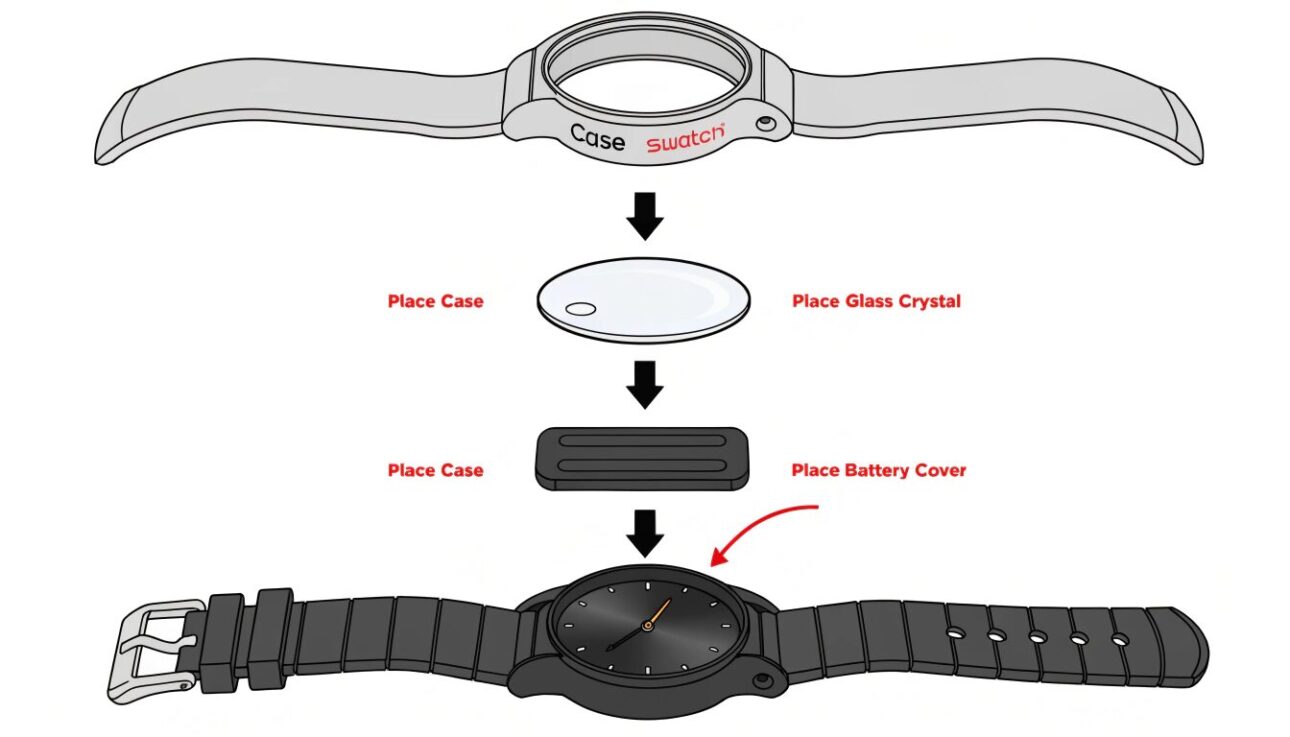
According to accounts of the project, the pair first sketched their simplified watch concept, originally nicknamed “Vulgaris,” and pitched it to Thomke around 1980. Over roughly two years of development, they refined the idea into a working, patentable design. It is worth noting that some patent filings from this period also list a third name, Alphonse Bron, alongside Mock and Müller, so readers researching the original documents may see slightly different inventor lists depending on the specific filing referenced.
The practical takeaway is that the Swatch was not a single flash of inspiration from one person. It came from a small, focused engineering team given a clear cost target, which is a useful example of how constraint-driven design projects can work.
Why did the Swiss watch industry need this patent so badly?
The Swiss watch industry needed this patent because it was losing badly to cheap, reliable Japanese quartz watches during the so-called quartz crisis of the 1970s and early 1980s, and it had no answer at a similar price point. Without a fundamentally cheaper way to build a Swiss watch, entire regions built around watchmaking risked losing their industry completely.
Consultant Nicolas Hayek, brought in by banks to assess the crumbling industry, is often credited with steering Swiss watch companies toward a merger and a new low-cost strategy instead of simply managing a shutdown. The Mock and Müller case design gave that strategy a concrete product to build around, since it let a Swiss-made watch be manufactured on a highly automated line for a fraction of the previous cost.
This is the part of the story with the clearest lesson for readers outside the watch world too. A single, well-protected piece of engineering can become the foundation an entire company, or even an entire industry, rebuilds itself around.
How did the patented case cut costs so dramatically?
The patented case cut costs by removing dozens of separate parts and by replacing slow, hand-assembled construction with a fast, automated one. A traditional Swiss watch of that era used around 91 individual components, while the patented Swatch design brought that number down to about 51, largely by building the movement directly into the case instead of assembling it separately first.
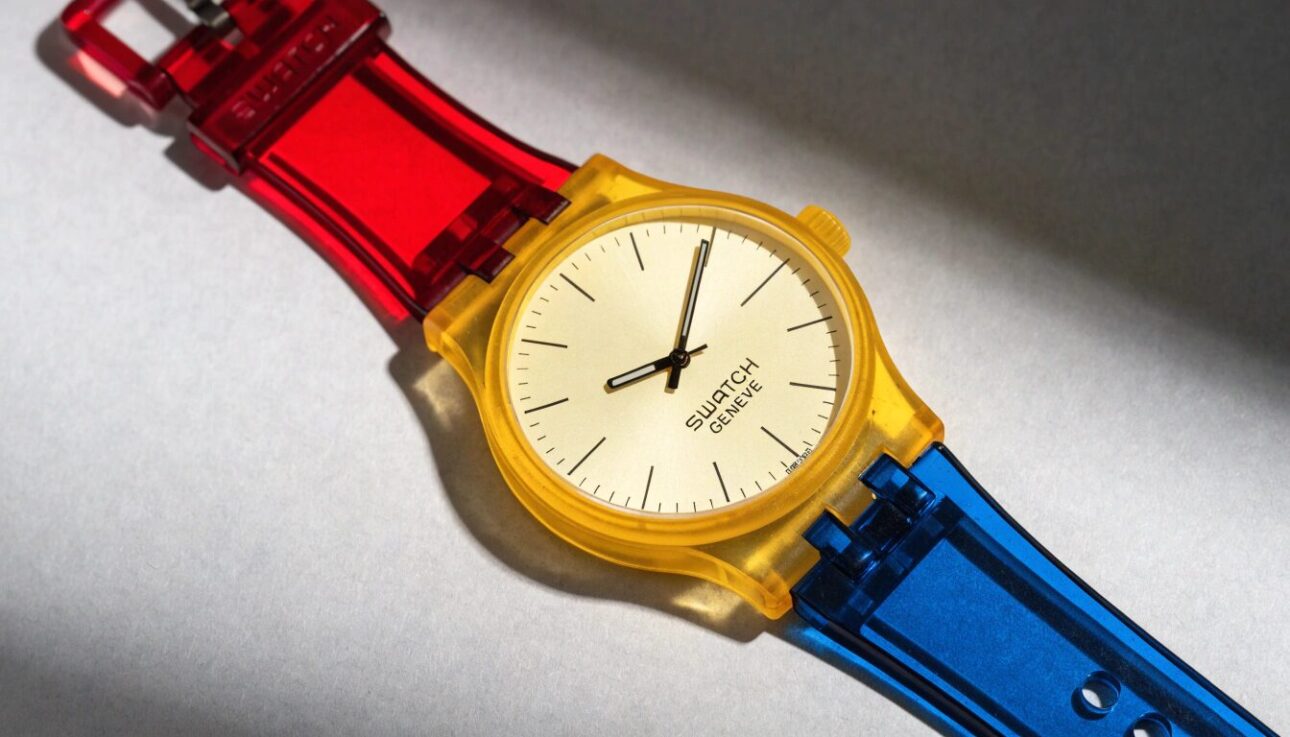
Because the plastic case and crystal were fused together with ultrasonic welding rather than fitted with screws or glue, the watch could be sealed on a fast-moving assembly line with very little manual labor. Reports on the original production run describe the finished watch costing only a few Swiss francs to manufacture while selling to the public for around 39.90 to 49.90 Swiss francs, a wide enough margin to support mass marketing and rapid global expansion.
For anyone studying product design, this section is really the heart of the story. Removing parts and automating assembly did more for the final price than any raw material choice could have, since fewer parts means fewer places for slow, expensive human labor to be needed.
Did the patented design have any downsides?
Yes, the biggest downside of the patented design was that the sealed, welded case made the watch essentially impossible to repair in the traditional sense, since opening it meant breaking the ultrasonic weld that held it together. Older Swiss watches were designed to be opened, serviced, and passed down for decades, while the original Swatch was effectively built to be replaced rather than fixed.
This tradeoff was intentional rather than accidental. Since the watch was so cheap to buy in the first place, the company judged that most customers would rather replace a broken unit than pay for a repair, and the low price supported that model well. It also fit neatly with Swatch’s fashion-driven approach, where owning several designs and swapping between them mattered more than keeping one watch running for years.
For a reader weighing this history against a purchase decision today, the lesson still applies loosely. A cheaper, sealed design usually trades long-term repairability for a much lower upfront cost, and that tradeoff is worth thinking through depending on how the item will actually be used.
How does Swatch Group protect its designs today?
Swatch Group protects its designs today through a very large, ongoing patent and industrial design portfolio, holding roughly 1,800 patents with close to 200 new patent applications filed in a single recent year alone. This is a far cry from the single foundational case patent that launched the brand, and it reflects how much the company has grown into a full-scale watch technology developer.
Modern filings cover a much wider range of inventions than the original plastic case, including things like humidity-sensing watch cases and other technical features spread across the group’s many brands, from Swatch itself to Omega and Tissot. Swatch is also a major user of the World Intellectual Property Organization’s Hague System, which lets a company register an industrial design internationally through one application instead of filing separately in every country.
The practical benefit of understanding this is scale. What started as one company protecting one clever case design in 1982 has grown into an entire corporate strategy built around owning a large, defensible pile of intellectual property across the whole watch business.
What came before the patented case design?
Before the patented case design, Mock and Müller worked from an earlier concept sketch that was originally nicknamed “Vulgaris,” presented to ETA leadership around 1980. This early proposal set out the basic goal of a simplified, low-cost timepiece, but it still needed roughly two more years of engineering work before it became a design solid enough to patent and manufacture at scale.
During that development window, the team also drew on techniques from an earlier ETA project called the Delirium, an extremely thin watch that had already experimented with mounting components directly onto the case back instead of building a separate movement housing. That earlier work helped point Mock and Müller toward the idea of integrating the movement into the case itself, which became one of the defining features of the eventual patent.
Seeing this earlier step matters for understanding the invention properly. The patented Swatch case was not an overnight discovery. It was the result of an existing engineering team building on a prior in-house project, then spending roughly two years refining a rough concept into something that could survive real-world manufacturing and pass patent review.
FAQ
What was the Swatch industrial patent?
It was the patented design for a sealed, injection-molded plastic watch case with the crystal ultrasonically welded to the case, most commonly identified as Swiss patent CH650894. This design is what allowed the original Swatch to be built with far fewer parts than a traditional watch.
Who invented the Swatch case patent?
Engineers Elmar Mock and Jacques Müller are most commonly credited as the inventors, working under ETA CEO Ernst Thomke. Some filings from the same period also list a third name, Alphonse Bron, alongside them.
When was the core Swatch patent filed?
The most widely cited filing date is August 12, 1982, for Swiss patent CH650894. The first Swatch watches reached the market the following year, in 1983.
How many parts did the patented design remove?
The design cut the typical watch part count from about 91 down to about 51. Most of that reduction came from building the movement directly into the sealed case instead of assembling it as a separate unit.
Can a Swatch built with the patented design be repaired?
Generally, no, since the ultrasonic welding that seals the case is not meant to be reopened without damaging it. This was an intentional tradeoff to keep manufacturing costs and assembly time as low as possible.
References
- Watchonista, “Prix Gaïa 2010: Jacques Muller and Elmar Mock, Craftsmanship-Creation category.”
- Commoncog Case Library, “How Swatch Saved the Swiss Watch Industry, But Not From Quartz.”
- NZZ, “Swatch: The crazy product that saved the Swiss watch industry.”
- WIPO Magazine, “A Tribute to the Man behind the Swatch: Mr. Nicolas G. Hayek.”
- Fortune, “Swatch became the elite Swiss watch industry’s crusader by making colorful timepieces with plastic.”
- Swatch Group, “Innovation Powerhouse.”

Sarah Anderson . J
I’m the mom behind Wise Mom Blogger, where everyday creativity meets real-life motherhood. I share easy DIY crafts, cozy knitting and crochet projects, beginner-friendly sewing ideas, and family-tested recipes—plus quick baking hacks that make homemade feel doable on busy days.