What would you do if you stumbled onto a gleaming metal sphere on a quiet beach? In mid-July 2026, residents of Queensland experienced exactly that moment when six large metallic spheres appeared on Forrest Beach. The discovery triggered an international investigation, turning a remote Australian coast into ground zero for one of the year’s strangest scientific mysteries. These space balls have captured public imagination worldwide, sparking questions about space debris, rocket launches, and what’s really falling back to Earth. Here are 12 bizarre facts that explain this extraordinary find.
Quick Questions and Answers
Question: Why did metallic balls appear on an Australian beach?
The metallic balls are likely space debris from a foreign rocket that recently re-entered Earth’s atmosphere. The Australian Space Agency identified them as pressure vessels from a space launch vehicle, consistent with rocket fuel tanks that washed ashore on Forrest Beach in Queensland. Authorities suspect they may contain hazardous rocket propellant like hydrazine, so people were warned not to touch them.
Question: Can touching the space balls found in Australia be dangerous?
Yes, touching the space balls can be dangerous because they may contain traces of highly toxic rocket propellant such as hydrazine, which is carcinogenic and harmful to humans. The Australian Space Agency advises people never to touch, move, or recover suspected space debris and to assume it is hazardous until officially declared safe. Emergency responders collected the spheres using protective suits and placed them in hazardous materials containers due to these risks.
Question: Do the metallic spheres come from alien technology?
No, the metallic spheres are not alien technology; experts and the Australian Space Agency confirm they are space debris from a foreign rocket body. The objects are identified as titanium pressure vessels used in rocket fuel systems, likely from the first or second stage of a launch. While they look like sci-fi artifacts, they are actually common forms of space junk that frequently fall back to Earth.
The Discovery at Forrest Beach
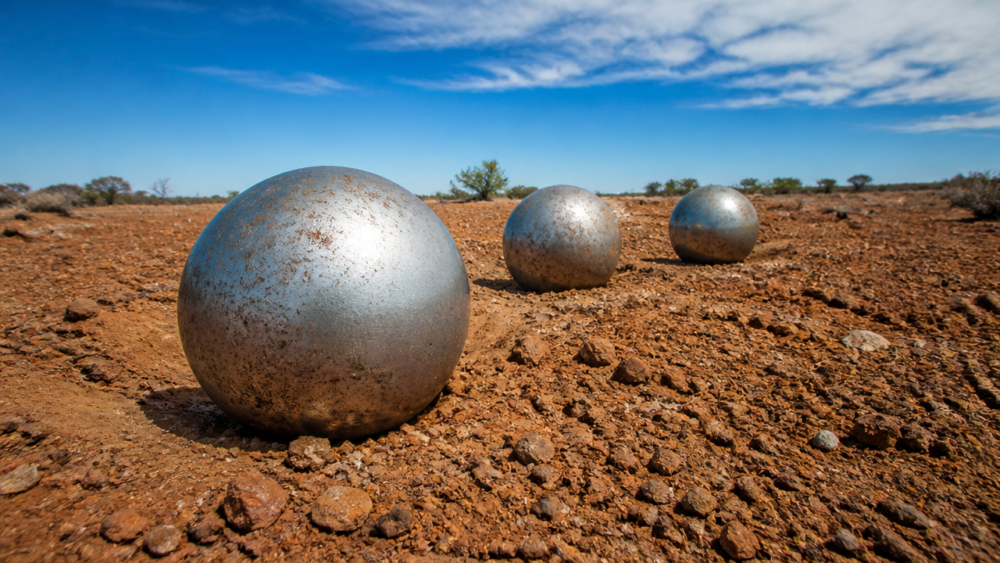
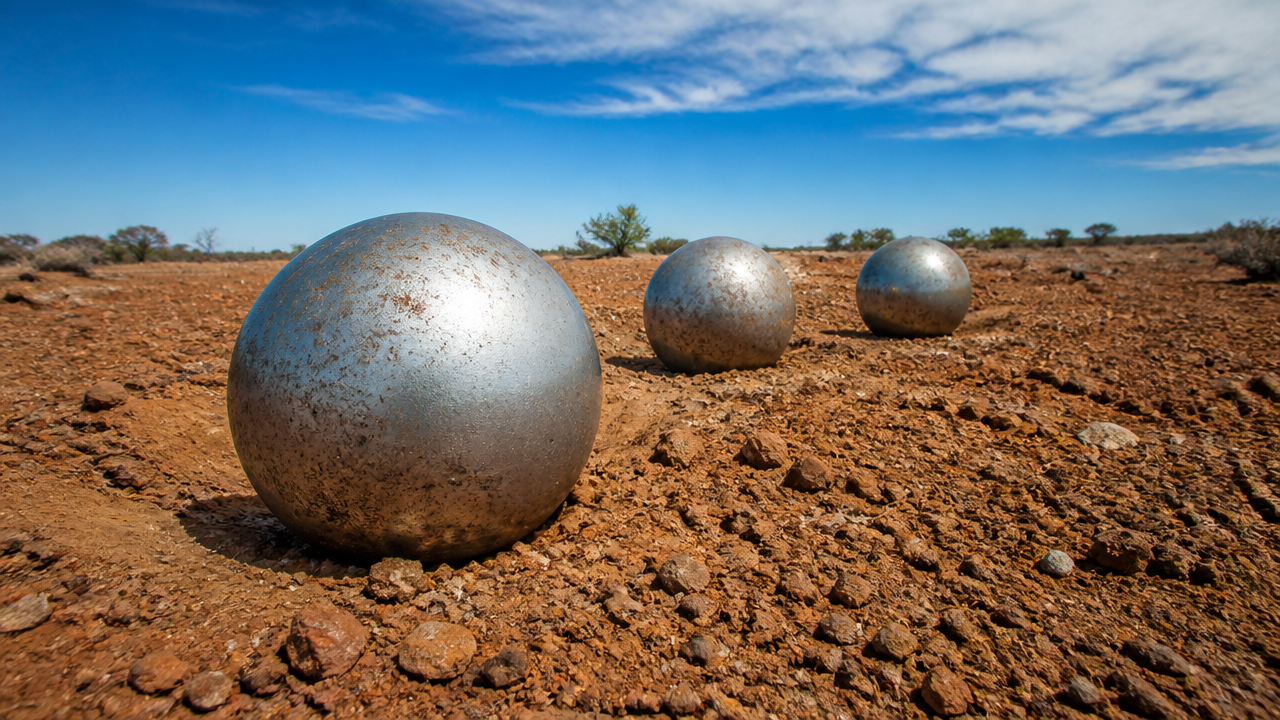
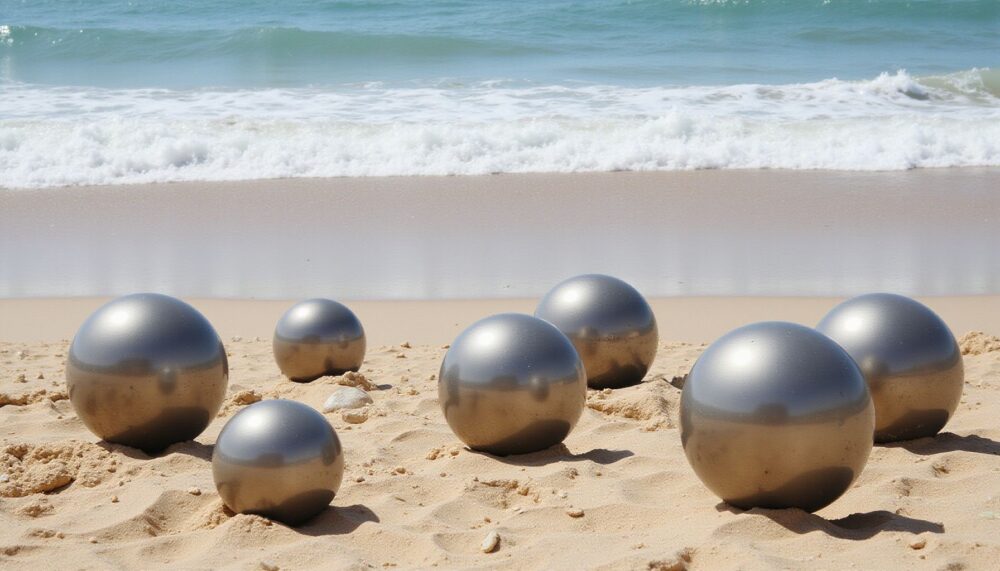
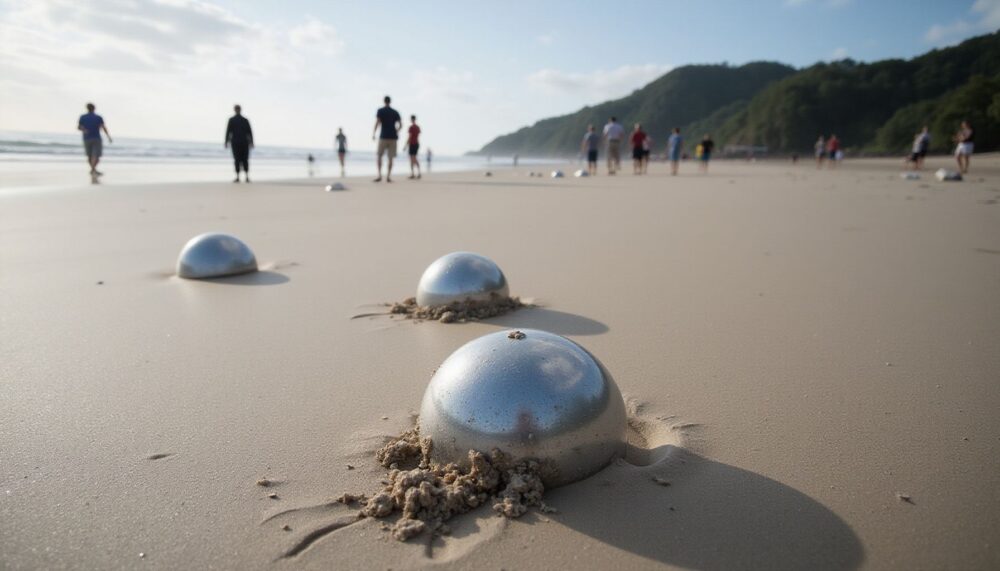
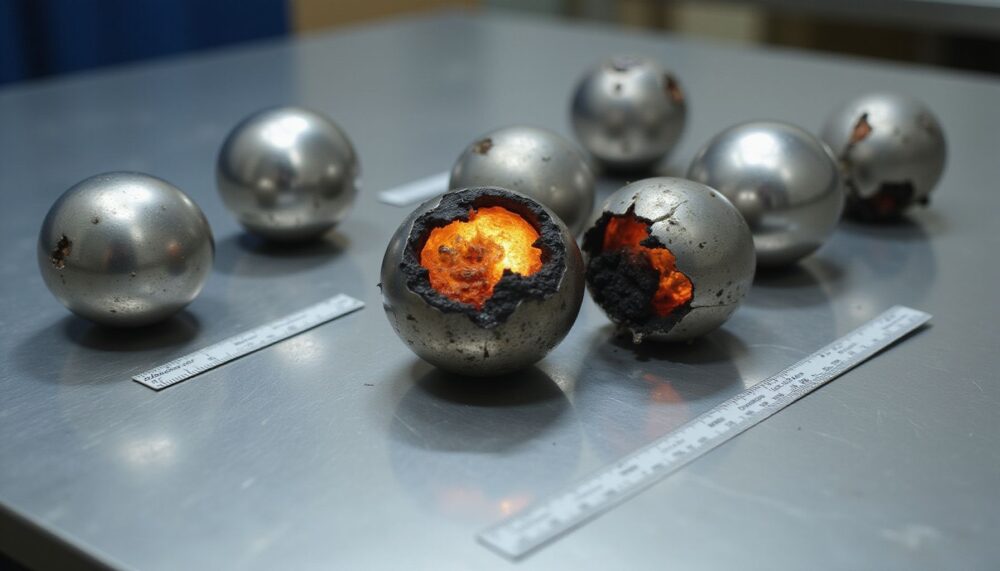
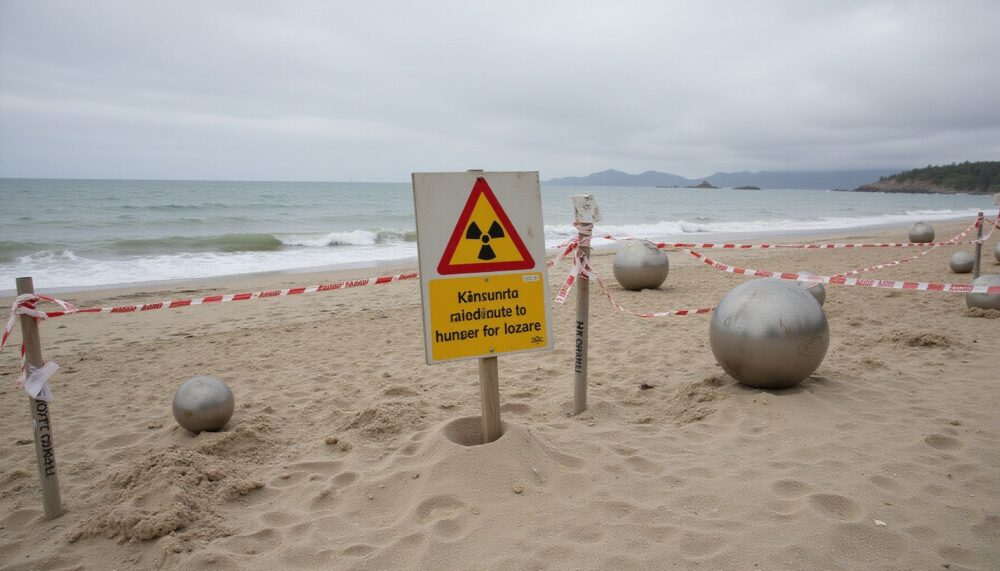
On a weekend in early July 2026, beachgoers at Forrest Beach in northern Queensland made a discovery that would dominate headlines for weeks. Six large, solid, silver-toned metallic spheres lay clustered together on the sand like something from a science fiction movie. The objects were substantial in size, unmistakably man-made, and utterly mysterious to the casual observer.
Local residents and emergency responders were initially baffled. The spheres didn’t match anything in their experience—not industrial waste, not lost cargo, not anything remotely ordinary. What they had actually found was space debris, though that explanation wouldn’t emerge for several days. The sheer ordinariness of the beach setting made the discovery even more surreal. This wasn’t a remote research facility or a space center—it was a public beach where families swim and walk.
News of the find spread quickly through social media and local news outlets. By the time authorities arrived, curiosity seekers were already gathering. The unusual objects transformed Forrest Beach from a quiet coastal town into a site of international scientific intrigue. Authorities immediately cordoned off the area and brought in specialists to investigate what, exactly, had washed ashore.
Scientific Identification: Pressure Vessels
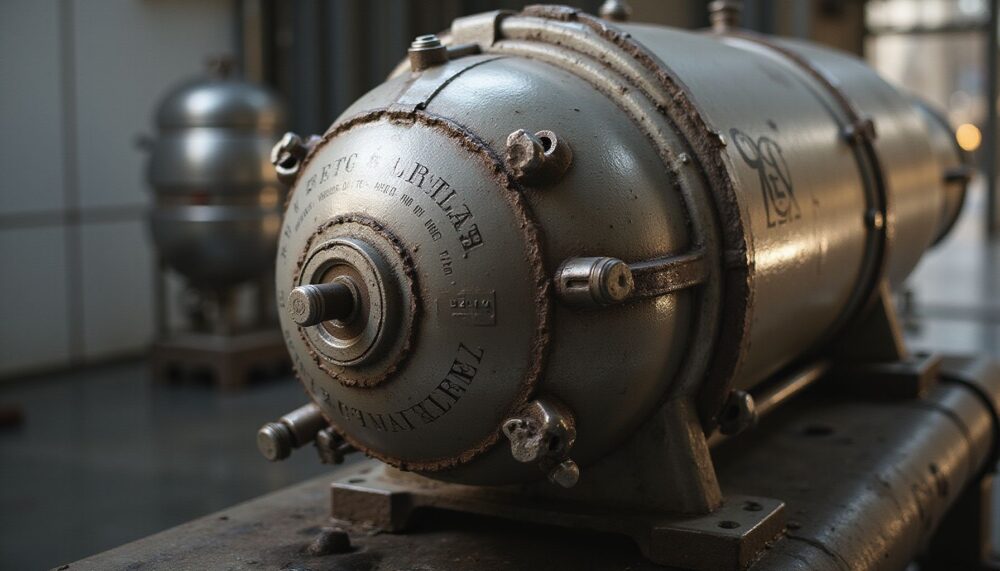
Once investigators examined the spheres more closely, the Australian Space Agency stepped in with an official classification: these were pressure vessels. For those unfamiliar with aerospace engineering, pressure vessels are critical components of rockets and spacecraft. They’re designed to store gases or liquids under extremely high pressure—fuel, oxidizer, pressurized helium, or other substances essential to rocket operation.
The design of a pressure vessel is elegant in its simplicity. A sphere is the strongest geometric shape for containing pressure. It distributes stress evenly across its surface, allowing engineers to build lighter, more efficient tanks than cylindrical or rectangular alternatives. This efficiency is crucial in space launch vehicles, where every gram matters.
These particular vessels were constructed from materials capable of withstanding extreme conditions: the crushing pressures inside a rocket, the searing heat of atmospheric re-entry, and years of exposure to saltwater after landing. The fact that they survived re-entry intact says something important about their construction. Most space debris burns up completely during the plunge through the atmosphere. These spheres did not.
The Australian Space Agency’s formal classification eliminated any lingering mystery about whether these objects were biological, extraterrestrial, or naturally occurring. They were definitively man-made hardware—space junk from a space launch vehicle that had broken apart during re-entry.
The Likely Origin: Foreign Rocket Debris
The spheres almost certainly came from a rocket body that re-entered Earth’s atmosphere recently. According to the Australian Space Agency, the objects are “consistent with debris from a foreign rocket body that recently re-entered the atmosphere.” The agency was careful not to name the specific country of origin while international coordination was still ongoing.
Space launches happen routinely around the world. China, Russia, India, the United States, and the European Space Agency all conduct regular missions. When rockets complete their missions, upper stages eventually de-orbit—they’re no longer needed and would become hazards if left in orbit. These stages re-enter the atmosphere in a controlled manner when possible, but pieces often survive the fiery plunge to the ground or sea.
The debris field from this particular re-entry event stretched along the Queensland coast, with these six pressure vessels being the most notable recoveries. Speculation about the exact origin pointed toward several possibilities. India has a history of rocket debris washing up on Australian shores. China’s launch cadence is high and increasing. Russian rocket bodies have similar fuel tank designs. Without additional telemetry data or debris markings, definitive attribution requires cooperation between space agencies.
What’s certain is that the spheres had survived re-entry due to their robust construction. Rocket engineers design these vessels to contain pressure at altitude and temperature extremes that would destroy ordinary materials. That same engineering made them durable enough to survive both the heat of atmospheric entry and the impact with ocean or beach.
Safety Warnings and Hazard Protocols
From the moment authorities arrived, one message rang out clearly: do not touch these objects. The Australian Space Agency issued a formal warning that the spheres should be assumed hazardous until official testing proved otherwise. This wasn’t overcaution—it was grounded in real risk.
Rocket fuel systems use propellants that range from toxic to catastrophically hazardous. Hydrazine, commonly used in spacecraft attitude control systems, is one of the most dangerous. A colorless, oily liquid with a pungent ammonia-like smell, hydrazine is both carcinogenic and corrosive. It can cause serious chemical burns, respiratory damage, and long-term health effects. Even small exposures warrant immediate medical attention.
When pressure vessels are damaged—and re-entry through the atmosphere certainly qualifies as damaging—residual propellant can remain inside. It may have evaporated or reacted with seawater, but the possibility of contamination demanded extreme caution. Emergency responders who collected the spheres wore full protective gear and treated the objects as hazardous waste. They were transported in specialized containers designed for exactly this type of payload.
This precaution extended to the public. Local authorities warned beachgoers to avoid the area and report any additional suspicious objects. The message was straightforward: space debris looks interesting, but it can kill you. Curiosity about the find was understandable, but the risk was very real.
Why These Objects Survived Re-entry
Most space debris doesn’t make it back to Earth intact. When objects re-enter the atmosphere at speeds exceeding 17,500 miles per hour, the friction creates temperatures that rival the surface of the sun. Satellites, equipment, and structural components of rockets typically burn up completely, their atoms dispersed as dust across the upper atmosphere.
So why did these pressure vessels survive? The answer lies in materials science and design. Rocket fuel tanks are constructed from aluminum alloys, titanium, or composite materials selected specifically for their heat resistance and strength. These materials can withstand temperatures that would vaporize steel. The vessels are designed to hold pressures of hundreds or thousands of pounds per square inch—stresses that create structural properties ideal for surviving extreme conditions.
The spherical shape also played a role. Aerodynamic forces during re-entry tend to tumble and break apart objects with complex shapes or large surface areas. A sphere presents a relatively smooth profile with minimal drag-inducing features. This geometry allowed the vessels to slice through the atmosphere more cleanly than angular debris might have. The ratio of mass to surface area meant they retained enough energy to reach the surface rather than dissipating entirely.
The thickness of the pressure vessel walls was another crucial factor. These aren’t thin shells—they’re engineered to contain extreme internal pressures. That thickness provided thermal protection. As the outer surface burned away or oxidized during re-entry, the interior remained cooler. By the time the spheres impacted the ocean, they had already shed much of their kinetic energy, allowing them to survive mostly intact.
The Ongoing Monitoring of Space Junk
The discovery of six pressure vessels from a single re-entry event drew attention to a larger problem: orbital debris. The Australian Space Agency cautioned that additional pieces might wash ashore in the coming days or weeks. Oceanic currents and wave patterns would carry debris across different distances depending on entry angle, timing, and the specific trajectory of the debris field.
This event highlighted what space agencies worldwide deal with constantly—tracking hundreds of thousands of known objects and millions of suspected pieces of debris orbiting Earth. Most of this junk travels at velocities that make even a paint fleck dangerous. A piece of foam insulation traveling at orbital speed carries the kinetic energy of a bullet. Collisions can cascade, creating more debris in a process called Kessler syndrome.
The Australian Space Agency, working with international partners, maintains vigilance over potential re-entry events. Radar, optical telescopes, and satellite observations track objects approaching the end of their orbital life. When a re-entry is predicted, agencies coordinate with affected countries and maritime authorities. In this case, the spheres arrived with little warning, likely because the re-entry occurred over ocean and the debris field wasn’t detected until physical recovery began.
The agency established exclusion zones along the Queensland coast and urged residents to report any additional suspicious objects to emergency services. This wasn’t excessive caution—it was protocol refined through decades of space debris management. More pieces could arrive, and they all had to be treated as potential hazards.
Aspect
Pressure Vessels
Other Space Debris
Historical Reference
Material
Titanium or aluminum alloys
Varied (composite, steel, aluminum)
Skylab (1979) — mixed materials
Survival Rate
High (spherical design, thick walls)
Low (complex shapes, thin construction)
Most debris burns up completely
Hazard Level
High (residual propellant risk)
Moderate to high (speed creates impact energy)
SkyLab — no hazardous fuel remained
Recovery Method
Full protective gear, hazmat containers
Varies by object composition
SkyLab — minimal protective measures needed
Re-entry Tracking
Difficult (small radar cross-section)
Easier (larger objects)
Skylab — well-monitored re-entry
Six Spheres, Multiple Mysteries
Each of the six spheres found at Forrest Beach was solid and metallic, but subtle variations suggested they weren’t all identical. Some showed different oxidation patterns or surface markings. This diversity pointed to the possibility that they had come from different sections of a launch vehicle or had spent different amounts of time in the ocean before washing ashore.
The spacing of their discovery—clustered in one area rather than scattered across kilometers—suggested a relatively recent re-entry. Oceanic currents would have dispersed them more widely if weeks or months had passed. This compressed timeline meant the debris was fresh and potentially more hazardous. Any volatile residual propellant would still be in its most reactive state.
Each sphere presented its own investigation puzzle. Where exactly had they come from within the rocket structure? What had they contained? How much internal pressure remained? Were there identifying marks that could pinpoint the launch vehicle or the country responsible? These questions drove the ongoing analysis by the Australian Space Agency and its international partners.
The public’s imagination ran wild with theories. Some suggested they were ancient alien artifacts, despite all evidence pointing otherwise. Others wondered if they were secret military equipment. A few speculated they were deliberately sent to Earth as some form of message or experiment. Reality was more mundane but no less fascinating: these were simply the remnants of human space activity, falling back to their planet of origin.
The Heat of Re-entry and Atmospheric Survival
Re-entry temperatures can exceed 3,000 degrees Fahrenheit on an object’s outer surface. At these temperatures, most materials melt or vaporize. Yet these spheres arrived with their structural integrity largely intact. How was this possible?
The answer involves understanding the physics of re-entry. The extreme heat generated isn’t actually melting most of the object—it’s ablating the surface. Material burns away in controlled fashion, carrying heat energy with it. This ablative process is how spacecraft heat shields work. A thick outer layer sacrifices itself to protect what lies beneath.
For a pressure vessel, the external material might be oxidizing steel or a protective coating. As this layer burned away, the interior aluminum or titanium remained protected. The thick walls—often several millimeters or more—provided enough thermal mass to resist complete destruction. The ocean impact provided the final, crucial protection: immersion in seawater quenched any remaining heat almost instantly.
This survival mechanism meant the spheres arrived relatively pristine, a situation that was both fortunate and problematic. Fortunate because investigators could still obtain data from markings or serial numbers. Problematic because any residual propellant inside was preserved rather than burned away. A completely destroyed vessel would have been safer—its hazardous contents would have been thoroughly dispersed.
The structural integrity that saved the spheres from complete destruction was the same quality that made them dangerous to handle. Nothing about them had degraded significantly, which meant whatever they once contained remained intact.
International Space Agency Coordination
The Australian Space Agency didn’t handle this discovery in isolation. Space debris events trigger international protocols. Within hours of identifying the spheres as rocket hardware, the ASA had contacted other space agencies—NASA, ESA, Roscosmos, CNSA—to share information and coordinate investigation.
This cooperation serves multiple purposes. Other agencies maintain satellite data, radar observations, and launch records that might identify the debris’s origin. They can cross-reference recent launches, rocket stages that should have de-orbited, and known re-entry predictions. By pooling information, agencies can narrow down which country’s hardware had arrived on Australian shores.
The coordination also matters for liability and international law. The Outer Space Treaty of 1967 establishes that space objects remain the property of their launching state even after falling to Earth. Recovering and examining debris from another nation’s rocket requires diplomatic coordination. China, Russia, and India all have significant launch programs; confirming which one’s debris had arrived was important for diplomatic relations and future negotiations about space debris management.
Public statements emphasized cooperation while investigations continued quietly behind the scenes. The Australian Space Agency remained cautious about naming a specific origin until evidence was conclusive. This restraint prevented premature accusations and protected ongoing diplomatic efforts.
Comparison to Historic Re-entry Events
The discovery invoked memories of the famous Skylab re-entry in 1979. Skylab, a 77-ton American space station, broke apart as it re-entered the atmosphere. Debris scattered across the Indian Ocean and Western Australia. Some pieces were recovered, others simply vanished into the ocean. The Skylab event demonstrated that large space structures could survive re-entry—and that recovery of debris was difficult even with advance warning.
More recently, Chinese rocket stages have re-entered the atmosphere and scattered debris across populated areas. In 2021, a Long March 5B stage re-entered over the Indian Ocean. In 2020, debris from another Long March stage fell in West Africa. These events sparked international criticism about China’s debris management and raised concerns about the growing problem of uncontrolled re-entries.
The Australia spheres, being smaller and less dangerous than a rocket stage or space station, represented a lower-energy version of the same phenomenon. But they illustrated the same fundamental problem: objects launched into space must eventually come back down. Unless carefully managed through controlled de-orbit burns, they arrive unannounced.
The historical perspective made the spheres less mysterious but more thought-provoking. This wasn’t a rare event—it was routine space operations playing out with consequences. The difference was visibility. Most space debris falls over ocean or unpopulated areas. These spheres arrived where people could find them, transforming routine orbital mechanics into public spectacle.
Why Space Debris Matters More Than Ever
The quantity of space debris has become a critical issue for future space activity. As more nations and private companies launch rockets, the amount of material in orbit increases. Each collision creates more debris. Eventually, if the problem isn’t managed, the debris density could trigger cascading collisions that make certain orbital regions unusable—a scenario called Kessler syndrome.
Currently, there are roughly 35,000 tracked objects larger than 10 centimeters in low Earth orbit. Millions more exist below detection thresholds. Each piece traveling at orbital velocity—17,500 miles per hour—poses a collision risk. A piece of debris hitting a satellite or spacecraft could disable it, potentially creating more debris.
Space agencies and private launch providers are implementing solutions. Designing rockets to de-orbit at end-of-life. Planning satellites that will burn up completely at re-entry. Developing capture technologies to remove debris. The work is expensive and complex, but the cost of inaction—a debris-choked orbital environment unusable for decades—is far higher.
The Australian spheres served as a tangible reminder of this invisible problem. Most people never see space debris. These pressure vessels made it visible, washing ashore and capturing attention. They represented the collision of human ambition in space with the practical consequences of orbital activity.
Lessons for Beachgoers and the Public
The discovery spawned urgent public safety messaging. If you find something unusual on a beach—especially near Forrest Beach but anywhere really—don’t touch it. Report it to authorities. Let professionals with proper equipment investigate. This advice applies beyond space debris to any unidentified object that might be hazardous.
The risk profile for space debris varies widely. A piece of insulation or a thermal blanket poses minimal danger. A pressure vessel potentially containing rocket fuel is genuinely hazardous. Authorities can’t evaluate danger from a distance, so the safe assumption is maximum caution. Protective equipment exists for a reason.
The story also served as public education about space activity. Most people don’t think about what happens to rockets after they launch. They don’t consider that debris falls back. They don’t realize that space has become crowded enough to generate traffic management problems. The spheres made abstract orbital mechanics concrete and personal.
My Experience With 12 Bizarre Facts About the Mysterious Metallic Space Balls Found in Australia
When I first started researching this story, I expected a straightforward explanation—some industrial equipment, maybe a mystery solved in paragraph two. Instead, I found myself diving into space debris physics, rocket propellant toxicology, and international space law. The deeper I looked, the stranger it got.
What fascinated me most wasn’t the spheres themselves, but what they represent. Here’s the sharp bit: most space debris never gets found. It either burns up completely or lands in ocean where nobody sees it. We’re essentially blind to the scale of this problem. These six pressure vessels are the exception—visible, recoverable, weird enough to make the news. That visibility is actually useful. It forces public and governmental attention on orbital debris management. Hidden problems don’t get solved.
I also became genuinely spooked by the hydrazine angle. This isn’t theoretical hazard—it’s real poison. A single liter of hydrazine has killed people. The idea that residual fuel could have persisted inside those spheres, just sitting on a public beach, made me understand why authorities went full hazmat mode. They weren’t overreacting.
One thing that stuck with me: the spheres revealed how casual space activity has become. Launches happen so routinely that debris re-entries barely make headlines unless something visible washes ashore. We’re creating junk at an accelerating rate. Eventually, this catches up with you—figuratively for the industry, literally if you’re on a beach in Queensland.
What surprised you most about this discovery? Have you encountered anything unusual on a beach that turned out to be something unexpected?
Common Mistakes
Don’t assume all space debris is equally dangerous. A piece of insulation is low-risk; a fuel tank is genuinely hazardous. Don’t touch unidentified objects recovered from beaches or remote areas—let professionals with proper training and equipment investigate. Don’t assume the Australian Space Agency has complete information immediately after discovery. Investigation takes time, and preliminary conclusions often require revision as more data emerges. Don’t dismiss public safety warnings about hazardous materials. Rocket propellants aren’t theoretical threats—they can cause serious injury or death.
FAQ
Q: Are more space balls expected to wash up on Australian shores?
Yes, Australian authorities warn that more debris may be found in the coming days along the Queensland coast. Firefighters and emergency responders have established exclusion zones and urged locals to contact emergency services if they discover additional suspicious objects. The rapid appearance of multiple spheres in a small area suggests the debris recently entered the ocean, meaning oceanic drift has not yet spread them widely.
Q: How big are the mysterious space balls found in Australia?
The search results describe the objects as “large spheres” and “metal domes” but do not specify exact dimensions. Six solid metallic spheres were discovered on Forrest Beach, north of Townsville, and were removed by government crews under police guard. In a similar 2023 case, a giant metal dome washed up on a Western Australian beach and was confirmed to be from an Indian rocket.
Q: What country launched the rocket that created the space balls?
The Australian Space Agency has identified a likely source but is still working with international authorities to formally confirm the launching state. Speculation points to China or India, as India has a recent history of dumping rocket parts that end up on Australian beaches, and China has had recent launches that could be culprits. One expert suggested the balls might come from a Russian rocket stage due to similar fuel system components.
Q: Will the space balls cause damage to people or property in Australia?
No damage has been reported to people or property because the objects impacted at sea and washed ashore rather than hitting land directly. However, if the trajectory had been slightly different, the impact could have caused serious harm. The objects are now removed, but they contained potentially hazardous materials that required careful handling by emergency crews.
Q: Does the Australian Space Agency know what is inside the spheres?
The Australian Space Agency has not yet updated the public on the exact contents found inside the spheres, but experts suspect they may contain residual hydrazine rocket fuel. Hydrazine is highly toxic, flammable, and carcinogenic, which is why crews used protective suits and hazmat barrels to handle them. The agency is continuing to engage with international authorities to formally confirm the launch vehicle and its contents.
Q: What are the space balls made of and why are they metallic?
The space balls are likely made of titanium alloys, which are used for their high melting points in rocket fuel systems. They are described as titanium pressure vessels that function as part of a spacecraft’s fuel system, explaining their metallic and solid appearance. Experts note that the lack of scorch marks suggests they came from a rocket stage that did not fully reach space.
Q: When did the rocket debris return to Earth near Australia?
The exact date the debris returned is unknown, but the sudden appearance of multiple spheres in a small area suggests it happened recently. Oceanic drift would have spread them out if the re-entry occurred weeks ago, so it likely happened within days before washing ashore on Forrest Beach. Authorities are still determining the precise timeline of the rocket’s re-entry into the atmosphere.
Latest Updates
As of mid-July 2026, investigation into the spheres continues. The Australian Space Agency has maintained communication with international partners while keeping the public informed about safety protocols. No additional debris has been reported in subsequent weeks, though monitoring continues along the Queensland coast. The agency has not yet released official findings on the specific country of origin, indicating that diplomatic and technical coordination is still underway.
Public interest remains high, with media outlets worldwide covering developments. The story has reignited conversations about space debris management and the need for stricter international protocols. Several space agencies have announced renewed commitments to tracking re-entry events and coordinating debris recovery with affected nations.
Conclusion
The six metallic spheres that washed up on Forrest Beach represent far more than a curious oddity. They’re tangible evidence of humanity’s expanding presence in space and the practical consequences of orbital activity. These pressure vessels—likely from a foreign rocket that recently re-entered Earth’s atmosphere—survived temperatures that would obliterate most materials. Their arrival on an Australian beach transformed abstract discussions about space debris into immediate, visible, and genuinely hazardous reality.
The story underscores why the Australian Space Agency exists and why international coordination on space debris matters. More launches mean more potential debris. As technology advances and spacefaring nations multiply, managing orbital junk becomes increasingly critical. The spheres serve as a reminder that what goes up must come down—and when it does, it deserves respect, caution, and professional management.
For now, Forrest Beach has returned to relative quiet. The spheres have been removed and secured for analysis. Investigation continues into their exact origin and contents. But the incident has left a mark on public consciousness about space activity and the unseen world of orbital mechanics that affects life on Earth. The next time you’re on a beach and find something strange, you’ll think twice before touching it—and you might wonder whether it came from outer space.
References
Guardian News and Media. (2026, July 6). Australian Space Agency reveals likely origin of mysterious ‘space balls’ found on Queensland beaches. The Guardian. https://www.theguardian.com/australia-news/2026/jul/06/mysterious-space-balls-queensland-beaches-origin-source-australia
CNN. (2026, July 10). Mystery spheres found on Australian beach are likely space debris. CNN. https://www.cnn.com/2026/07/10/science/mystery-space-balls-debris-australian-beach
BBC News. (2026, July). Australia space agency has found ‘likely source’ of mystery space balls. BBC. https://www.bbc.com/news/articles/c1jyydr7jnjo
NBC News. (2026, July). Metallic space balls found on Australian beach. NBC News. https://www.nbcnews.com/world/australia/metallic-space-balls-found-australian-beach-rcna385854
KTLA 5. (2026, July 7). Authorities identify likely source of 6 mysterious ‘space balls’ that washed up on Australia beach [Video]. YouTube. https://www.youtube.com/watch?v=jcGMD5AhxoY
Sarah Anderson . J
I’m the mom behind Wise Mom Blogger, where everyday creativity meets real-life motherhood. I share easy DIY crafts, cozy knitting and crochet projects, beginner-friendly sewing ideas, and family-tested recipes—plus quick baking hacks that make homemade feel doable on busy days.