Is the stock market down because of global policy shifts, cooling economic data, or a sudden change in how you and other investors view risk? Watching your portfolio decline can be unsettling, but understanding that this movement often ties back to supply and demand helps steady the nerves. Whether you are planning for a summer retirement goal or adjusting a portfolio for holiday expenses, recognizing the forces behind market volatility remains essential. This guide explains why markets move downward and how various indicators interact during periods of uncertainty.
Quick Questions and Answers
Question: Why is the stock market down today?
Answer: The most common reasons are weaker investor demand, higher interest-rate expectations, and fear of slower economic growth. Recent market selloffs have also been tied to specific triggers such as doubts about AI-driven valuations and concern that central banks may keep rates elevated longer than expected. In practice, a down day is usually the result of several forces moving together rather than one headline.
Question: What causes stock market downturns?
Answer: A downturn happens when sellers outnumber buyers and confidence weakens. Common causes include recession fears, rising interest rates, inflation, poor earnings, geopolitical shocks, and panic selling. Sources also note that downturns often follow periods of excessive optimism and high valuations.
Question: Can interest rates make stocks fall?
Answer: Yes. Higher interest rates raise borrowing costs for companies and consumers, which can slow growth and reduce expected profits. They also make bonds and cash-like investments more attractive, so some investors move money out of stocks and into safer assets.
Key Takeaways
Stock market declines are rarely the result of a single event; they emerge from a combination of economic uncertainty, investor sentiment, and financial stress.
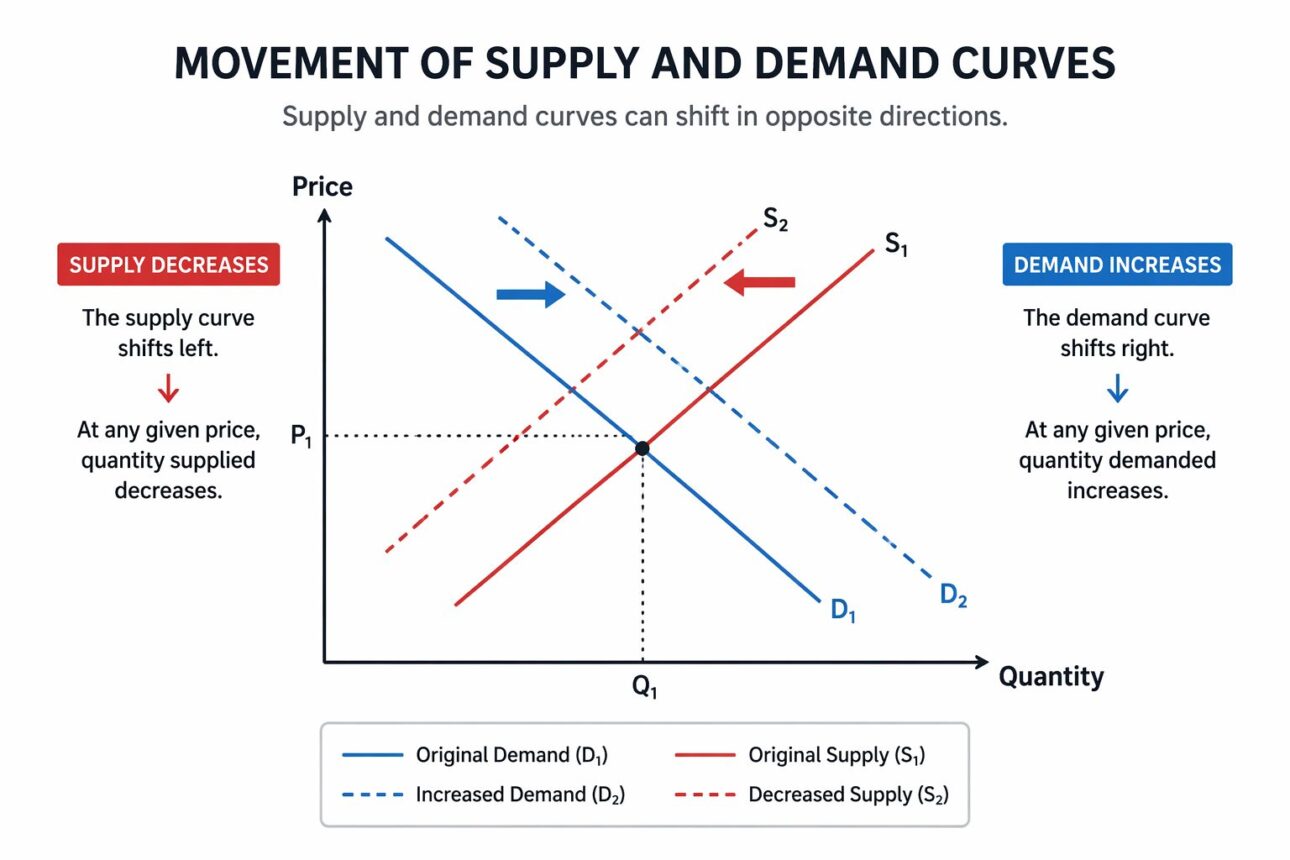
The fundamental driver of price movement is the balance of supply and demand; when buyers vanish, prices naturally drop.
Recent market volatility often stems from skepticism in high-growth sectors, such as AI, coupled with central bank policy that remains restrictive.
Panic selling can quickly turn a normal price correction into a broad-based crash by creating a feedback loop of fear.
Stock Market Down: Anatomy of a Declining Market
A stock market crash represents a sudden, dramatic decline of stock prices across a major cross-section of a market. Unlike a minor dip, a crash typically involves major indices and signifies that something has changed in the collective outlook of the financial community. According to Wikipedia, these events often involve significant losses of paper wealth and follow periods of high leverage or speculative bubbles.
At the core of this movement lies the basic law of supply and demand. Stock prices are not static values; they are equilibrium points where buyers meet sellers. When interest in acquiring shares wanes, prices adjust downward until a new level of demand emerges. This is why you often see broad selling across entire industries rather than just one underperforming company.
The Role of Supply, Demand, and Investor Sentiment
Stock prices reflect the current mood of the market. As one market expert cited by Acorns notes, prices rise when many people want to buy, but they fall when interest vanishes. This dynamic explains why markets sometimes drop on news that feels disconnected from actual corporate earnings.
Panic selling often amplifies these initial declines. When investors see indices moving lower, fear can overwhelm logic, leading to a scramble to liquidate assets. This reflexive behavior creates a feedback loop that pushes prices down faster than the underlying economic reality might dictate. CMC Markets emphasizes that this emotional contagion is a major feature of market instability.
Factor
Primary Effect on Market
Typical Speed of Impact
Interest Rate Hike
Increases borrowing costs
Gradual to Moderate
Geopolitical Shock
Triggers immediate fear
Instant
Poor Earnings Report
Weakens specific sector
Immediate
Panic Selling
Drives broad selloff
Rapid
Macroeconomic Triggers and Policy Shifts
High interest rates change how the entire economy functions. When borrowing becomes expensive, companies struggle to expand, and consumers reduce their discretionary spending. Groww points out that these costs suppress equity valuations, as investors lower their expectations for future corporate profit growth.
Central banks play the lead role in this process. Recent volatility has been attributed to global policy shifts, such as the Bank of Japan raising rates from near zero. When interest rates move up, Why Gold Prices Are Falling: A Complete Guide for Investors can help you realize that capital often shifts between asset classes. If the Federal Reserve delays expected rate cuts, investors often exit riskier stock positions in favor of bonds or cash.
The Impact of Geopolitics and External Shocks
Policy-driven volatility creates sudden, unpredictable shifts. The start of the 2025 market crash on April 2, 2025, serves as a recent example of how trade policy acts as a catalyst. The introduction of worldwide tariffs by President Donald Trump triggered immediate, broad-based selling because investors worried about global supply chains.
Geopolitical instability also forces capital into safe-haven assets. When countries engage in wars, trade conflicts, or face pandemics, the natural reaction for large-scale investors is to reduce exposure to equities. Even if a specific company is performing well, it can still lose value as the entire market moves toward safety.
Fundamental Imbalances and Speculative Bubbles
Markets often experience a “correction” after a long period of excessive optimism. When price-to-earnings ratios reach historical highs, the market becomes vulnerable to any negative news. The use of heavy margin debt—where investors borrow money to buy more stocks—also makes the market more prone to sharp drops when individual positions start to lose value.
Skepticism toward high-growth sectors, particularly artificial intelligence, often serves as a trigger after a prolonged rally. ABC News reports that many analysts see this as a re-evaluation phase. Investors begin questioning whether the high valuations were based on actual results or just speculation. If you are curious about broader currency shifts during these times, Argentine Peso to US Dollar Conversion Explained provides context on how global money moves during economic stress.
Key Takeaways for Market Observers
Crashes rarely stem from a single, isolated event. You should view them as the result of a combination of economic uncertainty, investor sentiment, and financial stress. A true mark of a crash is its broad-based nature, where the decline hits most sectors rather than just one corner of the market.
Remember that when confidence falters, money often flows into bonds. This is why you might see bond yields fluctuate while the stock market is falling. It is a sign of a flight to safety, where the priority shifts from chasing growth to protecting capital.
My Experience With Why is the Stock Market Down Right Now?
I have spent many hours staring at red charts on my screen, wondering if the market had developed a personal vendetta against my savings. Early in my journey, I used to panic at every headline. I would watch a headline about central bank policy and immediately want to sell everything before the index dropped another percent. You eventually learn that the market loves to overreact to anything that sounds like a storm is coming.
The most important lesson I picked up is that markets rarely crash because of one bad piece of news. It is almost always a slow build of factors—rising costs, stretched valuations, and a little bit of group anxiety—that gets the ball rolling. My best moves usually involve doing absolutely nothing, especially when the noise is loudest. Watching the numbers go down is never pleasant, but realizing that it is a systemic process rather than a personal failure makes it much easier to sleep at night. Does seeing your account value fluctuate in real-time make you want to change your strategy, or do you find it easier to look away and check back in a month?
FAQ
Q: Does panic selling cause market crashes?
Yes, panic selling can turn a normal decline into a crash. When investors see prices falling, fear can lead them to sell quickly, which adds more downward pressure and can create a feedback loop. Several sources describe this as a major feature of market crashes.
Q: Are stock market crashes always caused by one event?
No. Multiple sources say crashes rarely come from a single cause. They are usually the result of a combination of economic weakness, policy changes, investor sentiment, and external shocks such as wars, pandemics, or tariffs.
Q: How do tariffs affect the stock market?
Tariffs can make markets fall because they raise uncertainty, increase costs, and can hurt corporate profits. The 2025 stock market crash page specifically says a major decline began after worldwide tariffs put in place by President Trump. That example shows how trade policy can trigger broad selling.
Q: Why do rising inflation and stocks often move opposite?
High inflation can squeeze consumers and raise business costs, which can reduce profits and slow growth. Central banks often respond by raising interest rates, and that can further pressure stock valuations. As a result, persistent inflation is often negative for equities.
Q: What is the difference between a stock crash and a downturn?
A downturn is a broader term for a market decline, while a crash implies a faster, sharper, and more dramatic drop. Sources describe crashes as sudden, broad-based, and often panic-driven, while downturns can also refer to smaller or more gradual declines. Both can be caused by similar economic and psychological factors.
Q: Which sectors usually fall first in a market selloff?
The first sectors to fall are often the ones most sensitive to growth, interest rates, or consumer demand. Examples mentioned in sources include housing-related stocks when mortgage rates rise and companies tied to discretionary spending when consumers pull back. In recent selloffs, AI-related names have also been especially sensitive to valuation concerns.
Q: What should investors do when the stock market drops?
The sources here focus more on causes than personal advice, but the main implication is that investors should identify whether the drop is driven by fundamentals, rates, or sentiment. Because many declines are broad and temporary, sudden panic selling can lock in losses. A calmer response is usually to review diversification, time horizon, and risk exposure before making changes.
ABC News. (2025). Why are stocks falling and what should investors do?. ABC News. https://abcnews.com/Business/stocks-falling-investors-experts-explain/story?id=127589011
CBS News. (2025). 4 reasons the stock market is plunging — and what experts say. CBS News. https://www.cbsnews.com/news/why-is-the-stock-market-down-what-should-investors-do
Sarah Anderson . J
I’m the mom behind Wise Mom Blogger, where everyday creativity meets real-life motherhood. I share easy DIY crafts, cozy knitting and crochet projects, beginner-friendly sewing ideas, and family-tested recipes—plus quick baking hacks that make homemade feel doable on busy days.