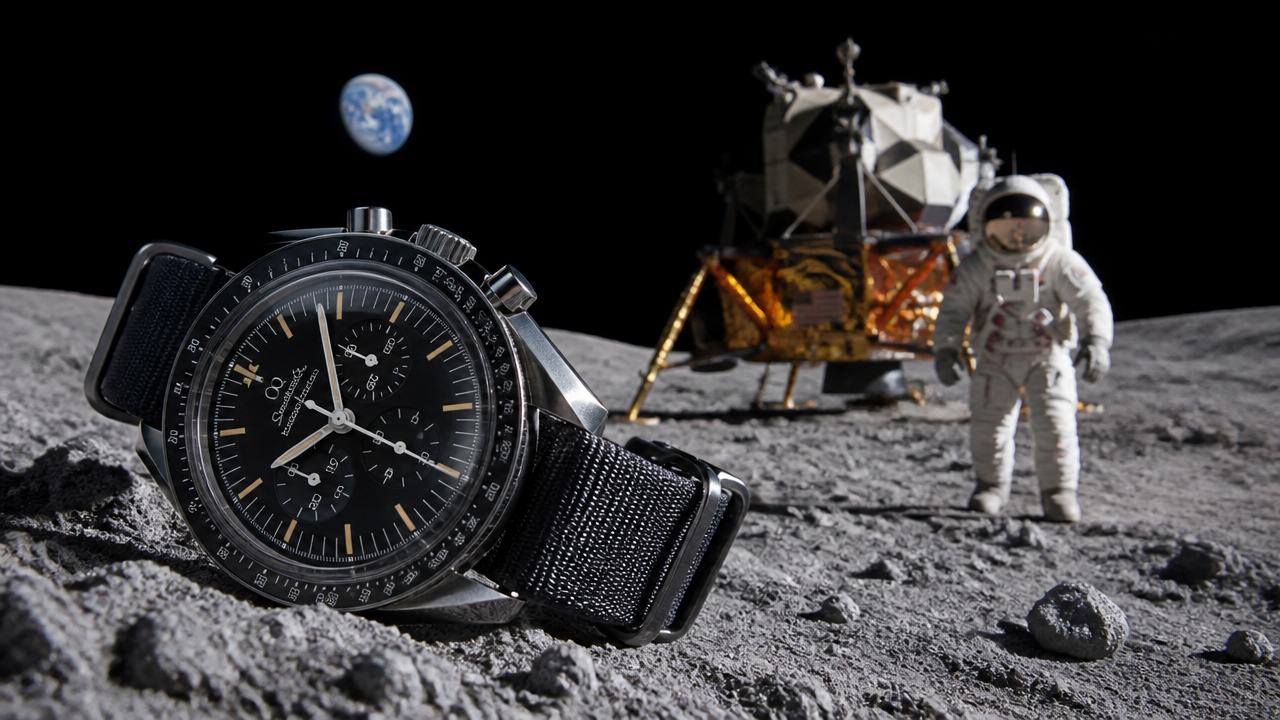
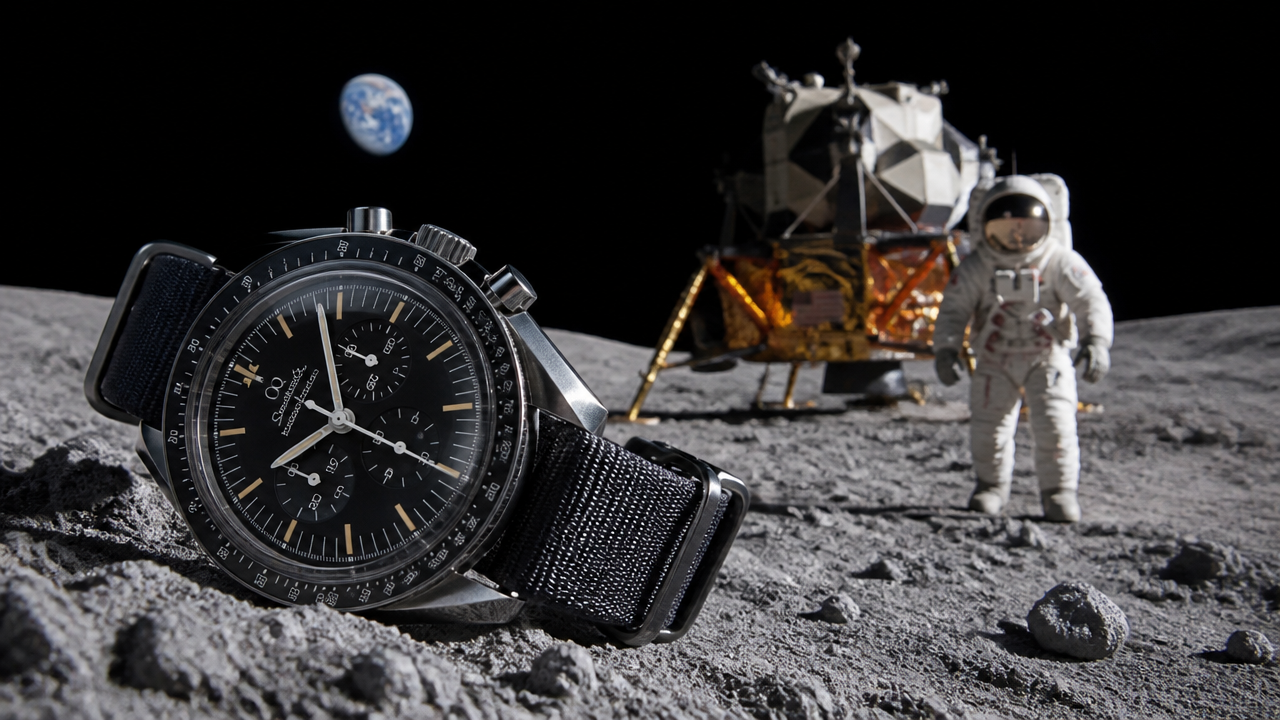
Which timepiece graced the wrist of every Apollo 11 astronaut in 1969? You might assume a digital device or a simple tool, but the answer involves a precision chronograph built for harsh environments. Summer heat or lunar night brings extremes, yet the Omega Speedmaster endured it all. Whether planning a backyard space race or watching the anniversary, accuracy matters. The Omega Speedmaster defined that era. I’ll show you why this watch holds the title of first lunar timekeeper alongside its legendary history.
Two details often get left out of this story: the watch’s Hesalite crystal and its hand-wound Caliber 321 movement. The Hesalite (acrylic) crystal was chosen specifically because it cracks instead of shattering, so a broken watch face inside a pressurized cabin wouldn’t scatter sharp glass shards in microgravity. The manually-wound Caliber 321 movement mattered just as much, since it never depended on a battery that could fail unpredictably in space.
Quick Questions and Answers
Question: Why did NASA choose the Omega Speedmaster for space missions? Answer: NASA chose the Omega Speedmaster because it was water-resistant, shock-proof, and could withstand 12 Gs of acceleration. In 1965, NASA officially certified it as the only chronograph for all manned space missions and Extravehicular Activity, making it an essential part of every astronaut’s kit.
Question: What exact Omega models did Apollo 11 astronauts wear? Answer: The Apollo 11 astronauts wore the Omega Speedmaster Professional models ST 105.012 and ST 145.012. These specific 1967 “pre-Moon” versions were issued by NASA as standard flight equipment for the commander, command module pilot, and lunar module pilot.
Question: Did Neil Armstrong wear his watch on the moon surface? Answer: No, Neil Armstrong left his Speedmaster inside the lunar module “Eagle” to serve as a backup timer after the module’s electronic timer malfunctioned. Buzz Aldrin instead wore his watch, making it the first watch actually worn on the lunar surface.
Key Takeaways
- All three astronauts carried Omega Speedmasters, but history notes Aldrin’s as the first worn on the Moon.
- The watch survived rigorous testing in 1965 before official approval.
- The nickname “Moonwatch” stuck permanently after July 1969.
- Armstrong’s watch acted as a backup timer inside the lander.
- Collins wore his during the orbit phase in the command module.
- The Hesalite crystal and hand-wound Caliber 321 movement were key to why the watch survived spaceflight.
Apollo 11 Moonwatch: Identification and Historical Significance
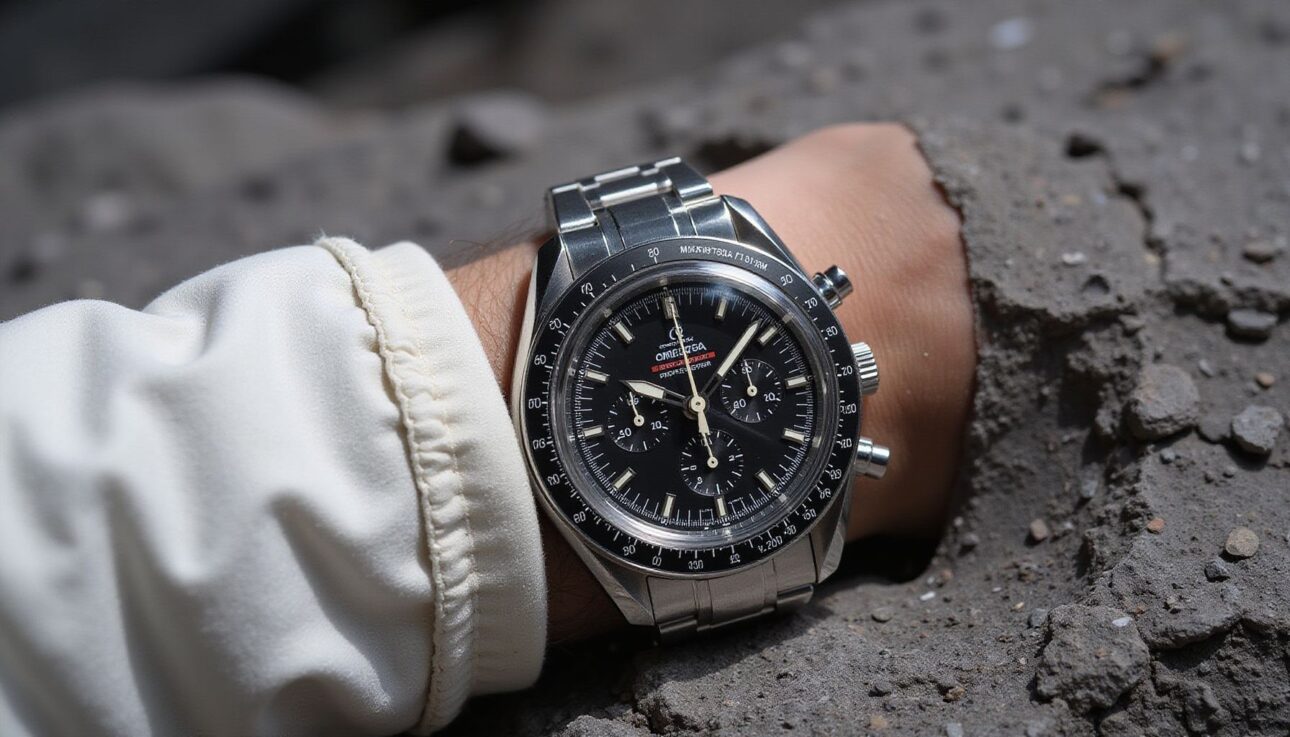
The Omega Speedmaster Professional holds the title of the first wristwatch worn on the Moon during the Apollo 11 mission on July 20, 1969. Buzz Aldrin is documented as the astronaut who wore the chronograph externally on his spacesuit while walking on the lunar surface. This event transformed a standard commercial timepiece into a historic artifact. The watch did not just tell time; it recorded the moment humanity touched another celestial body. The Speedmaster’s black dial and tachymeter bezel became instantly recognizable to the world.
A detail often missing from retellings of this moment: the watch worn on the surface still used its original acrylic Hesalite crystal, not sapphire. That acrylic face was tough enough to survive the temperature swings and handling of a moonwalk without cracking apart, which is part of why Omega and NASA stuck with it on every flight-qualified model for years afterward.
The Selection Process: NASA Testing and Qualification
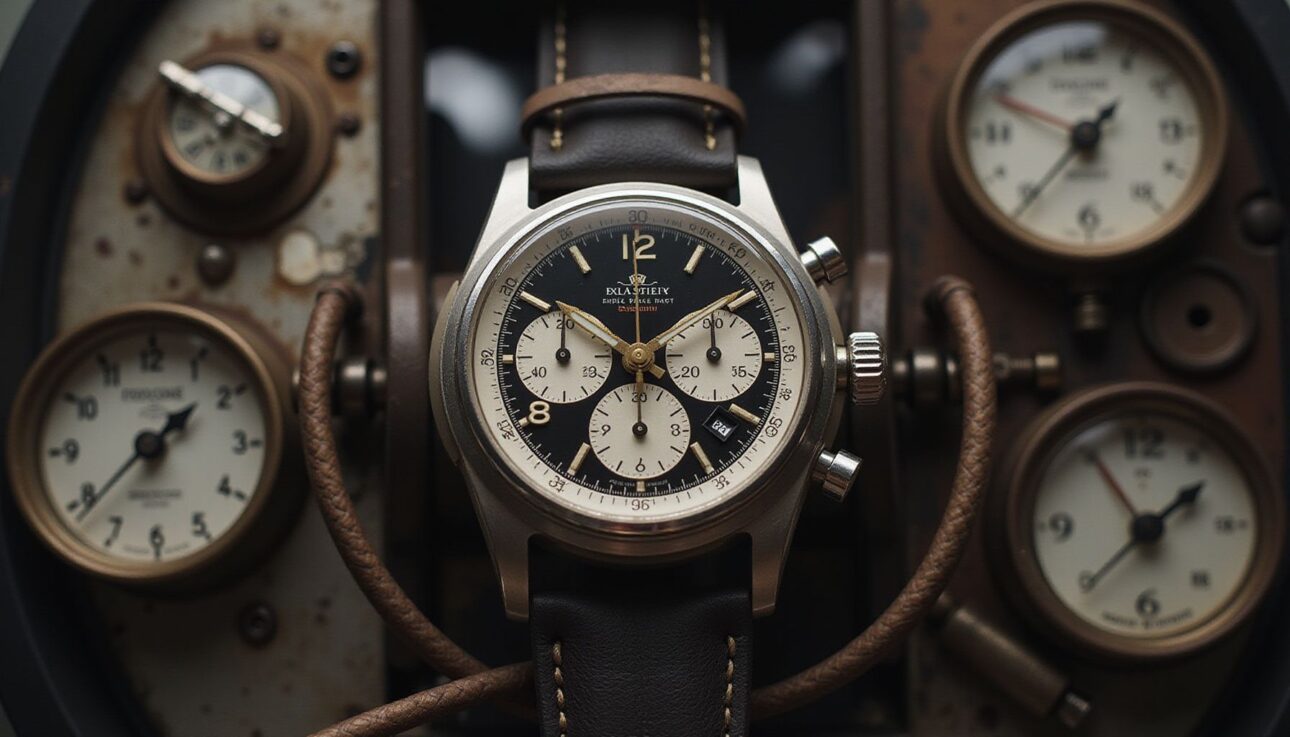
Before the Apollo missions, the Speedmaster underwent brutal environmental testing in 1965 to qualify as official flight equipment for NASA. Engineers subjected the watch to extreme temperatures, vibration, and high speeds to ensure reliability. The competition included Rolex, Longines, and Hamilton, but the Speedmaster won due to its mechanical design and manual-winding capability. Omega Chronicle confirms the rigorous evaluation process that led to the official green light.
Testing included exposure to pure oxygen environments to check for fire hazards. The watch also had to function in zero-pressure conditions. Mechanical movements were preferred over battery-powered electronics because electronics could fail unpredictably. This mechanical reliability made the Speedmaster a safe choice for critical missions where a backup battery could not be trusted.
NASA formally flight-qualified the Speedmaster on March 1, 1965, after it passed all eleven of NASA’s “task qualification” tests, including hot and cold extremes, vacuum, high pressure, shock, acceleration, and vibration. The version that passed used the manually-wound Caliber 321 movement and an acrylic Hesalite crystal, chosen because it could crack under stress without shattering into sharp fragments, a critical safety factor inside a pressurized cabin or a depressurized spacesuit.
How the Speedmaster Became the Moonwatch
The moniker ‘Moonwatch’ originated shortly after the mission, representing one of the first widely recognized nicknames for a specific timepiece in history. Following the lunar landing, Omega capitalized on the association, cementing the watch’s status as a symbol of space exploration excellence. It may be considered one of the first nicknames a wristwatch ever received, as noted by Fratellowatches.
This name change was not just marketing. The watch became a cultural icon. People began associating the design with achievement and exploration. The brand continued production models that retained the core design elements from 1969. Fans of the watch often refer to the “Moonwatch” version specifically to honor this lineage. The name distinguishes the chronograph from other Omega models.
Astronaut Roles and Usage During the Mission
While Buzz Aldrin’s watch has a confirmed presence on the lunar surface, Neil Armstrong’s watch was also verified as part of the mission equipment. Michael Collins, remaining in the command module during the landing, also carried an Omega chronograph as part of the standard kit supplied to the crew. Each piece of timing equipment was essential for mission control coordination.
Astronauts carried the watches inside their suit pockets or on the outside for easy reading in the harsh environment. The watches were strapped onto the arms using Velcro. This method prevented loose items from floating away in microgravity. The team needed precise timing for fuel calculations and landing sequences. The Omega Speedmaster served everyone equally in the hierarchy of gear.
This reliability extended beyond Apollo 11. The watch remained on subsequent missions, including Apollo 13, where it helped time a critical maneuver after the explosion. Its role in rescuing the crew further cemented its reputation.
Evolution of the Moonwatch Legacy
The design of the Speedmaster Professional has remained remarkably consistent since its 1957 inception, continuing to be produced as a manual-wound timepiece today. Anniversary editions, such as the 50th-anniversary launch in 2019, continue to celebrate the watch’s role in the successful 1969 lunar landing. Some modern iterations include subtle updates, but the core mechanical movement stays true to the original.
| Model Variant | Movement Type | Case Material | Best For |
|---|---|---|---|
| Speedmaster Professional Moonwatch | Manual Winding | Stainless Steel | Enthusiasts and collectors |
| Apollo 11 50th Anniversary Co-Axial | Automatic | Stainless Steel | Modern daily wear |
| Speedmaster Dark Side of the Moon | Automatic | Ceramic | Night sky appreciation |
| Gold Limited Editions | Manual Winding | 18k Gold | Investment pieces |
| Original 1967 Flight Models | Manual Winding | Stainless Steel | Historical verification |
The watch often appears in film depictions of space travel. It looks authentic on screen, which reinforces the public’s image of space exploration. You can sometimes find links to other pop culture topics nearby, such as cinematic works. For example, just as space films influence the public view of NASA, a film blog might discuss Is Christopher Nolan Directing an Odyssey Movie?. These connections show how space culture permeates media.
Frequently Asked Questions
Q: Are there special gold Omega watches for Apollo 11?
Yes, Omega created a limited 18-karat gold commemorative Speedmaster, reference BA145.022-69, in 1969 to celebrate the mission. Only 1,014 pieces were made, with numbers 3 to 28 presented to active NASA astronauts at a Houston banquet. These pieces hold significant value for collectors due to their direct link to the program.
Q: How did the Omega Speedmaster get the name Moonwatch?
The Speedmaster became known as the “Moonwatch” because it was the first watch worn on the Moon during the Apollo 11 landing in July 1969. After this historic event, the model was forever associated with lunar exploration and human spaceflight history. The name stuck and remains the standard term for the model today.
Q: Which astronauts were equipped with Speedmasters on Apollo 11?
All three Apollo 11 astronauts were officially equipped with Omega Speedmasters: Commander Neil Armstrong, Command Module Pilot Michael Collins, and Lunar Module Pilot Edwin “Buzz” Aldrin. Each strap was secured to their spacesuit using a Velcro strap for the mission.
Q: Was the Omega Speedmaster the first watch in space?
The Omega Speedmaster was not the first watch in space, but it was the first watch worn by an astronaut walking on the Moon. It had previously been used during NASA’s Gemini 4 mission for the first American spacewalk and continued through early Apollo missions.
Q: What happened to the Apollo 11 watches after the mission?
After each mission, the watches were cleaned and any lunar dust on the surface was returned to NASA. The astronauts’ personal Speedmasters were not kept permanently as part of the mission equipment but were returned to their owners following the cleanup process.
Q: Can you buy a replica of the Apollo 11 Moonwatch today?
Yes, Omega releases special edition Speedmaster Apollo 11 series watches that tribute the 1969 Moon landing. These include limited stainless steel and “Moonshine” gold models that are nearly identical to the original commemorative Speedmaster released in 1969.
Q: Why is Neil Armstrong’s gold Omega watch so valuable?
Neil Armstrong’s gold Omega Speedmaster sold for a record $2.2 million because it was personally presented to him four months after he became the first person on the Moon. As a unique piece of space history issued to the mission commander, it holds immense collector value.
My Experience With What watch were the Apollo 11 astronauts wearing in 1969?
I remember watching the landing footage as a kid, but I didn’t know until recently that a wristwatch played a real role. I once asked a horologist about the mechanics, and he mentioned the manual winding required constant care. That detail alone makes me appreciate the gear even more. I checked my own collection later that week, looking at my modern speedmaster. It shares the same shape, but feels different in the hand. The weight comes from real brass rather than newer alloys.
It’s strange to think that same design helped humans walk on another planet. I still find it amazing when collectors talk about the dust on the dial or the specific bezel. I tried to track down a reference guide online, but found mostly replica claims. I prefer to trust museum archives for truth. Have you ever owned a watch with a space story attached to it? I’d love to hear about your finds.
Conclusion
The Omega Speedmaster Professional remains the definitive timepiece for the Apollo 11 mission. Buzz Aldrin’s watch became famous after landing on the lunar surface on July 20, 1969. This manual-winding chronograph met the strict demands of NASA. It continues to be produced with a similar design today. The mission proved the watch could work in the vacuum of space. The legacy endures in watchmaking history.
Latest Updates or 2026 Trends
Recent discussions among collectors focus on market appreciation for original flight models. AuthenticWrist reports continued interest in vintage variants. The brand released new commemorative editions to mark the 55th anniversary in recent years. Sales figures indicate steady demand regardless of market shifts. Watch enthusiasts continue to value the manual-winding heritage above quartz alternatives.
References
- Omega. (2023). Apollo 11 watch: the first watch on the Moon. Omega. https://www.omegawatches.com/chronicle/1969-the-first-journey-to-the-moon
- Wikipedia. (2024). Omega Speedmaster. Wikimedia Foundation. https://en.wikipedia.org/wiki/Omega_Speedmaster
- Fratellowatches. (2024). From The Archives: How The Omega Speedmaster Became The Moonwatch. Fratellowatches. https://www.fratellowatches.com/from-the-archives-how-the-omega-speedmaster-became-the-moonwatch/
- AuthenticWrist. (2026). Omega Speedmaster Complete Guide 2026 — The Moonwatch and Beyond. AuthenticWrist. https://authenticwrist.com/guides/omega-speedmaster-complete-guide-2026/
- Chronology 24. (2024). Omega Apollo 11. Chrono24. https://www.chrono24.com/omega/apollo-11–imod2736.htm
- WristBuzz. (2026). Hesalite Crystal (Acrylic): The Speedmaster Moonwatch. WristBuzz. https://wristbuzz.com/watch-wiki/hesalite-crystal/

Sarah Anderson . J
I’m the mom behind Wise Mom Blogger, where everyday creativity meets real-life motherhood. I share easy DIY crafts, cozy knitting and crochet projects, beginner-friendly sewing ideas, and family-tested recipes—plus quick baking hacks that make homemade feel doable on busy days.