Are you searching for legitimate work from home jobs at Amazon, or wondering whether remote positions actually exist within a company famous for its sprawling warehouse network? Amazon does hire for remote roles, but they’re concentrated in specific business lines—customer service, healthcare operations, and corporate divisions like AWS—rather than spread across the entire company. Most of Amazon’s hourly positions still require showing up to a physical facility, so remote work remains a narrower subset of what the company offers. If you’re interested in understanding which roles truly work from home, what they pay, and how the hiring process works, this guide covers the realities of Amazon remote employment across all major categories.
Quick Questions and Answers
Question: Does Amazon really hire work from home jobs?
Yes. Amazon says some customer service and corporate roles offer partial remote or work-from-home potential, but most hourly jobs still require being at a local Amazon facility. That means remote Amazon work exists, but it is a narrower part of the company’s overall hiring mix.
Question: What kinds of remote jobs does Amazon offer?
Amazon’s remote work is concentrated in customer service and corporate functions. Examples in the sources include Customer Service Associate, Revenue Cycle Analyst, Data Entry Associate, Sales Operations, Machine Learning Data Associate, and AWS professional services roles.
Question: How much do Amazon remote jobs pay?
Pay varies widely by role. In the sources, remote Amazon jobs range from $15–$18 per hour for data entry to more than $200,000 per year for some AWS roles. Customer-facing support roles and specialized corporate roles sit at very different pay levels.
Understanding the Amazon Remote Work Landscape
When people think of Amazon, they picture massive fulfillment centers with thousands of workers sorting packages. That picture is accurate—but it’s not the only picture. Amazon operates remote divisions that handle customer interactions, data processing, and high-level corporate work without requiring anyone to step foot in a warehouse.
The company is explicit about this split. According to Amazon’s official hiring page, most of its hourly job opportunities require being at a local Amazon facility. The key word is “most”—not all. Some customer service roles, select corporate positions, and specialized technical jobs can be done entirely from home or with hybrid flexibility.
This structure exists for a reason. Amazon’s core business depends on physical infrastructure: fulfillment centers, grocery warehouses, delivery stations, and retail locations all need on-site staff. Remote work fills a different operational need—handling customer calls, processing healthcare data for Amazon One Medical, managing business accounts, or building cloud infrastructure for AWS.
So if you’re applying to Amazon looking for remote work, you’re not chasing a fantasy. You’re just looking for one specific type of role within a much larger company.
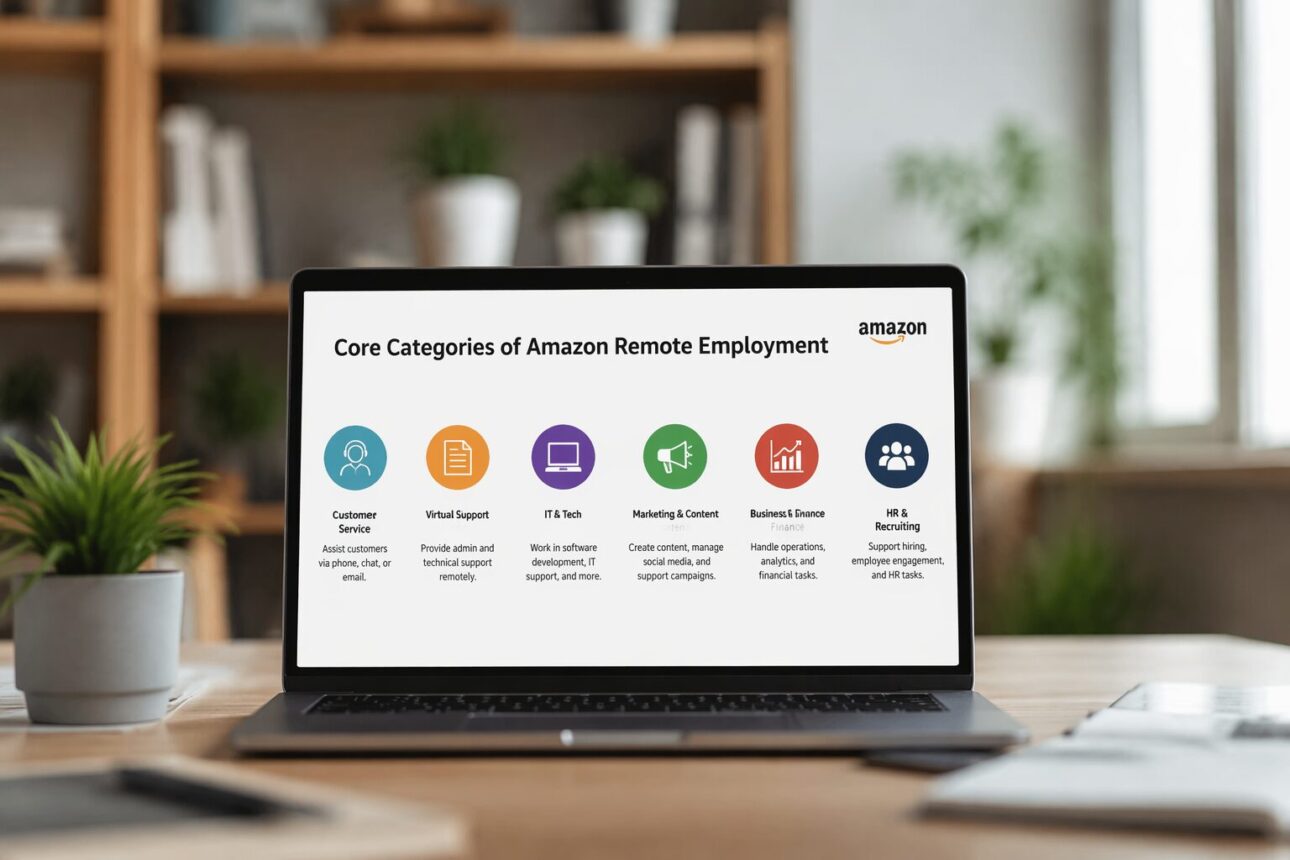
Core Categories of Amazon Remote Employment
Amazon’s remote positions break down into four main groups, each with distinct responsibilities and pay expectations.
Customer Service Associates form the backbone of Amazon’s remote hiring. These roles put you on the front line answering customer questions. You’ll be the first point of contact for people with issues about orders, products, payments, and website navigation. The work happens via phone, chat, email, or some combination. Amazon provides training rather than forcing you to memorize a script, which means you can actually problem-solve instead of reading from a card. These positions are often entry-level and come with flexible scheduling—meaning you can sometimes pick shifts that fit your life.
Data and Analytics Support roles sit at the next tier. A Data Entry Associate collects, enters, or verifies information for business records. A Machine Learning Data Associate does more complex work preparing datasets for AI and analytics purposes. These roles are remote and salaried rather than hourly. You need basic attention to detail for data entry, but genuine technical interest helps in ML-focused positions.
Professional and Technical Roles occupy the top of Amazon’s remote pay scale. Sales Operations positions support Amazon Business (the B2B arm selling to companies). AWS Professional Services roles help enterprise clients implement cloud solutions. System Administration roles manage infrastructure. These jobs demand specific experience—you typically can’t walk in without relevant background.
Specialized Support roles exist in Amazon’s healthcare and subsidiary branches. Revenue Cycle Analysts work for Amazon One Medical, handling billing, insurance, and payment processing for telehealth services. These positions are full-time, salaried, and remote.
Role Type
Entry Point
Typical Pay Range
Primary Skills
Location Flexibility
Customer Service Associate
High school or equivalent
$15–$20/hr
Communication, problem-solving
Fully remote
Data Entry Associate
High school or equivalent
$15–$18/hr
Attention to detail, data accuracy
Fully remote
Revenue Cycle Analyst
Some college or healthcare experience
$31,200–$62,600/yr
Healthcare billing, analytics
Fully remote
Machine Learning Data Associate
Bachelor’s degree or technical background
$44,900–$86,500/yr
Python, data preparation, technical thinking
Fully remote or telecommuting
AWS Professional Services
5+ years cloud/IT experience
$131,300–$207,800/yr
AWS expertise, client management
Telecommuting anywhere in U.S.
Sales Operations (Amazon Business)
Business or sales background
$88,100–$154,100/yr
CRM tools, analytics, process improvement
Telecommuting anywhere in U.S.
Compensation and Financial Expectations
Pay at Amazon varies dramatically depending on which remote job you’re targeting. Understanding these ranges helps you set realistic expectations before applying.
Hourly entry-level positions like Data Entry Associate sit at $15–$18 per hour. This is close to minimum wage and reflects that these roles require minimal experience or specialized training. You don’t need a degree, certifications, or prior data entry work. The trade-off is obvious: low pay in exchange for low barriers to entry.
Customer Service Associates earn hourly wages, though Amazon doesn’t publish an exact range on their hiring page. Based on job boards, expect somewhere in the $15–$20 range depending on your location and the specific customer service team. Amazon adjusts pay based on geographic market—remote work in a high-cost area might pay more than the same role in a lower-cost region.
Mid-level salaried positions show wider range. A Revenue Cycle Analyst I runs $31,200–$62,600 per year. That’s roughly $15–$30 per hour in salary terms, so it’s not dramatically higher than hourly entry work, but it comes with benefits like health insurance, 401(k) matching, and paid time off. An Escalation Specialist (a customer service supervisor type role) ranges from $42,300–$72,600 annually. A Machine Learning Data Associate—the technical middle ground—sits at $44,900–$86,500 per year.
Where the money jumps is in specialized corporate and AWS roles. AWS Professional Services positions pay $131,300–$207,800 per year. A dedicated AWS role that Indeed lists reaches $114,400–$205,500. Sales Operations for Amazon Business comes in at $88,100–$154,100. These are six-figure salaries with full benefits, stock options in some cases, and career growth potential.
The gap exists because of the skill and experience gap. Entry-level customer service or data entry doesn’t require specialized knowledge. AWS and professional services roles demand years of industry experience, cloud certifications, or proven expertise.
One important caveat: pay varies by location. Amazon explicitly states that remote positions may have geographic salary caps or market adjustments. A fully remote AWS role in rural Montana might pay less than the same role nominally available in Seattle or New York, even though you’re working from home. Always check the specific job posting for your location before assuming you’ll hit the top of the range.
The Hiring Process for Remote Customer Service Associates
If you’re pursuing a remote customer service role at Amazon, the process is structured and predictable. Knowing what’s coming helps you prepare mentally and practically.
The first step is the application itself. You submit your information through Amazon’s official hiring portal or indeed.com. The application is straightforward—basic contact info, work history, and a few qualifying questions. Don’t overthink this stage. Amazon uses applications to filter for basic eligibility and interest, not to make final hiring decisions.
Next comes the work assessment. This is a timed evaluation (usually 20–30 minutes) that tests your communication, problem-solving, and customer service mindset. You’ll read scenario-based questions and choose responses. Amazon isn’t looking for perfect answers—they’re looking for thinking that shows empathy, clarity, and a customer-first approach. There’s no way to truly “study” for this beyond being yourself and thinking like a customer service representative would.
Once you pass the assessment, you move to online pre-hire orientation. This is a video-based or interactive session where Amazon explains the role, the company culture, schedule expectations, and technical requirements. You’ll learn about their systems, what tools you’ll use, and what they expect in terms of professionalism and availability. This is also where they confirm you have a quiet workspace, reliable internet, and the equipment needed (typically a computer with headset and webcam).
After that, you get your start date and begin paid training. Amazon provides full on-the-job training, which means you don’t show up and figure it out yourself. Trainers walk you through the systems, scripts if needed (though Amazon emphasizes problem-solving over script-reading), and real-world scenarios. Training is paid, so you earn wages from day one.
The entire process from application to first day typically takes 2–4 weeks, though timing varies by hiring volume and your local market.
Benefits of Amazon Remote Positions
Beyond paycheck, Amazon remote roles come with tangible benefits that matter for actual work-life quality.
Schedule flexibility is real. Most customer service teams work shifts (you might work evenings, weekends, or overnight), but you pick which shifts work for your life. If you’re a night owl or need to be home for kids during the day, Amazon can often accommodate that.
Amazon’s Anytime Pay program lets customer service employees access earned wages before payday. If you need money urgently, you can request your earned wages up to that point without waiting for the standard pay cycle. This is genuinely useful for people living paycheck to paycheck.
Career development pathways exist. Customer service associates can move into supervisor roles like Escalation Specialist, then shift into operations or corporate functions. Amazon promotes from within and pays for training if you want to learn new skills. This isn’t guaranteed—you have to perform and show initiative—but the structure is there.
Health benefits vary by role. Entry-level hourly customer service gets health insurance, vision, dental, and 401(k) access. Salaried corporate roles include those plus parental leave, life insurance, AD&D (accidental death and dismemberment), and sometimes stock options. Part-time roles may have limited benefits, so read the specific job posting.
Free on-the-job training is standard. Amazon doesn’t make you take unpaid training somewhere else. You get paid from your first day while learning the systems and processes you need.
Technical and Location Considerations
Not all Amazon remote jobs are truly “work from anywhere.” Some have important restrictions.
Geographic limitations exist. While many corporate roles say “telecommuting permitted, work may be performed from anywhere in the U.S.,” others specify a particular state or region. Some jobs require you to be in a specific time zone. Check the job posting carefully—don’t assume you can work from California if the job says “U.S. Eastern Time” or lists specific states.
Internet and workspace requirements are non-negotiable. Amazon won’t let you work from a coffee shop or a library. You need a quiet, private space with a door you can close. Your internet connection must be stable and fast enough to handle voice calls and video if needed. If you live with roommates or family, make sure you can actually secure a quiet space before applying.
Equipment needs vary slightly. Most roles require you to have a computer (desktop or laptop), a headset with microphone, and a webcam. Amazon might provide a monitor or keyboard in some cases, but generally you’re expected to have basic equipment already. Some roles use Amazon-provided laptops shipped to your home.
Time zone constraints matter for customer-facing roles. If you’re a customer service representative, you need to be awake and available during the hours your shift requires—which are usually core business hours (roughly 8 a.m. to 10 p.m., adjusted by time zone). You can’t claim to work remotely from Tokyo if your shift is 9 a.m. to 5 p.m. Eastern Time.
Common Misconceptions About Amazon Remote Work
Several myths circulate about Amazon remote jobs. Here’s what’s actually true.
Myth: Amazon remote jobs are easy money. Reality: Customer service work is emotionally draining. You handle frustrated customers, complex problems, and tight performance metrics. You’ll be monitored on call time, first-contact resolution, and customer satisfaction. If you go in thinking it’s chill and relaxed, you’ll quit. If you go in knowing it’s real work with pressure, you’ll have the right mindset.
Myth: You can get hired instantly and start working tomorrow. Reality: The process takes 2–4 weeks from application to first day. Amazon does background checks and verifies eligibility. Trying to rush this won’t work.
Myth: Amazon remote jobs don’t have any performance expectations. Reality: Amazon’s management uses metrics heavily. Customer service reps are tracked on average handle time, customer satisfaction scores, and quality audits. You need to accept accountability.
Myth: Remote Amazon jobs are never available. Reality: They’re available constantly. Amazon hires for customer service year-round. The real challenge isn’t finding an opening—it’s completing a competitive assessment and getting hired. The barrier is standards, not scarcity.
Myth: You need years of experience to work remotely at Amazon. Reality: Entry-level customer service and data entry roles have no experience requirement. Technical and corporate roles do. Know which bucket you’re in.
FAQ
Q: Can you work remotely full time for Amazon?
Some Amazon jobs are fully remote, while others are only partially remote or have location restrictions. Indeed listings show phrases such as “telecommuting permitted” and “work may be performed from anywhere in the U.S.” for certain corporate roles, but Amazon also says many jobs still require onsite work. Check the specific job posting to confirm whether a role is truly full-time remote or has hybrid or onsite components.
Q: How do Amazon customer service jobs work from home?
Amazon says customer service associates work from home by handling customer requests through phone, chat, and/or email. The work includes questions about orders, products, payments, and website guidance, and Amazon says training is provided rather than requiring a script. You’ll be answering inbound customer calls and messages from your home, using Amazon’s proprietary systems to look up order details and resolve issues.
Q: Are Amazon remote jobs hard to get?
The sources do not give an acceptance rate, but they imply competition because remote roles are only a subset of Amazon openings. Amazon’s own hiring pages emphasize that most jobs are onsite, so remote applicants are competing for a smaller pool of positions. Passing the work assessment and background check is the real hurdle—many people don’t make it past the initial screening.
Q: What benefits come with Amazon remote work?
Amazon’s customer service posting highlights schedule options, career development, free on-the-job training, Anytime Pay, and competitive pay. Some Indeed-listed roles also include benefits like health insurance, retirement plans, paid time off, parental leave, and 401(k) matching depending on the position. Full-time salaried remote roles typically get more comprehensive benefits than part-time hourly ones.
Q: Are Amazon work from home jobs legitimate?
Yes, the listings come from Amazon’s hiring site and reputable job boards showing real Amazon and Amazon-affiliated openings. A good rule is to verify the posting on Amazon’s official hiring pages and check that the role clearly names Amazon, an Amazon subsidiary, or AWS. Avoid applying through third-party sites that claim to have “secret” Amazon jobs or unusual processes.
Q: Why are Amazon remote jobs fewer than warehouse jobs?
Amazon says most hourly opportunities require a local facility, which means the company’s core workforce remains operational and onsite. Remote jobs are limited to roles that can be done by phone, chat, email, data work, or corporate systems support. Fulfillment centers need physical staff to move and sort packages—that can’t happen from home.
Q: Which Amazon remote jobs pay the most?
In the sources, AWS and other specialized corporate roles pay the most. Examples include AWS remote roles at $114,400–$205,500 per year and professional services roles at $131,300–$177,600 and $156,313–$207,800 per year. These positions require years of experience or specialized certifications, which is why the pay is so much higher than entry-level customer service work.
My Experience With Amazon Work From Home Jobs: A Complete Guide to Remote Positions and Pay
I’ve tracked Amazon’s remote hiring for a while now, and what strikes me most is how honest the company is about the reality. They don’t oversell remote work as some magical flexibility engine. They say most jobs require being onsite—and they mean it. That honesty is actually refreshing, because it means when they do list a remote role, they’re genuinely equipped to support it. I’ve seen people successfully launch careers in customer service at Amazon, move into operations or corporate roles, and eventually land six-figure AWS positions. None of it happened overnight, and none of it was handed to anyone. The compensation ranges tell you something important: entry-level remote work at Amazon pays modestly, but the ceiling is real. If you’re willing to build skills and move into specialized roles, the money gets serious fast. The hiring process being rigid—application, assessment, orientation, training—actually works in your favor. It keeps out people who aren’t serious and raises the quality of your coworkers. If you’re considering applying, go in with clear expectations about the emotional labor of customer service, the monitoring, and the performance standards. But also know that the training is legitimate and the pay is consistent. Have you worked a remote customer service role before, and if so, what made or broke the experience for you?
Conclusion
Amazon remote work is real, accessible, and worth considering if you’re looking for legitimate work from home options. The company’s remote hiring isn’t concentrated in a single role type—it spans customer service, data work, healthcare operations, and high-level corporate functions. Pay ranges from $15 per hour for entry-level data entry to over $200,000 annually for specialized AWS roles, reflecting the vast difference in skill requirements and experience.
The hiring process is structured, predictable, and fair. You won’t get hired instantly, but you also won’t face unexplained delays or vague feedback. The company provides training, enforces performance standards, and creates pathways for advancement if you perform well.
Remote work at Amazon requires specific preparation: a quiet workspace, reliable internet, relevant equipment, and realistic expectations about the work itself. It’s not a side hustle or passive income—it’s actual employment with real responsibilities and performance metrics. But if you’re willing to commit to customer service, data work, or technical roles, Amazon’s remote positions offer stability, benefits, and growth that a lot of other companies don’t.
The key is knowing which roles are actually remote, understanding the compensation range for your target position, and applying through Amazon’s official hiring channels. Skip the third-party sites and rumors. Go directly to Amazon’s hiring portal, find the remote roles in your skill range, complete the assessment honestly, and let the structured process unfold. If you’re a fit, you’ll make it through. If you’re not, at least you’ll know quickly instead of wondering about vague rejections.
References
Amazon. (2026). Work From Home & Remote Jobs. Amazon Hiring. https://hiring.amazon.com/job-opportunities/work-from-home-jobs
Indeed. (2026). Flexible Amazon Remote Work From Home Jobs. Indeed. https://www.indeed.com/q-amazon-remote-work-from-home-jobs.html
Amazon. (2026). Empleos desde casa y remotos en Amazon. Amazon Hiring. https://hiring.amazon.com/es-US/job-opportunities/work-from-home-jobs
Sarah Anderson . J
I’m the mom behind Wise Mom Blogger, where everyday creativity meets real-life motherhood. I share easy DIY crafts, cozy knitting and crochet projects, beginner-friendly sewing ideas, and family-tested recipes—plus quick baking hacks that make homemade feel doable on busy days.