Quick answer: As of July 2026, the U.S. State Department lists 23 countries at Level 4 “Do Not Travel,” its highest warning. These include Afghanistan, Belarus, Burkina Faso, Myanmar, the Central African Republic, Chad, the Democratic Republic of the Congo, Haiti, Iran, Iraq, Lebanon, Libya, Mali, Niger, North Korea, Russia, Somalia, South Sudan, Sudan, Syria, Uganda, Ukraine, and Yemen. Several Gulf states, including Saudi Arabia and the UAE, sit one step down at Level 3 “Reconsider Travel.”
If you’re planning a trip and you want to know which places are risky right now, you’re in the right spot. The U.S. government keeps a running list of countries that are too dangerous for Americans to visit. This list changes as wars start, crime spikes, or governments crack down on foreigners. Below, you’ll find the full current list, what it means, and how to check any destination before you book a flight.
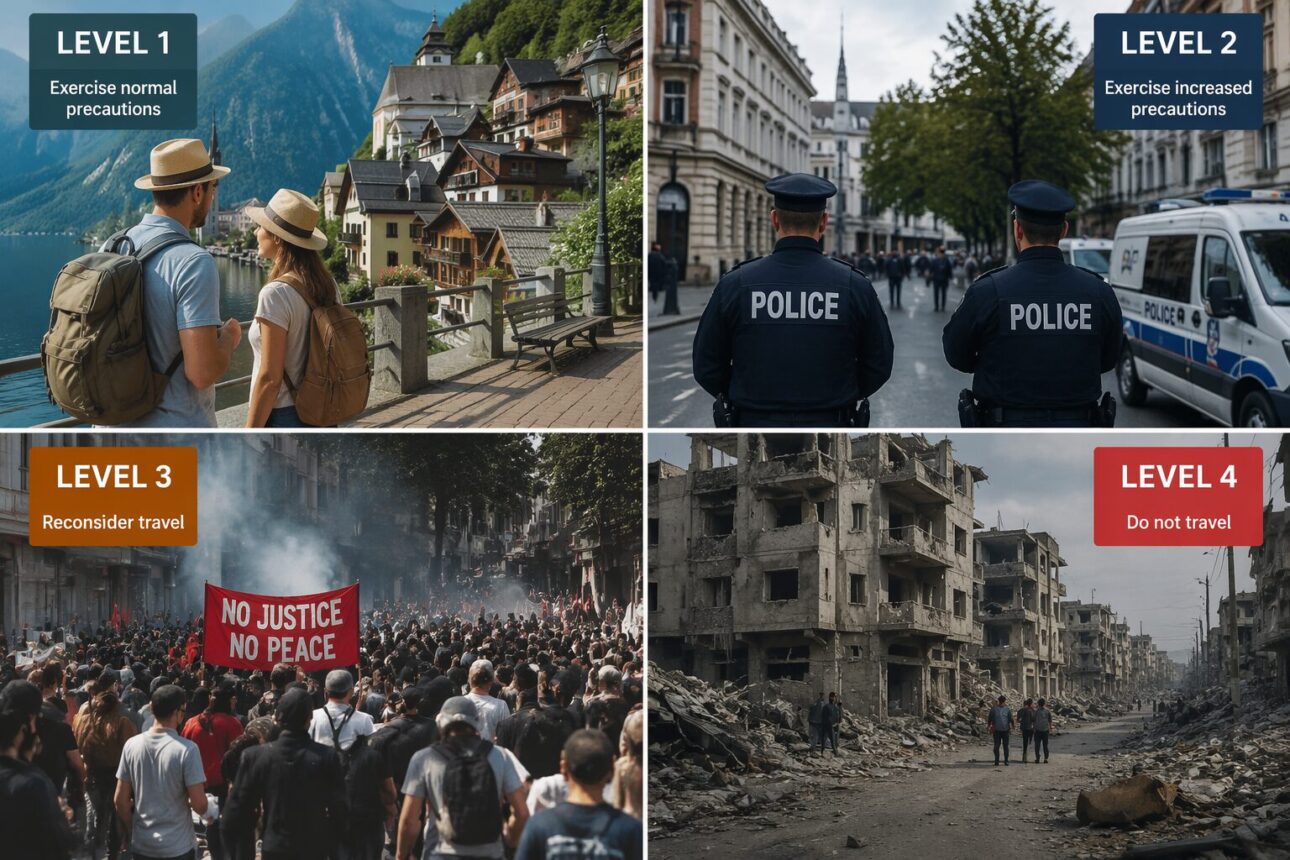
Advisory Level
Meaning
Status Badge
Level 1
Exercise normal precautions
Standard
Level 2
Exercise increased caution
Varies
Level 3
Reconsider travel
Varies
Level 4
Do not travel
Caution
Countries by advisory level (approximate global count, mid-2026)
Level 1
83
Level 2
82
Level 3
27
Level 4
23
Counts based on Mappr’s live tracking of State Department advisory data, July 2026. Numbers shift often as advisories are reviewed.
Which countries are on the Do Not Travel list right now?
As of mid-July 2026, 23 countries hold a Level 4 “Do Not Travel” advisory. These are Afghanistan, Belarus, Burkina Faso, Myanmar (Burma), the Central African Republic, Chad, the Democratic Republic of the Congo, Haiti, Iran, Iraq, Lebanon, Libya, Mali, Niger, North Korea, Russia, Somalia, South Sudan, Sudan, Syria, Uganda, Ukraine, and Yemen. Each one made the list for its own reasons, ranging from active war to gang violence to a total lack of U.S. consular support.
Some patterns show up again and again. War and its side effects explain the presence of Ukraine, Russia, and Belarus. Conflict and terrorism drive the Middle East cluster of Iran, Iraq, Syria, Lebanon, and Yemen. A belt of instability across the Sahel and Horn of Africa accounts for Mali, Niger, Burkina Faso, Chad, the Central African Republic, Sudan, South Sudan, Somalia, and Uganda, plus the Democratic Republic of the Congo. Haiti stands alone as a case driven almost entirely by gang violence rather than war.
Knowing this list matters because Level 4 is not a suggestion. It is the State Department’s way of saying it may not be able to help you if something goes wrong in that country. Per Newsweek’s July 2026 reporting on TravelGov guidance, the department describes these places bluntly: dangerous, with no good reason to visit.
Full Level 4 “Do Not Travel” List (July 2026)
Country
Main Risk
Status
Afghanistan
Terrorism, kidnapping, civil unrest
Level 4
Belarus
Arbitrary detention, support for Russia’s war
Level 4
Burkina Faso
Terrorism, armed insurgency
Level 4
Myanmar (Burma)
Armed conflict, civil unrest
Level 4
Central African Republic
Armed groups, kidnapping
Level 4
Chad
Crime, terrorism, landmines
Level 4
Democratic Republic of the Congo
Armed conflict, kidnapping, Ebola risk
Level 4
Haiti
Gang violence, kidnapping
Level 4
Iran
Wrongful detention, terrorism
Level 4
Iraq
Terrorism, regional instability
Level 4
Lebanon
Armed conflict, terrorism, kidnapping
Level 4
Libya
Armed militias, crime
Level 4
Mali
Terrorism, kidnapping
Level 4
Niger
Terrorism, kidnapping
Level 4
North Korea
Arrest and long-term detention risk
Level 4
Russia
Wrongful detention, war-related risk
Level 4
Somalia
Terrorism, kidnapping, piracy
Level 4
South Sudan
Armed conflict, crime
Level 4
Sudan
Conflict between military factions
Level 4
Syria
Civil war, terrorism, hostage risk
Level 4
Uganda
Terrorism-related security concerns
Level 4
Ukraine
Active combat, missile attacks
Level 4
Yemen
Armed conflict, terrorism, kidnapping
Level 4
Note: Advisory levels change often. Always confirm the current status for your destination on travel.state.gov before booking.
What does a Level 4 advisory actually mean?
A Level 4 advisory means the State Department is telling Americans not to go to that country for any reason. It is the highest of four warning levels, and it sits above Level 3’s “reconsider travel” language.
The reason for this top-tier warning usually comes down to two things working together: real physical danger and the U.S. government’s limited power to step in if you get hurt, arrested, or stuck. That danger can take the shape of open warfare, terrorism, kidnapping, wrongful detention, or violent crime. In some Level 4 countries, like Iran and North Korea, the U.S. does not even have a normal diplomatic presence, so there is almost no one nearby who can help a U.S. citizen in trouble.
For a traveler, this means more than just extra risk. It usually means travel insurance won’t cover you, evacuation may not be possible, and even routine problems like a lost passport can turn into a serious ordeal. Per the State Department’s own advisory page, Level 4 destinations are reviewed at least every six months, so the list is a living document, not a fixed one.
How is the advisory list different from a travel ban?
A Do Not Travel advisory is a strong warning, not a legal ban, except in one case: North Korea. That is the only country U.S. law actually forbids Americans from entering without special permission.
For every other Level 4 country, you technically can still buy a ticket and go. The advisory is guidance, not a lock on your passport. North Korea works differently because of a law passed after the death of American student Otto Warmbier in 2017. U.S. passports are not valid for travel there unless the State Department grants a special validation, usually reserved for journalists or humanitarian workers.
This distinction matters for trip planning. If you’re weighing a trip to, say, Lebanon or Iraq, the choice is legally yours, even though it’s a risky one. If North Korea is on your list for any reason, you’ll need a specific government exception first, and even then, travel is tightly restricted.
Are any popular tourist spots newly at risk in 2026?
Yes. The biggest shift in 2026 is across the Gulf, where several well-known destinations dropped from safe zones to Level 3 “Reconsider Travel” after a wave of U.S.-Iran tensions early in the year.
Following clashes between U.S. and Iranian forces around the Strait of Hormuz in February 2026, the State Department raised advisories for Bahrain, Kuwait, Oman, Qatar, Saudi Arabia, the United Arab Emirates, and Jordan, all the way up to Level 3. That’s notable because it includes Dubai and Doha, two of the busiest airports on Earth. None of these countries reached Level 4, but the jump from a normal green or blue status to an orange “reconsider” warning caught a lot of travelers off guard.
For anyone with a trip booked through the Gulf this year, this is worth double-checking. A Level 3 label doesn’t mean cancel your trip, but it does mean building in extra flexibility, since regional tensions can shift flight paths and airport operations with little warning.
Is Venezuela on the Do Not Travel list?
No, not officially. Venezuela sits at Level 3, “Reconsider Travel,” on the State Department’s live advisory feed, even though many older articles and roundups still group it with the Level 4 countries.
This mix-up happens a lot with fast-changing advisories. Older news stories get reposted and shared without anyone checking whether the label has since changed. According to Mappr’s country-by-country tracker, which pulls straight from the government’s machine-readable feed, Venezuela’s actual current level is 3, not 4. Crime, political instability, and the risk of wrongful detention are still real concerns there, they’re just classified one tier below the most severe warning.
The takeaway here isn’t “Venezuela is fine.” It’s that even a country widely reported as one of the most dangerous still deserves a fresh check on the official source, since labels shift and old headlines stick around long after the facts change.
What should you do before booking a trip to a risky destination?
Check the destination’s current advisory level directly on travel.state.gov before you do anything else, since that page is updated more often than most news coverage.
Advisory levels aren’t just a number. Each country page also lists specific risk letters, things like C for crime, T for terrorism, K for kidnapping, D for wrongful detention, and H for health risks, so you can see exactly why a place earned its rating instead of guessing. Two countries can share the same Level 3 rating for very different reasons, so reading the specifics matters more than just glancing at the color.
Beyond checking the level, enroll in the Smart Traveler Enrollment Program, known as STEP. It’s free, and it lets the nearest U.S. embassy contact you directly if conditions change while you’re traveling. It’s also worth buying travel insurance that explicitly covers medical evacuation, since many standard policies exclude Level 3 and Level 4 destinations altogether.
Do advisory levels ever go down instead of up?
Yes, advisories move in both directions, and plenty of countries have been downgraded to a lower, safer level as conditions on the ground improved.
The State Department reviews Level 1 and Level 2 advisories about once a year, and it reviews the more serious Level 3 and Level 4 advisories at least every six months, sometimes sooner if something major happens. A country can drop a level after a ceasefire, a change in government, or a drop in crime rates, just as easily as it can climb after a coup or an outbreak of violence.
This is exactly why a screenshot from last year, or even last month, isn’t reliable for trip planning. If a destination matters to you, it’s worth checking again close to your departure date, not just once during the early planning stage.
Frequently Asked Questions
How many countries are on the Do Not Travel list in 2026?
There are 23 countries at Level 4 as of July 2026. This number has moved between 21 and 23 through the year as the State Department reviewed different destinations, so it’s worth a quick recheck before booking.
Can I still legally travel to a Level 4 country?
In almost every case, yes, since the advisory is a warning, not a law. North Korea is the one exception, where U.S. passports need special government validation to be used for entry.
Where can I check the most current advisory for a specific country?
The official source is travel.state.gov, where you can search any country by name and see its current level along with the specific risks behind it. This page updates faster than most news articles or blog roundups.
Does travel insurance cover trips to Do Not Travel countries?
Often not, or only with specific add-on coverage. Many standard travel insurance policies exclude Level 3 and Level 4 destinations, so it’s important to check the fine print or call the provider directly before you buy a policy.
I’m the mom behind Wise Mom Blogger, where everyday creativity meets real-life motherhood. I share easy DIY crafts, cozy knitting and crochet projects, beginner-friendly sewing ideas, and family-tested recipes—plus quick baking hacks that make homemade feel doable on busy days.