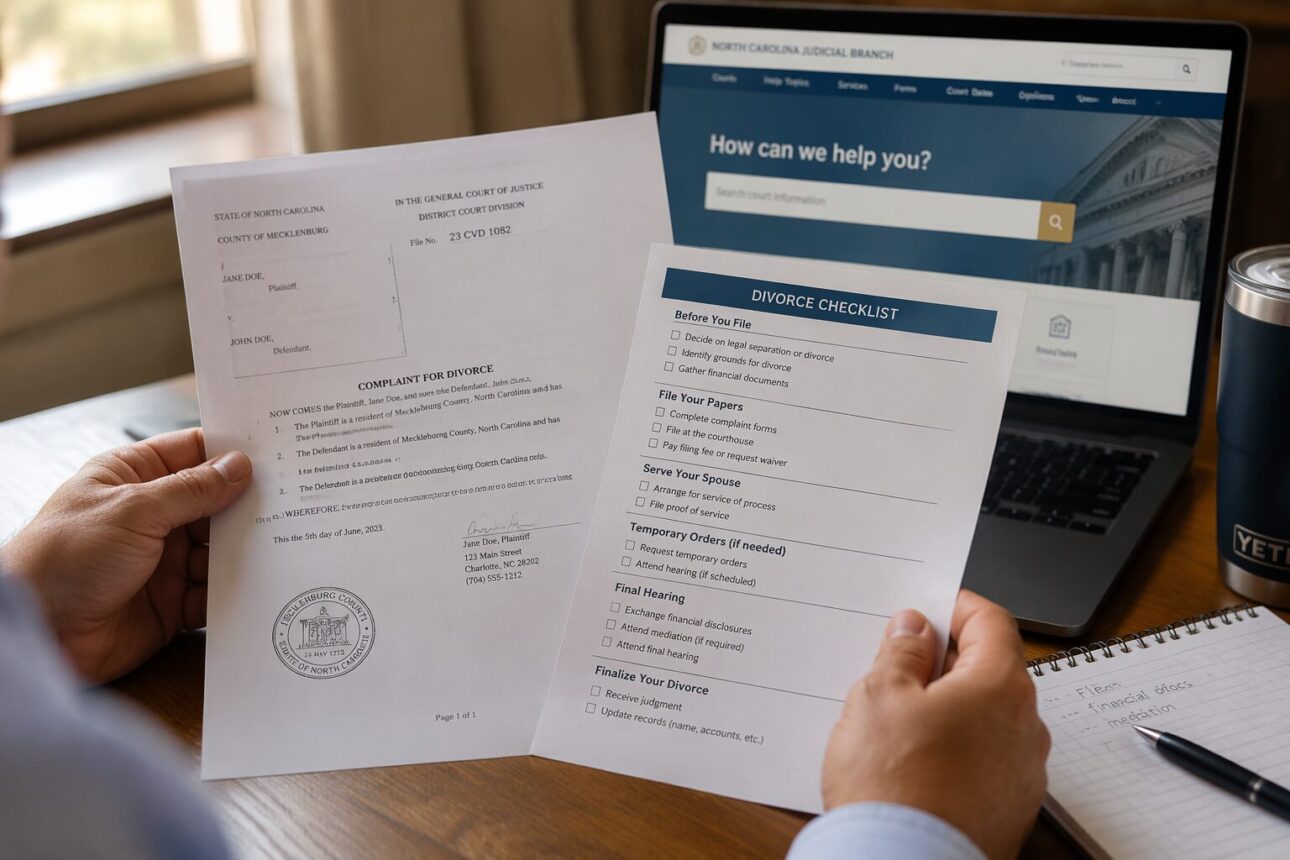
Facing a divorce without savings or income is genuinely scary, but it doesn’t mean you’re locked out of the legal system. A no-money or low-cost divorce relies on fee waivers, free legal resources, and strategic use of court self-help tools rather than expensive attorneys. The process takes longer and demands more paperwork from you, but thousands complete it every year. This guide walks you through every step, from proving financial hardship to finalizing your divorce without draining what little you have.
Quick Questions and Answers
Question: How can I divorce if I have no money at all?
The lowest-cost path combines a fee waiver with self-help divorce forms and, when possible, an uncontested agreement where both spouses agree on major issues. Many courts provide self-help portals with free forms, and legal aid groups or pro bono programs can help with paperwork advice or representation at key stages.
Question: Can you get divorced for free with no lawyer?
In some cases, yes, though “free” typically means no attorney retainer and a waived court filing fee. You may still encounter costs for certified copies of your final decree, notary services, or process service (officially notifying your spouse). Some courts waive or reduce these fees for low-income filers, so always ask the clerk about free options available in your jurisdiction.
Question: What papers do I need for a no-cost divorce?
You’ll need a divorce petition form, financial disclosure documents, and a fee-waiver or indigency application if you cannot afford the filing fee. Many court self-help systems provide all required forms online or through the clerk’s office, and completing them accurately is critical to avoiding delays or rejection.
What You Need
Item
Purpose
Notes
Proof of income (pay stubs, tax returns, or unemployment letters)
Establish eligibility for fee waivers and indigent status
Required for “In Forma Pauperis” applications; missing docs cause delays
Bank statements and debt records
Document your financial hardship and marital debts
Needed for asset/debt division and fee-waiver approval
State or county self-help forms
Complete your divorce petition, financial disclosures, and settlement agreement
Each state and county has specific required forms; using the wrong ones causes rejection
Fee-waiver or “In Forma Pauperis” application
Eliminate or reduce court filing fees
Apply simultaneously with your petition; courts review both together
Proof of service (certified mail receipt or process server documentation)
Show the court that your spouse was legally notified
Required to proceed; failure to serve correctly halts the case
Contact information for local legal aid or pro bono programs
Access free or low-cost legal guidance
LSC, bar associations, law school clinics, and 211.org are starting points
Access to your state’s judicial branch self-help website is essential. Every state maintains a “Self-Help” or “Family Law Self-Help Center” section on its court website where you can download mandatory forms specific to your county. You’ll also want contact information for the Legal Services Corporation, which directs you to local legal aid offices, and resources like 211.org or Probono.net to find volunteer attorney programs.
Open a separate bank account in your name if at all possible. Even if you share marital funds, having your own account gives you access to essentials like housing, groceries, or childcare while you navigate the process. Document every withdrawal and its purpose—this protects you legally and shows the court you’re managing resources responsibly.
Step 1: Determine Your Eligibility for a Simple Divorce
Not all divorces qualify for the cheapest route. A “simple divorce” or “summary dissolution” is available in many states only when both spouses meet specific criteria: no minor children, no ongoing spousal or child support claims, minimal or no marital assets to divide, and—critically—mutual agreement on all major issues.
Check your state’s judicial website to see if this option exists in your jurisdiction. Some states call it a “summary dissolution,” others use different names, but the principle is the same: fewer disputes mean fewer court hearings and less paperwork overall. If you and your spouse cannot agree on asset division or custody, you’ll need the full divorce process, which takes longer but is still achievable on a tight budget.
Visit your county clerk’s office or website and download the specific forms required. Using the wrong template—even if it’s from another county or state—will cause immediate rejection. The clerk can usually point you to the correct packet or direct you to the online self-help portal.
Step 2: Request an “In Forma Pauperis” Fee Waiver
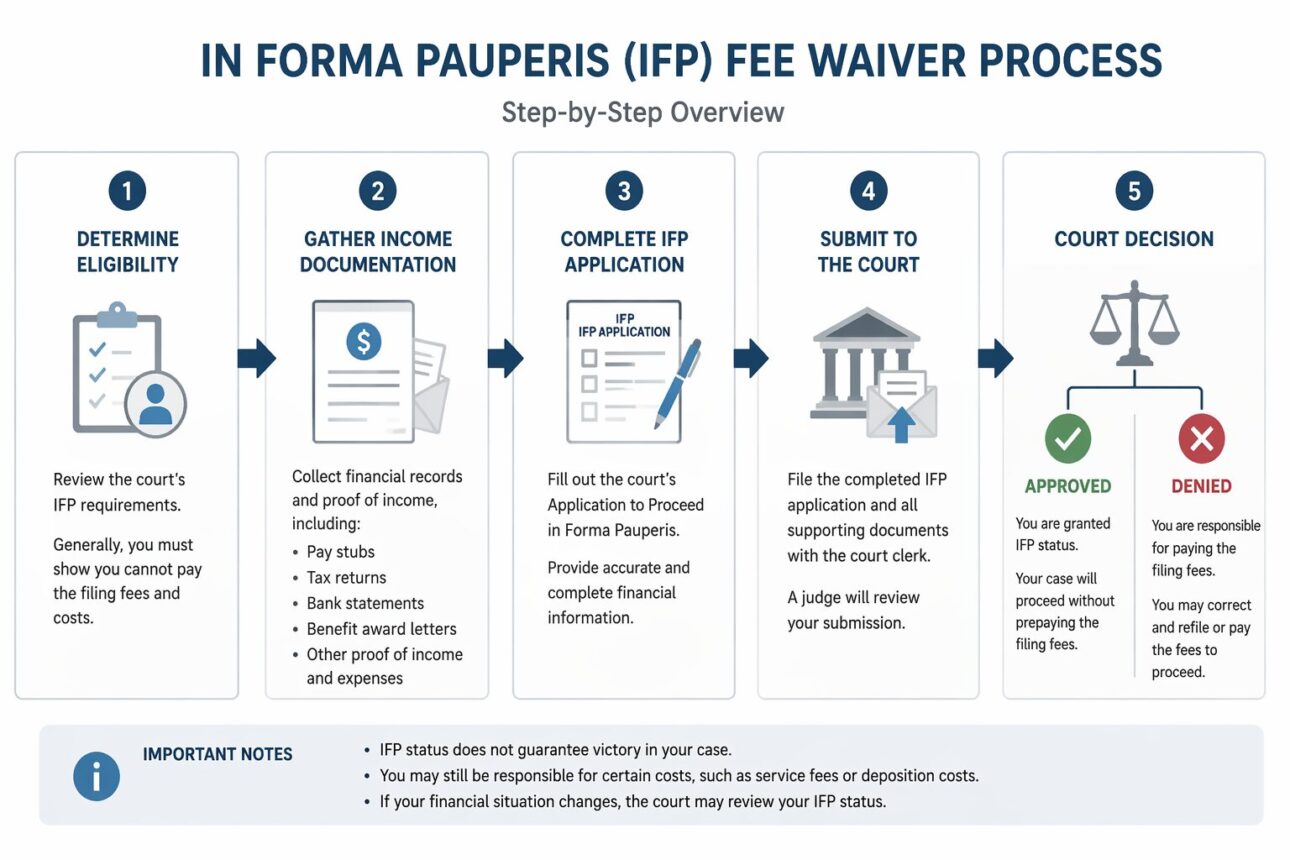
“In Forma Pauperis” is Latin for “in the form of a poor person.” It’s a formal legal mechanism that allows courts to waive filing fees and other court costs for people who cannot afford them. This is how you divorce with no money upfront.
Obtain the fee-waiver application from your county clerk or the state judiciary website. You’ll fill out a form declaring your income, expenses, and assets. Courts typically use federal poverty guidelines to determine eligibility, though some use a percentage above the poverty line (like 125% or 150%). The application asks for recent pay stubs, tax returns, proof of unemployment benefits, and bank statements.
File this application simultaneously with your divorce petition. Courts review both documents together; a waiver denial doesn’t stop your case—it just means you must pay the filing fee. If denied, review the court’s reason. Often a denial happens because of missing documentation, not because you’re actually ineligible.
Step 3: Utilize Free and Low-Cost Legal Resources
Your county clerk can direct you to court-approved resources, but it’s worth doing your own research too. The Legal Services Corporation is a federal nonprofit that funds legal aid offices nationwide. Call 211 or visit 211.org to find your nearest LSC provider. Legal aid lawyers often handle divorce cases, especially when custody or domestic violence is involved.
Law school clinics exist in most regions and often provide free representation supervised by experienced faculty. Contact nearby law schools directly or ask your county clerk for referrals. Pro bono programs run by local bar associations match volunteer attorneys with low-income clients for specific tasks or full representation.
Unbundled legal services are also worth asking about. Some private lawyers offer “low bono” or a la carte help: instead of paying for full representation ($1,500–$5,000+), you pay only to have an attorney review your forms, advise on strategy, or represent you at key hearings. This hybrid approach keeps costs under $500 in many cases.
According to FreshStartsRegistry, additional resources include courthouse referrals (the clerk often knows which lawyers do pro bono work), sliding-scale attorneys who charge based on income, and state or county family court websites offering self-help forms and guidance.
Step 4: Leverage Court-Provided Accommodations
Many family courts offer services you don’t know exist because they’re not advertised. Call your local court clerk and ask directly: Does your court provide free mediation for divorcing couples? Do you offer free language interpretation? Are disability accommodations available?
Mediation is powerful. A trained neutral mediator helps you and your spouse negotiate settlements without lawyers present. According to Custody X Change, mediation can resolve disputes in as little as one session, and some local courts offer free mediation programs. Even when it costs money, mediation typically runs $200–$500 per couple, far less than attorney fees.
Free language interpretation is often available for non-English speakers. Disability accommodations—like extended filing deadlines for people with mobility issues or cognitive conditions—can make the process less overwhelming. Ask the clerk what’s available; don’t assume you’re ineligible.
Step 5: Gather and Organize Your Financial Documentation
Before you file anything, compile complete financial proof. Courts won’t approve a fee waiver or settle a divorce without knowing your actual financial picture. Start by collecting recent pay stubs (last 2–3 months), your most recent tax return, bank statements (3 months), and bills or proof of expenses.
If you’re unemployed, gather documentation of unemployment benefits, disability payments, or any other income. If you have debt, list it: credit cards, medical bills, car loans, student loans. All of this goes into financial disclosures that become part of your court file.
Organize these documents clearly and make copies. You’ll need originals or certified copies for the court. HerMoney advises that “most states offer fee waivers if your income is low enough,” and completing this step correctly is what determines approval.
Step 6: Complete and File Your Divorce Petition
Use only the official forms provided by your county court. Download them, print them, and fill them out carefully. Forms typically include a petition for dissolution, financial disclosure statements, and any settlement agreement you’ve negotiated with your spouse.
Read instructions thoroughly. Courts reject incomplete or incorrectly filled forms constantly, adding weeks or months to the process. If the form asks for your spouse’s Social Security number, provide it. If it requires notarization, get it done (many courts or libraries offer free notary services for low-income filers).
Make three copies: one for the court, one for your spouse, and one for yourself. File the packet with the fee waiver application and a cover letter explaining your situation. Some courts let you file online; others require in-person filing. Check your court’s website for instructions.
Step 7: Serve Your Spouse Properly
Your spouse must be legally notified of the divorce. This is called “service of process.” If you serve incorrectly, the court will dismiss your case and you’ll have to start over. Do not skip this step or do it casually.
Certified mail is the cheapest method in most cases. Send your spouse a copy of your filed petition and all supporting documents via certified mail with return receipt requested. Keep the receipt. You’ll file this receipt with the court as proof of service.
Some jurisdictions allow service by regular mail or email. Others require a professional process server or sheriff’s deputy. Check your court’s rules. If your spouse agrees to accept service, get it in writing and file that agreement with the court—this can speed up the process.
Step 8: Wait for Court Approval
Once filed, your case enters a waiting period. The court reviews your fee waiver first. If approved, you pay nothing. If denied, you have a few days to pay the filing fee or request a hearing to contest the denial. Ask whether you can make payments instead of paying in full upfront.
Your spouse has time to respond (usually 20–30 days, depending on your state). If they don’t respond and you have an uncontested divorce, the court may grant your divorce by default. If they do respond and disagree with your terms, the case becomes contested and takes longer.
Courts often schedule a status conference or settlement conference before trial. This is your chance to negotiate face-to-face, often with a mediator or judge. Many cases settle at this stage, avoiding costly trials.
Tips
Be persistent with paperwork. Courts are strict about form completion. A single missing signature or incomplete field causes rejection. When in doubt, call the clerk’s office and ask for clarification. They’re there to help, and getting it right the first time saves months.
Ask for payment plans on remaining costs. Even after a fee waiver, you may owe for certified copies of your final decree (typically $20–$50 per copy) or other minor fees. Courts often allow payment plans. Don’t assume you have to pay in full immediately.
Request pro se (self-represented) accommodations. Courts know self-represented litigants are common and often provide extra help: extended deadlines, simplified procedures, clearer instructions. Ask the clerk what’s available.
Keep detailed records of all communications. Save emails, letters, and notes about conversations with your spouse, the court, and your attorney (if you hire one). These documents protect you if disputes arise about what was agreed.
Avoid new debt. Taking out loans or opening new credit cards during divorce proceedings can complicate asset division and fee-waiver eligibility. Live as lean as possible until the divorce is final.
Document all marital assets, even if you’re giving them up. You need a full inventory of bank accounts, retirement savings, vehicles, and property—even if you’re not claiming a share. The court needs this picture to ensure fairness.
FAQ
Q: Does legal aid help with divorce cases?
Legal aid organizations often help low-income people with family law matters, including divorce and custody issues. The Legal Services Corporation funds local legal aid offices nationwide, and many also work with bar associations and law school clinics to provide representation or guidance at key stages.
Q: How do fee waivers work in divorce court?
A fee waiver, formally called “In Forma Pauperis,” asks the court to let you file without paying the standard filing fee because you cannot afford it. Approval usually depends on income proof such as pay stubs, benefits letters, or unemployment documentation. Courts compare your income to federal poverty guidelines to determine eligibility.
Q: Is mediation cheaper than hiring divorce lawyers?
Usually, yes, especially when both spouses are willing to negotiate. Mediation typically costs $200–$500 per couple and can resolve disputes in one or two sessions. Full litigation with attorneys often costs thousands, making mediation a realistic alternative for low-income couples.
Q: What is an uncontested divorce and why is it cheaper?
An uncontested divorce is one where both spouses agree on major issues: asset division, child custody, and support. Because there’s no dispute, lawyers spend far less time fighting, and courts process the case faster. Self-prepared paperwork is often the cheapest option when both sides cooperate.
Q: Can I file for divorce online if I am broke?
In many states, yes. Some court systems offer online filing portals and self-help forms available free on their websites. Online filing reduces the need to travel to court repeatedly, which saves time and transportation costs.
Q: What if my spouse has all the money and controls everything?
If your spouse controls household finances, focus on free court resources first. Open a separate bank account if possible and use marital funds for essentials like housing, groceries, or childcare—courts generally allow this while divorce proceedings are underway. Legal aid and fee-waiver requests are your next steps. Document your financial dependence; courts take this seriously when dividing assets.
Q: How long does a low-cost divorce usually take?
Timeline varies by state and case complexity. Uncontested divorces sometimes finish in 2–3 months. Contested cases with disputes over assets or custody can take 6–12 months or longer. Mediation may accelerate settlement, while fee-waiver processing and service delays add time.
My Experience With How to Divorce With No Money: A Complete Guide to Low-Cost Options
Watching people navigate divorce without money taught me that the system isn’t as stacked against you as it feels. Fee waivers exist because courts recognize that poverty shouldn’t bar access to legal dissolution. That said, the process demands patience—courts move slowly, paperwork gets lost, and you’ll call the clerk’s office more times than you’d like.
The sharpest insight I’ve learned: uncontested divorces are genuinely cheap because they’re about agreement, not combat. Once both spouses stop fighting, the cost collapses. Legal fees exist to pay for conflict—depositions, trials, motions, appeals. No conflict means no fees. That’s why mediation works even on a shoestring budget. It removes the fight before it gets expensive.
I’ve also seen people derail themselves by not documenting financial proof correctly. A single missing pay stub delays fee-waiver approval by weeks. It sounds small until you’re waiting for court approval with no income coming in. So get your documentation right the first time.
The hardest part isn’t the paperwork—it’s the isolation. Divorce is emotional even when it’s necessary, and doing it alone, without a lawyer to call, can feel brutal. That’s why free legal consultations and pro bono programs matter so much. You don’t always need full representation; sometimes you just need someone to tell you you’re doing it right.
Have you navigated a low-cost divorce, or are you considering one? What held you back or pushed you forward?
Conclusion
Divorcing with no money is entirely possible. Fee waivers eliminate filing costs, court self-help systems provide forms and guidance, and legal aid organizations exist specifically to help low-income people navigate family law. Mediation costs far less than litigation. Uncontested divorces settle faster. Every step saves money compared to hiring a full-service attorney.
Start by visiting your county clerk’s office or court website. Download the fee-waiver application and divorce forms. Call your nearest legal aid office. Request free mediation if your court offers it. Document your financial hardship carefully. Serve your spouse correctly. Be patient with the process.
The cost of divorce drops dramatically when you handle paperwork yourself, when both spouses agree, and when you use free resources. Thousands complete low-cost divorces every year. You can too.
References
LegalZoom. (n.d.). How to Get a Divorce with No Money. https://www.legalzoom.com/articles/how-to-get-a-divorce-with-no-money
FreshStartsRegistry. (n.d.). 10 Realistic Ways to Pay for a Divorce When You’re Broke. https://www.freshstartsregistry.com/blog/10-ways-to-pay-for-a-divorce-when-you-have-no-money
Custody X Change. (n.d.). How To Pay for a Divorce Lawyer With No Money. https://www.custodyxchange.com/topics/divorce/professionals/pay-for-divorce-with-no-money.php
HerMoney. (n.d.). How To Get A Divorce With No Money (And No Lawyer). https://hermoney.com/connect/how-to-get-a-divorce-with-no-money-and-no-lawyer/
DivorceandFinance.org. (n.d.). I Want a Divorce but Have No Money: A Comprehensive How To Guide. https://www.divorceandfinance.org/i-want-a-divorce-but-have-no-money
Yahoo Finance. (n.d.). How to Get Divorced Without Paying a Penny. https://finance.yahoo.com/news/divorced-without-paying-penny-130042699.html
Reddit. (n.d.). How do you file for divorce with no money. https://www.reddit.com/r/Marriage/comments/15m0469/how_do_you_file_for_divorce_with_no_money/
Sarah Anderson . J
I’m the mom behind Wise Mom Blogger, where everyday creativity meets real-life motherhood. I share easy DIY crafts, cozy knitting and crochet projects, beginner-friendly sewing ideas, and family-tested recipes—plus quick baking hacks that make homemade feel doable on busy days.