How do institutional giants manage massive amounts of precious metals, and why does the distinction between paper silver and physical bullion drive global markets today? Whether tracking financial shifts or planning for long-term portfolio stability, understanding these market dynamics determines how you view silver holdings. Banks operate differently than retail investors, often balancing billions in assets across global vaults. The historical price of gold offers a lesson in how metal value evolves, and today, institutional silver exposure follows a similar, complex path. Silver holdings represent a core component of wholesale finance, and watching these reserves move gives clear signals about market health.
Quick Questions and Answers
Question: Why do banks hold so much silver bullion?
Answer: Banks hold silver bullion mainly as a trading, custody, and liquidity asset. Some banks also maintain large inventories to support market-making, settle physical delivery, and back exchange-traded products or vault services. In silver, this can make a bank look like a major holder even when some metal is held on behalf of clients or linked to derivatives activity.
Question: Can JPMorgan really be the largest silver holder?
Answer: Several sources say JPMorgan is widely cited as the largest private holder of physical silver, but estimates vary a lot. Reported figures range from about 100 million to more than 1 billion ounces depending on whether the source counts COMEX vault inventory, ETF custodianship, or other holdings. That makes the claim plausible in some contexts, but not uniformly defined across all reports.
Question: How much silver does JPMorgan hold today?
Answer: Published estimates differ sharply. Some sources put JPMorgan’s physical silver stockpile in the 100 million to 200 million ounce range, while others claim much higher totals when adding COMEX, ETF, and other vault-related holdings. Because these figures use different methods, there is no single universally accepted number.
Key Takeaways
Major banks often act as intermediaries between physical metal and paper derivative markets.
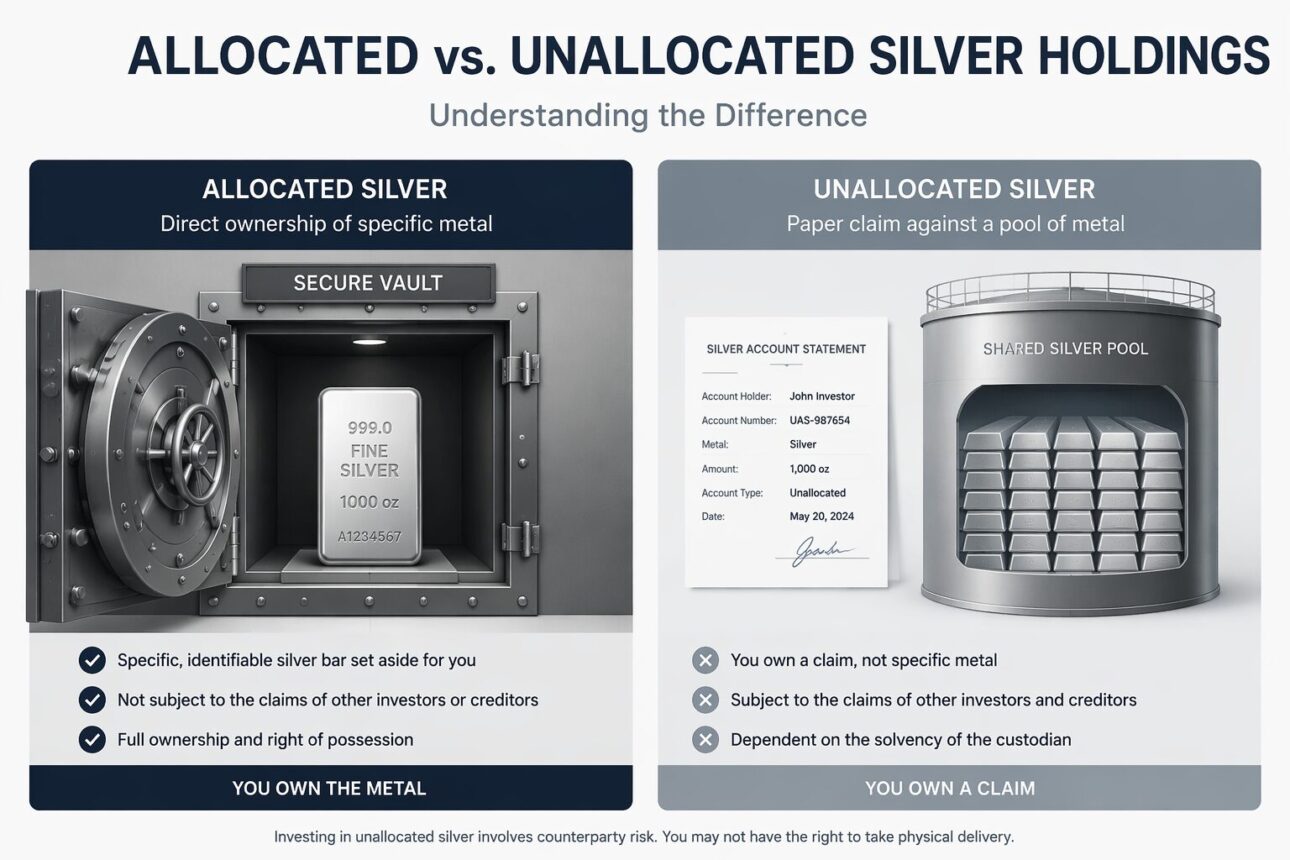
A clear divide exists between allocated physical ownership and unallocated claims against a bank.
Institutional strategies frequently involve hedging, where short positions balance long-term physical assets.
J.P. Morgan recently transitioned from a massive short position to a significant net-long holder of physical silver.
Tracking institutional vault changes provides insight into broader trends of supply constraints and industrial demand.
Bank Silver Holdings: Regulatory Framework and Market Reality
Bullion banking is the practice where financial institutions act as intermediaries between physical metal markets and traders holding paper derivatives. These banks facilitate the movement of silver from mines to industrial users and investors. You might imagine vaults filled with bars designated for specific people, but the reality involves a mix of physical custody and digital ledger entries.
An allocated account means you own specific bars with unique serial numbers stored in a segregated vault space. In contrast, unallocated accounts serve as a claim against a bank’s general pool of silver. When you hold an unallocated position, you are effectively a creditor of the bank, trusting them to deliver metal on demand rather than possessing a specific piece of bullion.
Paper silver refers to financial derivatives such as futures, options, and swaps. These contracts allow traders to bet on price movements without ever touching a physical ounce. Because these instruments are highly leveraged, the total value of paper claims often outweighs the physical metal available for immediate delivery. This decoupling creates the complex market environment that distinguishes institutional holders from retail buyers.
Why Banks Hold Silver: Strategic Roles and Motivations
Commercial banks use silver derivatives as hedging tools to manage price risk for clients who rely on silver for production. Whether a jewelry manufacturer needs to lock in prices or a tech company anticipates supply shortages, banks provide the necessary liquidity. By balancing these derivatives against their own balance sheets, banks stabilize their institutional exposure.
Short positions traditionally form the backbone of these strategies. When a bank takes a short position, it bets on or hedges against future price decreases. This practice often involves controlling massive amounts of paper silver relative to the actual inventory held in a physical vault. As Bitget explains, these institutional roles prioritize market velocity and risk mitigation over the simple accumulation of bullion for investment purposes.
Central banks historically prioritized gold as a reserve asset for over 150 years. This long-standing tradition relegated silver to industrial markets, leaving bullion banks as the primary curators of the silver market. While gold remains a standard sovereign reserve, silver has stayed in the realm of private investors and corporate vaults. This historical divide explains why government intervention in silver is rare compared to the central bank-driven gold market.
The Shift from Paper to Physical: The Case of J.P. Morgan
J.P. Morgan’s shift from a long-term short seller to a net-long holder represents a major change in market structure. The bank now reportedly holds roughly 750 million ounces of silver, a stockpile valued at more than 40 billion dollars. This represents control over approximately 40% of COMEX silver futures contracts, a level of dominance that analysts view as highly abnormal.
Most institutional participants typically account for 10% to 15% of commodity futures markets. By grabbing such a significant percentage of available contracts and physical metal, the institution has signaled confidence in physical scarcity. Some observers wonder if Mark Cuban’s stock options strategy could provide parallels for how large players pivot, though precious metals require a long-game mindset rarely found in standard equity trading.
Motivations for this accumulation include tight physical supply and recurring shortages at the U.S. Mint. When physical silver becomes difficult to source for coin production, vaults become the ultimate insurance policy. J.P. Morgan’s pivot shows that even the largest institutions acknowledge the necessity of moving toward hard, physical assets when paper markets show signs of extreme concentration.
The Mechanics of Market Influence: Paper vs. Physical Disparity
The concentration of short positions among the four largest U.S. banks often creates volatility that exceeds annual mine production for several countries. This disparity highlights the systemic nature of derivative pricing. On the COMEX exchange, registered silver is divided into specific categories that define what can be delivered upon contract maturity.
Large-scale derivatives exposure impacts banking stability within the U.S. economy. When the paper-to-physical ratio stretches too thin, small spikes in physical demand can trigger outsized price shifts in the futures market. This sensitivity is precisely what makes monitoring these institutional bank roles essential for any serious market observer.
The London wholesale market further illustrates this complexity. As reported by the LBMA, many investors hold substantial amounts of unallocated silver in London vaults. This creates a disconnect where retail and institutional investors believe they have guaranteed access to bullion, yet they only hold a contractual claim against the bank’s pool. If that bank faces a liquidity crisis, the claim may not convert into physical metal as quickly as expected.
Key Takeaways for Market Observers
Investing in physical bullion provides a level of certainty that paper-based silver instruments simply cannot match. If you own physical bars or coins in your own possession, you eliminate the counterparty risk inherent in unallocated bank accounts. Paper silver is effective for short-term trading, yet it carries the systemic risks associated with major financial institutions.
Monitoring the shifting positions of top-tier banks acts as a leading indicator for precious metal cycles. When firms like J.P. Morgan change their stance, the market usually reacts in kind. These shifts reveal where the “smart money” expects supply constraints to show up next.
Reserve diversification remains an area to watch for long-term investors. While central banks currently focus on gold, the growing industrial demand for solar panels and green technology may force a rethink of silver’s status. Even if Google earnings reports suggest high-tech sectors carry the economy, the physical components sitting in bank vaults ensure that the industrial pipeline remains operational.
My Experience With Bank Silver Holdings Explained: Who Holds the Most and Why
I clearly remember the first time I realized that my paper exposure to silver was tied to a “claim” rather than a metal bar. It felt a bit like finding out the bank doesn’t actually keep a box of cash with your name on it for every dollar in your checking account. It is a humbling realization for any investor. Dealing with institutional bullion data has taught me that the biggest players don’t care about the asset’s “lustre” in the way a collector does—they treat it like a balancing act on a tightrope.
You develop a certain dry sense of humor watching these massive banks try to hedge their way out of a tight supply. Watching the “Big 4” pivot their paper short positions while simultaneously shoring up physical vaults is the ultimate game of chess. My expert take? Pay less attention to the daily headlines about price and far more attention to the vault inventory reports on the COMEX exchange. That is where the reality of the market lives, hidden away from the volatility of the futures board. Have you ever tried to track your own precious metals holdings against institutional reports, or do you prefer the simplicity of holding physical coins?
FAQ
Q: What bank owns the most silver in the world?
JPMorgan is the bank most often identified as the biggest private holder of silver. Reports also mention other bullion banks such as HSBC and ICBC Standard Bank as significant vaulting and market participants, but JPMorgan is the name most commonly associated with the largest silver inventory.
Q: Do central banks hold much silver anymore?
No, central banks generally do not hold much silver today. Silver is no longer considered a major reserve asset, and most governments sold off their silver holdings in the 20th century after it lost its monetary role. Compared with gold, silver is now mostly held by private investors, industry, and funds.
Q: Why is silver not a major reserve asset?
Silver stopped being a core monetary reserve because governments moved away from silver-based currency systems and later sold much of their stockpiles. It is also used heavily in industry, so it is consumed and dispersed rather than stored like gold. That makes it less practical as a long-term official reserve asset.
Q: Are silver holdings mostly private or institutional?
Silver holdings are mostly private rather than central-bank owned. The largest pools are usually in private investment products like ETFs, bullion stocks, industrial uses, and household ownership of coins, bars, and jewelry. Central bank holdings are relatively small by comparison.
Q: Does JPMorgan own silver ETFs like SLV?
JPMorgan is widely described as the custodian for the iShares Silver Trust, not necessarily the direct owner of all the silver in it. Custodian status means it stores or safeguards the metal for the fund. That distinction matters because custody does not always equal beneficial ownership.
Q: When did JPMorgan start accumulating silver?
Some commentary says JPMorgan began building a large silver position after the 2011 silver-price peak. One source says it had little or no physical silver in 2011 and had accumulated millions of ounces by 2012, with later reports describing much larger stockpiles over time. Exact timing depends on which holdings are counted.
Q: What makes silver holdings hard to measure accurately?
Silver holdings are hard to measure because the same metal can be counted in different categories, such as exchange inventory, ETF custody, private vault stock, or derivative-linked positions. Some reports also mix physical ounces with paper exposure, which can inflate or confuse totals. That is why estimates for the biggest holders often disagree widely.
I’m the mom behind Wise Mom Blogger, where everyday creativity meets real-life motherhood. I share easy DIY crafts, cozy knitting and crochet projects, beginner-friendly sewing ideas, and family-tested recipes—plus quick baking hacks that make homemade feel doable on busy days.