Wondering if you or your student meets the requirements for Georgia’s HOPE Scholarship? This merit-based award helps Georgia residents pay for college tuition at eligible institutions, but earning it requires hitting specific academic and residency benchmarks. The application process is straightforward once you understand what the Georgia Student Finance Commission (GSFC) is looking for. Whether you’re a high school senior, a homeschooled student, or considering retroactive eligibility, the rules are consistent—and knowing them upfront saves time and disappointment.
Quick Questions and Answers
Question: Why do you need a 3.0 GPA for HOPE Scholarship?
For Georgia’s HOPE Scholarship, students must graduate from high school with at least a 3.0 calculated HOPE GPA. The scholarship is merit-based, so the GPA threshold is the main academic measure used to determine initial eligibility. Students must also keep a 3.0 cumulative postsecondary HOPE GPA to remain eligible.
Question: Can home school students qualify for the HOPE Scholarship?
Yes, home school students can qualify, but they usually must meet special academic requirements. For Georgia HOPE, students from an unaccredited home study program can qualify by earning a qualifying ACT or SAT score before graduation, or later by earning a 3.0 postsecondary HOPE GPA after completing college credit.
Question: Do you need Georgia residency for the HOPE Scholarship?
Yes, Georgia residency is one of the basic eligibility requirements. A student must meet the Georgia residency rules, be a U.S. citizen or eligible non-citizen, and attend an eligible Georgia college or university. These basic rules apply in addition to the academic requirements.
Key Takeaways
The HOPE Scholarship requires a 3.0 high school GPA calculated by GSFC, not your school’s internal GPA.
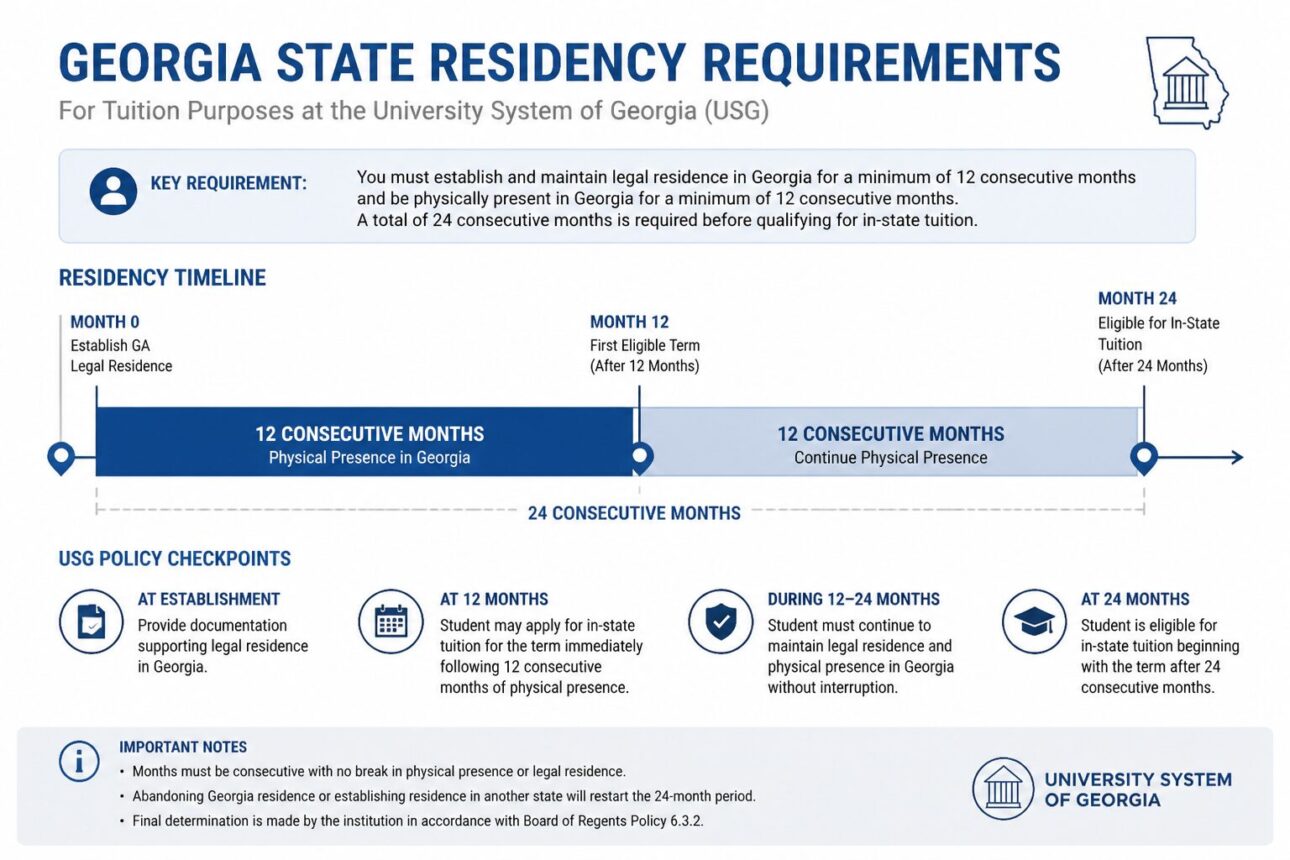
Georgia residency is mandatory, requiring 12 or 24 consecutive months of residence before enrollment.
You must remain in good standing on all student loans and avoid defaulting on any federal or state education debt.
A 3.0 college GPA must be maintained each term to keep your scholarship active.
Full-time enrollment is not required, but you must be in a degree-seeking program.
Understanding the Core Residency Requirements
Georgia residency is non-negotiable for HOPE eligibility. According to the University System of Georgia’s in-state tuition policy, applicants must meet formal residency classification by maintaining 12 or 24 consecutive months of residence in Georgia immediately before the first day of classes in the term for which you’re applying. This means you can’t simply move to Georgia in your senior year and expect to qualify.
You must also be a U.S. citizen or an Eligible Non-Citizen to receive HOPE funding. The Georgia Student Finance Commission verifies this status through your FAFSA submission and supporting documents. Residency requirements apply regardless of your citizenship status—both are separate and equally important criteria.
One common misconception: having family in Georgia doesn’t automatically qualify you as a resident. The GSFC looks at documented evidence of residency, such as utility bills, lease agreements, voter registration, or driver’s license history. Each institution within the University System of Georgia uses the same USG residency standards, so the rules are consistent whether you attend University of Georgia, Georgia Tech, or a regional state university.
Initial Academic Benchmarks for Incoming Freshmen
To qualify for HOPE as an entering freshman, you need to graduate from high school with a minimum 3.00 GPA as calculated specifically by the Georgia Student Finance Commission. This is critical: your high school may report an unweighted GPA, but the GSFC recalculates your HOPE GPA using its own methodology. The difference can matter, especially if your school weighted grades differently.
The Georgia Student Finance Commission’s official eligibility page details exactly which courses count toward your HOPE GPA and how they’re weighted. Most core academic courses in English, math, science, and social studies count, but electives and vocational courses typically do not. Students must also earn at least four full rigor credits from the approved Academic Rigor Course List if they graduated in 2017 or later.
Enrollment must be in a degree-seeking undergraduate program at an eligible Georgia college or university—this includes public universities, private colleges, and many technical colleges. If you earned a High School Equivalency (HSE) diploma through a Technical College System of Georgia (TCSG) institution, you’re also eligible to apply. The key requirement is that you must be pursuing a bachelor’s degree, not a certificate or non-degree program.
Students attending college part-time can still receive HOPE funding. Full-time enrollment status is not required to qualify or receive an award, though the amount you receive may depend on your enrollment level and your institution’s specific award policies.
Sustaining Eligibility During Postsecondary Education
Once you arrive on campus, the work isn’t over. You’re required to maintain a minimum 3.0 cumulative postsecondary GPA to keep your HOPE Scholarship active. This is calculated at each checkpoint—usually at the end of each semester or term. If your cumulative college GPA drops below 3.0, you lose eligibility and the scholarship ends, even if you raise your GPA back up later.
Your institution also enforces its own Satisfactory Academic Progress (SAP) policy, which is separate from the HOPE GPA requirement. SAP policies typically measure whether you’re completing a certain percentage of attempted credits and progressing toward your degree on schedule. Meeting a 3.0 GPA is not enough if you’re failing to make adequate progress toward degree completion. You need to satisfy both standards simultaneously.
Financial aid compliance is equally important. You must remain in good standing on all student loans and other financial aid programs. Any default on a federal or state education loan disqualifies you immediately from HOPE funding. Before you graduate or drop below half-time enrollment, check your loan status through the National Student Loan Data System (NSLDS) to ensure there are no hidden defaults or delinquencies.
Financial and Legal Standing Constraints
Compliance with the Georgia Drug-Free Postsecondary Education Act of 1990 is mandatory for all HOPE recipients. This means you cannot be convicted of selling or possessing illegal drugs while receiving the scholarship. A drug-related conviction can trigger loss of federal financial aid eligibility, which affects HOPE as well.
Applicants cannot be in default on any federal or state student loan, grant, or scholarship. If you defaulted on a previous loan years ago and have since rehabilitated it, you should verify with your loan servicer that the default status has been formally removed. A technical default or administrative error can disqualify you even if you’ve been making payments faithfully.
Award limits also apply. The HOPE program has maximum credit hour caps and aggregate award limits. Once you’ve exhausted your lifetime HOPE eligibility—typically after earning 127 credit hours for the scholarship—you cannot receive additional HOPE funding, even if you remain in good academic standing. This is why it’s crucial to monitor your credit hour usage and plan your academic path accordingly.
Latest Updates and Program Administration
All HOPE Scholarship eligibility determinations, GPA calculations, and award amounts are processed by the Georgia Student Finance Commission (GSFC). The GSFC maintains the official list of eligible postsecondary institutions and publishes program regulations annually.
Changes to HOPE program rules can happen. The rigor course requirements, award amounts, and eligibility pathways have been modified several times over the past decade. Students should verify current requirements through the official Georgia Student Finance Commission website, which provides the most up-to-date program guidelines and downloadable publications.
As of 2025-2026, HOPE continues to cover a significant portion of tuition costs at eligible institutions, but the exact award varies by school and program. Some specialized programs at universities may not be fully covered, and graduate programs typically require the separate HOPE Graduate Scholarship. The undergraduate HOPE Scholarship is designed for first-time college students who meet the initial eligibility criteria.
My Experience With What Qualifies You for the HOPE Scholarship?
I’ve watched countless students miss HOPE eligibility by fractions of a point or fail to understand the residency rules until it was too late. The most frustrating cases? Students with 2.97 GPAs who thought they’d get rounding in their favor, or families who moved to Georgia thinking their kid would automatically qualify. That’s not how it works.
The real insight here is that HOPE isn’t just a GPA threshold—it’s a continuous verification system. I’ve seen students lose the scholarship midway through college because they didn’t understand that a 2.95 cumulative GPA means no funding that semester, period. It doesn’t carry over. One bad term, and you’re paying out of pocket unless you appeal or retake courses.
Residency requirements trip people up too, especially military families or those who recently relocated. The 24-month rule is inflexible, even if you’ve got strong ties to Georgia. Plan ahead if you’re moving to Georgia specifically for college.
Have you or your student applied for HOPE, or are you still in the eligibility-checking stage?
FAQ
Q: Are dual enrollment credits counted for HOPE Scholarship eligibility?
Yes, college credit earned before high school graduation can matter for some HOPE eligibility paths, especially for students from ineligible high schools or unaccredited home study programs. However, official Georgia rules state that credit hours earned by examination or coursework taken before high school graduation cannot be used to gain retroactive HOPE eligibility through that specific pathway. If you’re pursuing retroactive eligibility, check with the GSFC about which credits count toward your 30-semester or 45-quarter-hour requirement.
Q: How many rigor credits are required for HOPE Scholarship?
Georgia HOPE requires students graduating in 2017 and beyond to earn at least four full rigor credits from the approved Academic Rigor Course List. This requirement is part of initial high school eligibility rules. The GPA requirement still applies alongside the rigor credits, so you need both to qualify. Not all advanced courses count as rigor credits—check the GSFC’s official list to confirm your courses qualify.
Q: Does the HOPE Scholarship cover full tuition?
The HOPE Scholarship is merit-based, but the amount depends on program rules and funding level rather than automatically covering every cost. Georgia’s HOPE Scholarship has award limits and eligibility rules that affect how much a student receives. It is not the same as a guaranteed full-ride scholarship for every student. The actual award varies by institution and may cover tuition fully at some schools while covering only a portion at others.
Q: What test scores qualify for HOPE Scholarship?
For some Georgia HOPE eligibility routes, students need a qualifying score on a single national or state/district ACT or a single national SAT before high school graduation. The minimum scores are a 24 composite on the ACT or 1160 on the SAT. This alternative pathway is available to students from certain ineligible high schools or unaccredited home study programs who couldn’t otherwise demonstrate academic achievement through GPA alone.
Q: How do college students keep HOPE Scholarship eligibility?
College students must remain enrolled at an eligible Georgia college or university and keep a minimum 3.0 calculated HOPE GPA at each checkpoint. They also must meet basic enrollment and financial-aid compliance rules, such as being in good standing and not exceeding award limits. Some schools have additional Satisfactory Academic Progress requirements beyond the 3.0 GPA, so check with your financial aid office about your institution’s specific policies.
Q: What basic requirements must you meet for HOPE Scholarship?
Applicants must meet Georgia’s basic eligibility rules, including U.S. citizenship or eligible non-citizen status, Georgia residency, enrollment in an eligible degree-seeking program, Selective Service compliance when applicable, and good standing on student loans and other aid. They also cannot have defaulted on state or federal student loans or owe refunds on Georgia aid. All of these must be satisfied simultaneously to maintain eligibility.
Q: Which students can receive HOPE Scholarship retroactively?
Students who graduated from an ineligible high school or completed an unaccredited home study program may receive HOPE retroactively if they were not initially eligible. To qualify, they must earn 30 semester or 45 quarter hours of college credit with a 3.0 postsecondary calculated HOPE GPA. Retroactive eligibility is a second chance for students who couldn’t establish HOPE eligibility at graduation.
Conclusion
The HOPE Scholarship is achievable if you meet Georgia’s clear-cut requirements: residency, citizenship, a 3.0 GPA, and good academic standing in college. The scholarship removes a significant financial barrier for eligible students, but it requires you to maintain your academic performance and stay compliant with state and federal financial aid rules throughout your college career.
Start early by confirming your residency status through your university’s financial aid office. Request your HOPE GPA calculation from GSFC well before your college enrollment date to catch any discrepancies. Once in college, treat your GPA like the non-negotiable requirement it is—the scholarship depends on it every single term.
If you don’t initially qualify, don’t assume you’re locked out forever. Retroactive eligibility exists for students from ineligible schools, and appealing a GPA shortfall is sometimes possible if extenuating circumstances affected your performance. The Georgia Student Finance Commission is your resource for clarification on any rule or calculation.
References
Georgia Student Finance Commission. (n.d.). Basic eligibility for the HOPE Scholarship. Georgia Futures. https://www.gafutures.org/hope-state-aid-programs/hope-zell-miller-scholarships/hope-scholarship/basic-eligibility/
Georgia Student Finance Commission. (n.d.). Initial academic eligibility for the HOPE Scholarship. Georgia Futures. https://www.gafutures.org/hope-state-aid-programs/hope-zell-miller-scholarships/hope-scholarship/initial-academic-eligibility/
Georgia State University Student Financial Services. (n.d.). HOPE Scholarship. Georgia State University. https://sfs.gsu.edu/hope-scholarship/
Georgia Institute of Technology Financial Aid. (n.d.). HOPE Scholarship. Georgia Tech. https://finaid.gatech.edu/undergraduate-types-aid/hope-scholarship
University of Georgia Student Financial Aid. (n.d.). HOPE and Zell Miller Scholarships. University of Georgia. https://osfa.uga.edu/types-of-aid/undergraduate/scholarships/hope-and-zell-miller-scholarships/
Georgia Southwestern State University Financial Aid. (n.d.). HOPE Scholarship. Georgia Southwestern. https://www.gsw.edu/financial-aid/scholarships-aid/federal-aid/hope-scholarship
Sarah Anderson . J
I’m the mom behind Wise Mom Blogger, where everyday creativity meets real-life motherhood. I share easy DIY crafts, cozy knitting and crochet projects, beginner-friendly sewing ideas, and family-tested recipes—plus quick baking hacks that make homemade feel doable on busy days.