


What do student loan qualification requirements actually involve when lenders review your application? Understanding approval factors means looking beyond just a credit score — lenders weigh income stability, debt-to-income ratios, enrollment status, and even academic performance before signing off. Whether you’re applying for federal aid before a fall semester or shopping private loans for summer classes, knowing what lenders check makes the difference between approval and rejection. This guide breaks down each factor so you know what to expect.
Quick Questions and Answers
Question: Why do lenders check credit for student loans? Answer: Lenders check credit to gauge how likely a borrower is to repay the loan on time. A stronger credit history can improve approval odds and may lead to better interest rates, while weaker credit can require a cosigner or disqualify the applicant. Private lenders use credit because they do not have the same federal protections and eligibility rules as federal loans.
Question: Can you get a student loan with bad credit? Answer: Yes, but it is usually harder with private student loans. Many lenders will want a cosigner with good credit, stable income, or both, because bad credit signals higher repayment risk. Federal student loans are generally easier to obtain because most do not require a credit check, though Grad PLUS loans do review adverse credit history.
Question: Do student loans require a cosigner for approval? Answer: Not always. Federal student loans generally do not require a cosigner, but many private lenders do if the borrower lacks sufficient credit or income. A cosigner can help the application qualify and may improve the loan terms because the lender can consider the cosigner’s finances too.
Key Takeaways
- Federal loans rely on FAFSA completion and school eligibility, not credit scores or income.
- Private lenders check credit history, income stability, and debt-to-income ratios to gauge repayment risk.
- A cosigner with good credit is the most reliable way to strengthen a weak application.
- DTI ratios above 43% can block approval even when credit and income look fine.
- Enrollment at an accredited institution and satisfactory academic progress are baseline requirements for most loans.
Understanding the Distinction Between Federal and Private Loan Requirements
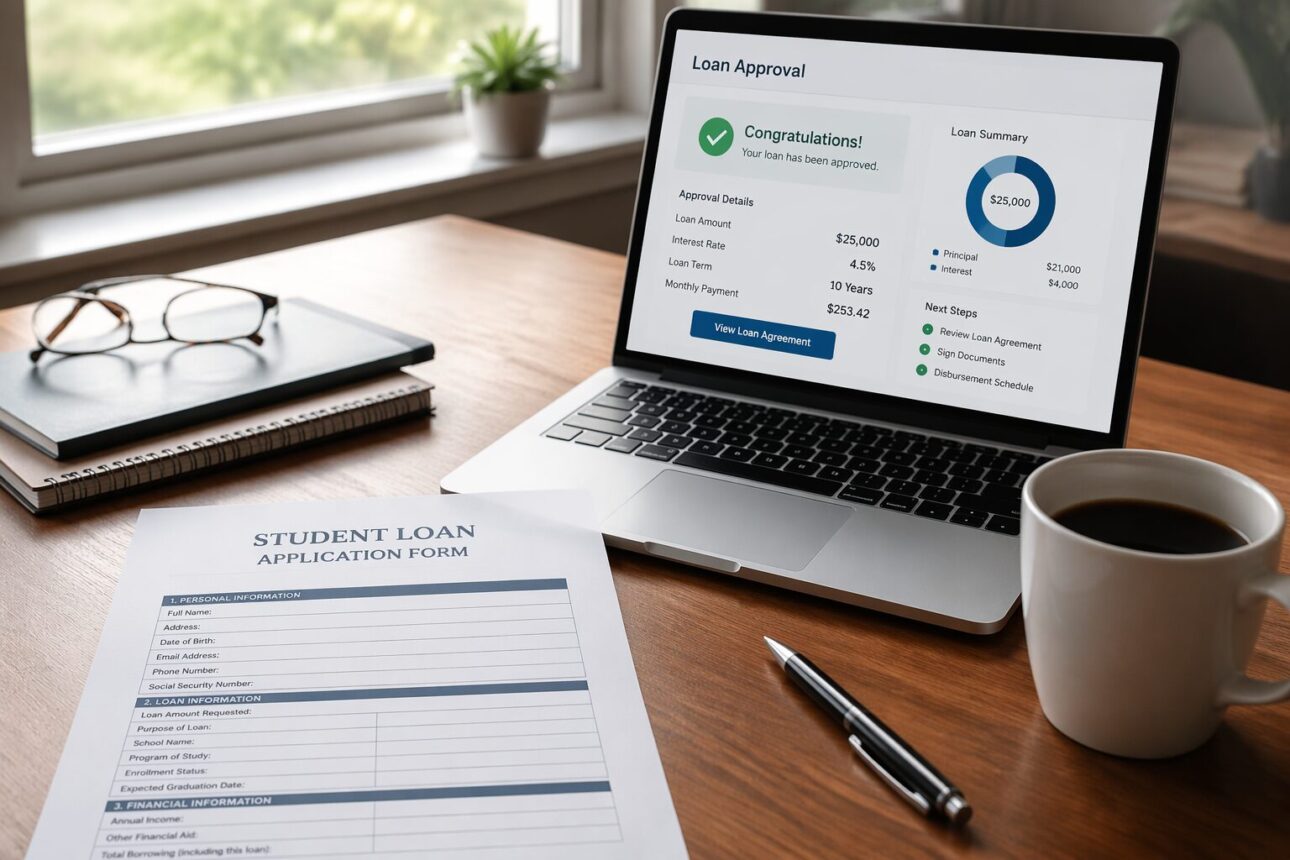
The first thing to get straight is that federal and private student loans operate under completely different rules. Federal loans, which come from the U.S. Department of Education, do not require a credit check for most borrowers. The main qualification tool is the Free Application for Federal Student Aid, known as the FAFSA. According to Federal Student Aid, completing the FAFSA form each school year is the single most important step for accessing federal loans, grants, and work-study funds.
To qualify for federal loans, you must be a U.S. citizen or eligible non-citizen, have a valid Social Security number, and maintain satisfactory academic progress at an eligible school. That is it. There is no minimum income threshold and no credit score requirement for Direct Subsidized or Unsubsidized loans. The Grad PLUS loan does check for adverse credit history, but that is the exception.
Private lenders operate differently. They are businesses taking on risk, so they evaluate each applicant like any other loan applicant. As Bankrate explains, private student loan eligibility depends on income, citizenship, credit score, and attendance requirements. Each lender sets its own bar, which means qualification criteria vary widely from one company to the next.
This distinction matters because many borrowers assume the process is the same for both types. It is not. Federal loans are designed to be accessible. Private loans are designed to be profitable for the lender, so the bar is higher.
The Role of Credit History and Co-signers
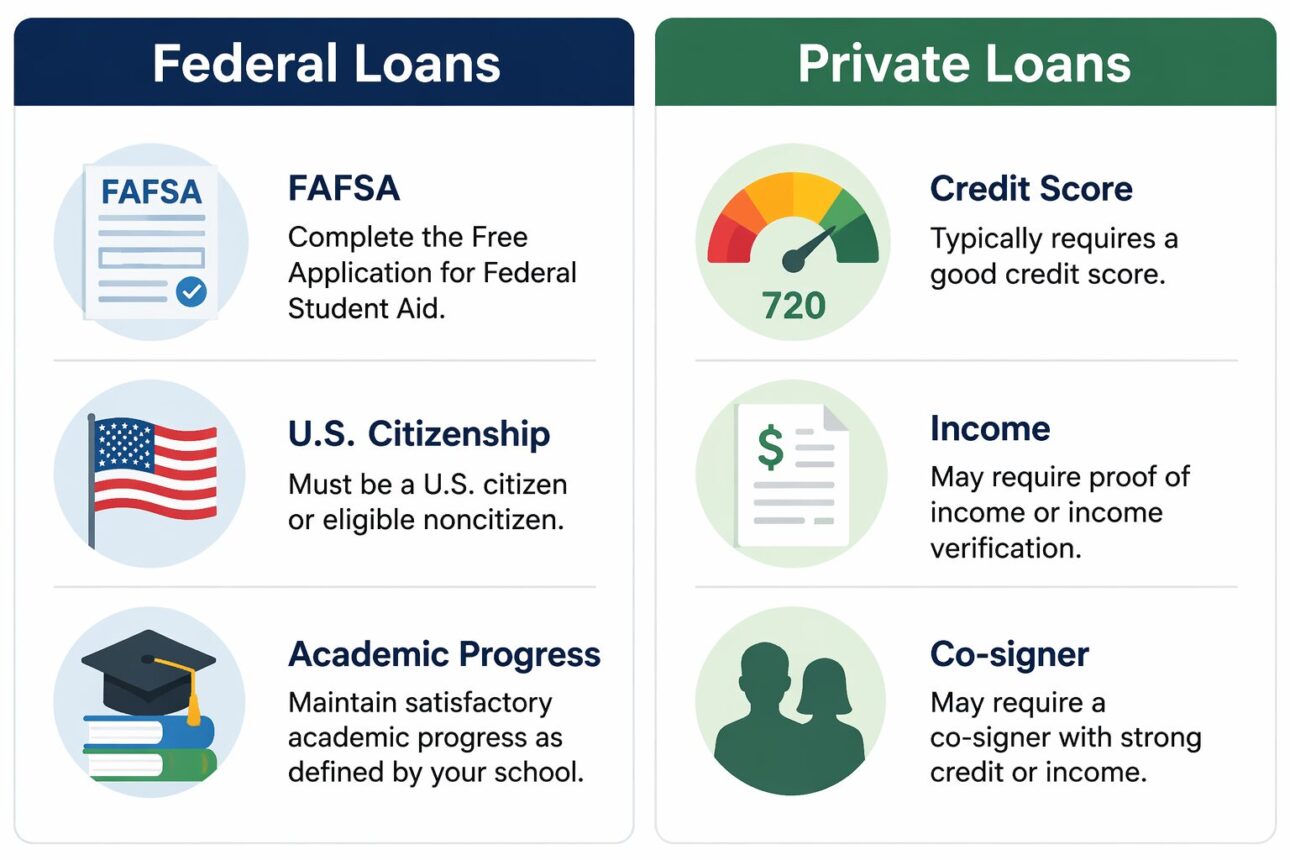
Credit history is the single biggest factor private lenders use to decide whether to approve a loan. Most private lenders want to see a credit score in at least the mid-600s, which falls in the fair to good range. Scores below that threshold typically trigger a denial — or a demand for a cosigner.
If your credit is thin or damaged, a cosigner with strong credit can rescue the application. The cosigner essentially guarantees repayment, which reduces the lender’s risk. Many students have no credit history at all, so a cosigner is the norm rather than the exception for private loans. A report from CNBC Select notes that most lenders prefer a credit score in the mid-600s, but borrowers with bad credit or no credit can still qualify by using a cosigner.
The cosigner’s credit score, income, and debt levels become part of the application. If the cosigner has a strong profile, the loan may be approved even if the borrower’s own credit is minimal. This is why lenders ask for cosigner information upfront.
One thing borrowers sometimes miss is that not all lenders treat cosigners the same way. Some offer cosigner release after a set number of on-time payments, which lets the cosigner off the hook. Others keep the cosigner on for the life of the loan. Shopping around matters.
Financial Stability Metrics: Income and Debt-to-Income (DTI) Ratios
Income and existing debt are the second and third legs of the private loan approval stool. Lenders want proof that you can make monthly payments without stretching too thin. They calculate your debt-to-income ratio to figure this out.
DTI compares your monthly debt payments to your monthly gross income. Mortgage lenders typically cap DTI around 43%, and private student loan lenders tend to use similar benchmarks. If your DTI creeps above that line, the lender sees too much risk.
What counts as debt for DTI purposes? Credit card minimum payments, car loans, personal loans, existing student loans, and any other recurring obligations. The new student loan payment gets added to that total. If the sum eats up too much of your income, the application gets declined.
Income verification is straightforward. Lenders ask for recent pay stubs, tax returns, or bank statements. For students with part-time jobs, the income numbers may be modest, which is why many private loans require a cosigner with a steady full-time job. According to a guide from ELFI, you need to demonstrate that you can repay the student loan — and that means showing income.
Self-employed borrowers face additional scrutiny. Lenders may ask for two or more years of tax returns to establish consistent earnings. Freelancers and gig workers should expect extra documentation requests.
Academic Performance and Professional Potential
Some lenders look at your academic record as a signal of future earning potential. The thinking is straightforward: a student with strong grades at a reputable school is more likely to graduate, find a well-paying job, and repay the loan on time.
Avanse, an education loan provider, states that your academic track record is a primary factor in the loan approval process because good academic performance can lead to professional success. This is not universal across all lenders, but it is common enough that students should be aware of it.
The type of school you attend also matters. Lenders prefer accredited institutions. If your school is not accredited by a recognized agency, the loan will likely be denied because the lender cannot verify that the program meets academic standards. Federal loans also require enrollment at an eligible school, which is tied to accreditation.
Your major can influence approval odds too. Degrees in fields with strong employment outcomes — nursing, engineering, computer science — may be viewed more favorably than degrees in fields with less certain job prospects. Lenders do not publish these preferences, but they are baked into the underwriting process.
Citizenship and Attendance Eligibility Criteria
Federal loans require U.S. citizenship or eligible non-citizen status. Private lenders have their own citizenship requirements, which typically include being a U.S. citizen, permanent resident, or qualifying non-citizen with proper documentation. International students can sometimes qualify with a cosigner who is a U.S. citizen or permanent resident.
Enrollment status is another baseline requirement. Most federal and private loans require at least half-time enrollment in an eligible degree or certificate program. The school certifies this enrollment directly to the lender. If you drop below half-time, the loan may enter repayment or be subject to additional grace period rules.
Satisfactory academic progress is a federal requirement that also shows up in private loan agreements. Schools measure this through grade point averages and credit completion rates. Falling below the school’s standards can trigger a loss of aid eligibility, including loans.
| Loan Type | Credit Check Required | Interest Rate Type | Cosigner Typical | FAFSA Needed |
|---|---|---|---|---|
| Federal Direct Subsidized | No | Fixed | No | Yes |
| Federal Direct Unsubsidized | No | Fixed | No | Yes |
| Federal Grad PLUS | Yes (adverse credit) | Fixed | Sometimes | Yes |
| Private Student Loans | Yes (score matters) | Fixed or Variable | Often | No |
Latest Trends and Strategies for Improving Approval Odds
Several trends are shaping the student loan landscape in 2026. Interest rates have remained elevated, which means private loan rates are higher than they were a few years ago. This makes credit scores even more important because a strong score can shave points off the rate.
Lenders are also tightening their income requirements in response to broader economic conditions. Stable employment is a top priority for lenders reviewing refinancing applications. A steady job with consistent paychecks carries more weight than high income from an unstable source.
For borrowers looking to improve their approval odds, a few strategies consistently work. First, check your credit report for errors before applying. A mistake on your report can lower your score and hurt your chances. Second, pay down existing credit card balances to improve your DTI ratio. Third, find a qualified cosigner before you start shopping.
Shopping multiple lenders is essential. Each lender uses its own formula for evaluating applications, so you may be approved by one and denied by another with the same financial profile. Comparing offers also helps you find better interest rates and fee structures.
For federal aid, the strategy is simpler but just as important: submit the FAFSA every year before the deadline. Missing the deadline can mean losing access to grants and subsidized loans. Renewal is not automatic.
Frequently Asked Questions About Loan Approval
Q: Are federal student loans easier to qualify for?
Yes. Federal student loans usually have simpler eligibility rules and do not require a credit score or income test for most borrowers. The main requirements are filling out the FAFSA, being enrolled at least half-time in an eligible program, and meeting citizenship and academic progress rules.
Q: How much income do student loan lenders want?
Private lenders often look for a minimum income, but the exact amount varies and is not always disclosed. Some lenders may accept relatively modest income levels, while others focus more on whether the borrower or cosigner has steady earnings and enough cash flow to handle monthly payments. Federal loans generally do not use income as a qualification requirement.
Q: What credit score do you need for private student loans?
Most private lenders prefer good credit, often around a 670 FICO score or higher. Some lenders do not publish a minimum, and approval also depends on income, debt-to-income ratio, and whether a cosigner is involved. A stronger score can also help lower the interest rate offered.
Q: Does being enrolled half-time affect student loan eligibility?
Yes. Many federal and private student loans require at least half-time enrollment in an eligible program. Lenders use enrollment status to confirm that the money is going toward active education and that the borrower meets the school’s loan eligibility rules.
Q: Will student loan approval depend on school accreditation?
Often, yes. Private lenders commonly require borrowers to attend an accredited institution, and federal loans also require enrollment in an eligible school and program. Accreditation matters because lenders want to know the school meets recognized academic standards and qualifies for aid programs.
Q: When do lenders look at debt-to-income ratio?
Private lenders often review debt-to-income ratio during underwriting to see how much of your monthly income already goes to debt payments. A high DTI can hurt approval chances even if credit is good, because it suggests less room for another loan payment. Federal student loans generally do not use DTI as a core eligibility test.
Q: What documents do lenders ask for on student loans?
Lenders commonly ask for proof of identity, enrollment, and income. Depending on the loan, they may also request a Social Security number, school acceptance or enrollment verification, tax forms, pay stubs, and cosigner financial documents if a cosigner is used.
My Experience With Student Loan Qualification Requirements: What Lenders Actually Look For
I have been through this process more times than I care to count — first as a nervous undergrad with no credit, then as a grad student with part-time income, and later helping younger relatives navigate their own applications. The single thing that surprised me most was how differently each lender evaluates the same numbers. One lender rejected me because my part-time income was too low. Another approved me at a decent rate with the exact same income and credit score. There is no universal pass-fail line.
The smartest move I made was finding a cosigner before I even started applying. My parents had solid credit and steady jobs, and their involvement turned a likely rejection into an approval with competitive terms. If your credit is thin or your income is modest, do not try to go it alone. That cosigner is not a crutch — it is a tool.
One insight that I think gets overlooked: lenders care more about consistency than size. A moderate income that arrives like clockwork every two weeks is more reassuring than a high income that fluctuates wildly. Show the lender you are steady, not just rich on paper. Have you found a particular strategy that made your student loan application go smoother?
Core Takeaways for Prospective Borrowers
Federal aid should be your first stop. Fill out the FAFSA every year without fail. These loans are accessible, have fixed rates, and come with borrower protections like income-driven repayment plans and deferment options that private loans do not offer.
Private loans fill the gap when federal aid falls short. To qualify, you need credit history, stable income, a reasonable DTI ratio, enrollment at an accredited school, and often a cosigner. Each lender weighs these factors differently, so apply to multiple lenders to find the best fit.
A cosigner with good credit is the most effective way to overcome a thin or adverse credit profile. If you need one, ask early and be transparent about what you are asking for.
Your academic record, school accreditation, and enrollment status all play supporting roles in the approval process. Stay enrolled at least half-time, maintain good grades, and confirm your school is accredited.
Finally, check your credit report before applying. Fix errors, pay down balances, and give yourself the best possible starting position. A little preparation goes a long way.
If you want to explore more ways to fund your education without taking on extra debt, check out this guide on 12 Proven Scholarships for Beginners Everyone Should Know.
References
- Federal Student Aid. (n.d.). Federal Student Loans. U.S. Department of Education. https://studentaid.gov/understand-aid/types/loans
- Bankrate. (2025, August 26). Private Student Loan Requirements: How To Qualify. Bankrate. https://www.bankrate.com/loans/student-loans/private-student-loan-requirements/
- CNBC Select. (2026). Best Student Loans For Bad or No Credit in 2026. CNBC. https://www.cnbc.com/select/best-bad-credit-student-loans/
- ELFI. (n.d.). How to Get Approved for Student Loans: Federal and Private. ELFI. https://www.elfi.com/how-to-get-approved-student-loans/
- Avanse. (2026). Education Loan Eligibility: Factors That Affect Approval in 2026. Avanse Blog. https://www.avanse.com/blog/education-loan-eligibility-factors-that-affect-approval-in-2026
- Saving for College. (n.d.). Student Loan Refinancing: 6 Ways to Increase Approval Odds. Savingforcollege.com. https://www.savingforcollege.com/article/how-to-increase-chances-of-qualifying-for-a-student-loan-refinance
- Barrett Financial Group. (n.d.). Does Having a Student Loan Affect a Mortgage Pre-Approval?. Barrett Financial Group. https://www.barrettfinancial.com/blog/does-having-a-student-loan-affect-a-mortgage-pre-approval

Sarah Anderson . J
I’m the mom behind Wise Mom Blogger, where everyday creativity meets real-life motherhood. I share easy DIY crafts, cozy knitting and crochet projects, beginner-friendly sewing ideas, and family-tested recipes—plus quick baking hacks that make homemade feel doable on busy days.