

Quick answer: NASA chose the Omega Speedmaster in 1965. On March 1, 1965, NASA declared it “Flight Qualified for All Manned Space Missions” after it was the only watch to survive a brutal series of tests. It flew in space for the first time three weeks later, on March 23, 1965.
The Omega Speedmaster is not just a nice watch that astronauts happened to like. It earned its spot on NASA’s wrist through a real contest, with real losers. Two other watch brands failed the tests. Only the Speedmaster passed every single one. This article walks through the exact year, the tests, and how the watch went from a race car chronograph to the watch worn on the Moon.
Understanding this timeline matters if you are researching the watch for a purchase, a school project, or just settling a debate with a friend. The date is not a marketing claim dreamed up decades later. It comes from an official NASA testing program with a documented outcome, and that outcome still shapes which watch Omega sells as its flagship model today.
| Fact | Detail |
| Year chosen by NASA | 1965 |
| Exact qualification date | March 1, 1965 |
| Watch reference tested | Speedmaster ST 105.003 |
| First spaceflight | March 23, 1965, Gemini 3 |
| First spacewalk use | June 3, 1965, Gemini 4 |
| Moon landing use | July 21, 1969, Apollo 11 |
| Brands that failed testing | Rolex, Longines-Wittnauer |
| Brand & Model Submitted | Test Result |
| Omega Speedmaster ST 105.003 | Passed all tests |
| Rolex (submitted model) | Failed, crystal popped off in humidity test |
| Longines-Wittnauer 235T | Failed temperature extremes |
Test Temperature Range the Speedmaster Survived
-18°C
Low
93°C
High
What year did NASA choose the Omega Speedmaster?
NASA chose the Omega Speedmaster in 1965. Officials tested a handful of chronographs from different watch brands and, on March 1, 1965, gave the Speedmaster the formal designation “Flight Qualified for All Manned Space Missions.” This happened during the early, fast-moving years of the American space program, just a few years after President Kennedy set the goal of landing a man on the Moon before the decade was out.
NASA needed a watch that would work no matter what happened outside the spacecraft, so it treated the selection like buying any other piece of flight equipment. That meant real competition, official testing, and a pass or fail result. For a reader today, the simple takeaway is this: the Speedmaster’s space legacy is not folklore or clever marketing. It is based on an actual government test that the watch won fair and square, according to Omega’s own historical records and NASA program accounts.
Why did NASA need to test wristwatches at all?
NASA needed a wristwatch because astronauts had to time procedures by hand, especially during moments when onboard electronics could not be trusted alone. Every second mattered for things like engine burns, oxygen use, and re-entry timing, so a dependable analog backup on the wrist was treated as essential safety gear, not a fashion accessory.
As a government agency, NASA could not just pick a watch off a store shelf because an astronaut liked it. It had to run a formal request for proposals, inviting watch manufacturers to submit models for consideration. Omega, Rolex, and Longines-Wittnauer were among the brands that sent watches in, and NASA ran each one through a punishing set of trials designed to copy the worst conditions a spacecraft could throw at a piece of equipment.
For a reader, this explains why the Speedmaster’s space story carries real weight in the watch world. It was not chosen because of a marketing deal. It was chosen because it kept working when other well-known brands did not.
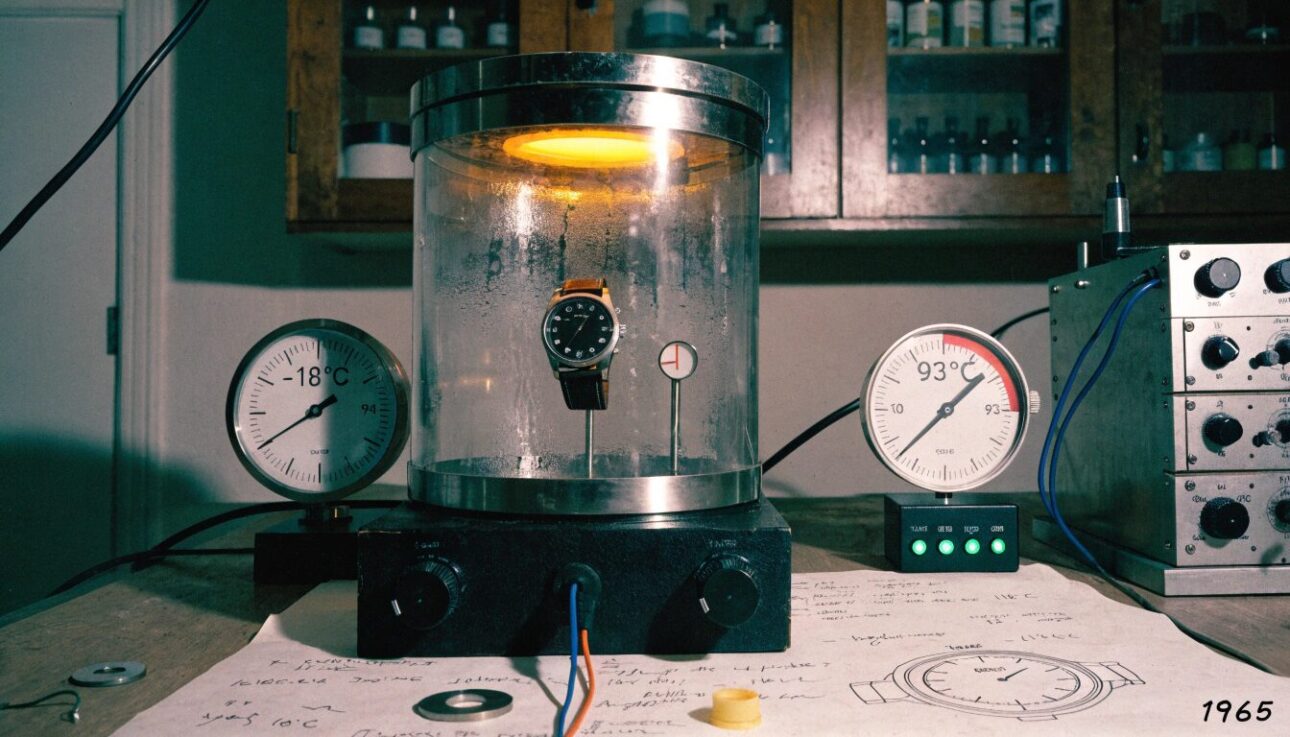
What tests did the Speedmaster have to pass?
The Speedmaster had to survive extreme heat and cold, vacuum, high humidity, strong shock, heavy vibration, and high acceleration forces, all without losing accuracy. Reported test temperatures ranged from about -18°C on the cold end to roughly 93°C on the hot end, and the watch also had to handle acceleration forces up to around 12 times normal gravity.
These conditions were meant to mirror what a watch might actually face strapped to an astronaut’s wrist, both inside a pressurized capsule and outside during a spacewalk. A watch that cracked, fogged up, or drifted out of accuracy under any one of these tests was disqualified. According to watch industry accounts of the tests, the competing Rolex model had its crystal pop off during the humidity test, and the Longines-Wittnauer model failed under the temperature extremes.
For anyone comparing watches today, this is the real benefit of understanding the tests. The Speedmaster’s reputation for toughness is not just branding. It comes from a documented history of outperforming its rivals under conditions designed to break it.
When did the Speedmaster first fly in space?
The Speedmaster first flew in space on March 23, 1965, just three weeks after its official NASA qualification, worn by astronauts Gus Grissom and John Young on the Gemini 3 mission. That quick turnaround shows how ready the watch already was by the time testing wrapped up.
A few months later, on June 3, 1965, astronaut Ed White wore his Speedmaster ST 105.003 during the first spacewalk by an American, on the Gemini 4 mission. This was the moment the watch proved itself outside a pressurized spacecraft, exposed directly to the vacuum of space on White’s wrist.
These early flights mattered because they turned a lab test result into a proven track record. By the time later missions came around, NASA already had real flight data showing the Speedmaster worked exactly as it had in testing.
How did the Speedmaster become known as the Moonwatch?
The Speedmaster became known as the Moonwatch after astronaut Buzz Aldrin wore his on the lunar surface during the Apollo 11 mission on July 21, 1969. That moment gave the watch its lasting nickname and cemented its place in space history.
Interestingly, mission commander Neil Armstrong left his Speedmaster inside the lunar module as a backup timer, since the module’s own clock had an issue, which is why Aldrin’s watch became the one associated with those first steps. The Speedmaster’s role did not stop there. During the Apollo 13 emergency in 1970, the crew reportedly used their Speedmaster chronographs to time a critical engine burn by hand after onboard systems were powered down to save energy, helping bring the crew home safely.
For collectors and casual buyers alike, this history is why the modern Speedmaster Professional still carries so much meaning. Wearing one connects to a specific, well-documented chapter of space exploration, not a vague idea of “vintage style.”
Is the Omega Speedmaster still used by astronauts today?
Yes, the Omega Speedmaster Professional remains flight qualified and is still issued to astronauts today, more than sixty years after it first passed NASA’s tests. It is one of the few pieces of official NASA-issued equipment that ordinary people can also buy in stores.
The watch has evolved over the decades, moving through different internal movements while keeping its original manual-winding chronograph design largely intact. Omega also makes a modern electronic version, the Speedmaster Skywalker X-33, which is separately qualified for space flight and used alongside the classic model. The classic hand-wound Speedmaster Professional, though, is the one astronauts and collectors both still call the true Moonwatch.
The practical benefit for a reader here is reassurance about longevity. A watch design that is still trusted by working astronauts after six decades has proven itself well beyond a single mission or era.
What happened before the 1965 NASA test?
Before the official 1965 test, individual astronauts were already wearing Speedmasters on their own, years ahead of any formal NASA program. Astronaut Wally Schirra wore his personal Omega Speedmaster during the Mercury Sigma 7 mission in 1962, making it the first Omega to fly in space, even though NASA had not yet issued the watch as standard equipment.
That early, informal use is part of why Omega had a head start when NASA finally opened the formal request for proposals. Astronauts already trusted the Speedmaster from personal experience, and Omega had real-world flight exposure before the official contest even began. NASA still ran its full battery of tests regardless of that history, since a personal favorite is not the same as a government-approved piece of flight equipment.
The original Speedmaster itself dates back even further, to 1957, when Omega launched it as a sport chronograph aimed at racing drivers and pilots rather than astronauts. Its oversized, easy-to-read dial and tachymeter bezel, both designed for quick reading under pressure on Earth, turned out to be exactly what NASA needed for reading elapsed time in a spacecraft too.
How did the Speedmaster help save the Apollo 13 crew?
The Speedmaster helped save the Apollo 13 crew by timing a critical engine burn by hand after an onboard explosion forced the crew to shut down much of the spacecraft’s electrical system to save power. With the ship’s automatic timing systems offline, the crew needed a completely manual way to measure exactly how long to fire the engine to correct their course back toward Earth.
Astronaut Jack Swigert used his Speedmaster chronograph to time this burn precisely, since even a few seconds of error could have sent the crippled spacecraft off course and out of reach of Earth. The maneuver worked, and the crew returned home safely in April 1970. NASA later credited the Speedmaster’s reliability during this emergency as one of the clearest real-world proofs of why the original 1965 qualification standards mattered.
This event is often cited as the moment the Speedmaster went from being a well-tested piece of equipment to something closer to a piece of astronaut folklore, a watch with a documented role in bringing a crew home during a genuine crisis.
How can you identify a Speedmaster built like the NASA-tested model?
You can identify a Speedmaster built like the NASA-tested model by looking for the manual-winding movement, a Hesalite plastic crystal rather than sapphire glass, and the black dial with a tachymeter scale on the bezel, since these are the core features that carried over from the original ST 105.003 tested in 1965. Omega’s current Speedmaster Professional Moonwatch keeps this same basic layout on purpose.
For a closer match to the exact watch NASA tested, Omega also sells the Speedmaster Caliber 321, introduced in 2020, which uses a rebuilt version of the original hand-wound Caliber 321 movement that powered every Speedmaster worn on the Moon. This model is aimed at collectors who want the closest possible link to the 1965 original, down to the symmetrical case shape and matching 39.7mm diameter.
For everyday buyers rather than collectors, the practical benefit is simpler. Any modern Speedmaster Professional carries the same flight-qualified engineering standard behind it, even if the specific reference number has changed many times since 1965.
FAQ
What year was the Omega Speedmaster chosen by NASA?
NASA chose the Omega Speedmaster in 1965, giving it official flight qualification on March 1 of that year. This came after a round of destructive testing against watches from other brands.
Which Speedmaster reference did NASA test?
NASA tested the Speedmaster reference ST 105.003. This was the specific model submitted for the qualification trials and later worn on early Gemini missions.
Did any other watch brands compete for the NASA contract?
Yes, Rolex and Longines-Wittnauer both submitted watches for testing alongside Omega. Both of those models failed different parts of the testing, leaving the Speedmaster as the only one qualified.
Was the Speedmaster the first watch worn in space?
No, the first watch worn in space was a Soviet Sturmanskie, worn by Yuri Gagarin in 1961. The Speedmaster was the first watch officially flight qualified by NASA and the first watch worn on the Moon.
Why is the Speedmaster called the Moonwatch?
It is called the Moonwatch because Buzz Aldrin wore his Speedmaster on the lunar surface during the Apollo 11 mission in July 1969. Omega adopted the nickname after that mission and has used it ever since.
References
- Omega, “1965: The Speedmaster is qualified by NASA for the space program,” OMEGA Chronicle.
- Swatch Group, “MoonSwatch 1965” press archive.
- WatchTime, “Flight-Qualified for Space: The Story Behind NASA’s Choice of the Omega Speedmaster.”
- Fratello Watches, “Celebrating 60 Years Of The Omega Speedmaster Becoming NASA Flight Qualified.”
- SwissWatchExpo, “OMEGA Celebrates 60 Years Since The Speedmaster Was Certified by NASA.”
- We Are The Mighty, “How Omega Speedmaster became first NASA-approved watch for space flight.”

Sarah Anderson . J
I’m the mom behind Wise Mom Blogger, where everyday creativity meets real-life motherhood. I share easy DIY crafts, cozy knitting and crochet projects, beginner-friendly sewing ideas, and family-tested recipes—plus quick baking hacks that make homemade feel doable on busy days.