

Last updated: March 11, 2026
Quick Answer
Homemade caesar salad dressing is a creamy, savory dressing made with garlic, anchovy, lemon, Parmesan, mustard, and oil, then whisked or blended until smooth. It tastes fresher and bolder than most bottled versions, and you can make it in about 10 minutes with pantry basics. If you want the best flavor, balance salt, acid, and umami instead of just copying a fixed recipe.
Key Takeaways
- Homemade caesar salad dressing is usually richer, sharper, and fresher than store-bought.
- The core flavor comes from anchovy, garlic, lemon, Parmesan, and black pepper.
- You can make it with raw egg yolk, mayonnaise, or without egg at all.
- Add oil slowly if you want a thick, stable emulsion.
- Choose mayo-based dressing if you want speed and less risk of splitting.
- Homemade dressing is best after 10 to 20 minutes of rest so the flavors blend.
- If the dressing is too thick, add water or lemon juice a little at a time.
- If the dressing is too salty, add more lemon, oil, or a bit of mayo.
- The dressing works best on romaine, croutons, grilled chicken, wraps, and roasted vegetables.
- Store it cold and use clean utensils every time.
What is homemade caesar salad dressing, and why make it yourself?
Homemade caesar salad dressing is a from-scratch version of classic Caesar dressing made with real, punchy ingredients. It’s a good choice for people who want stronger flavor, fewer additives, and control over texture, salt, and ingredients.
A good Caesar dressing should taste:
- Savory
- Tangy
- Creamy
- Peppery
- Slightly garlicky
What makes homemade better for many cooks?
- You control the anchovy level
- You can use fresh lemon instead of bottled acid
- You can make it thick for salad or thinner for dipping
- You avoid the flat taste that some shelf-stable dressings have
“A great Caesar dressing should taste bright first, then savory, then creamy.”
Who it’s for:
- Home cooks who want better salad dressing fast
- People who like restaurant-style Caesar salad
- Anyone who wants a flexible dressing for salads, wraps, and bowls
Who may want an alternative:
- People avoiding fish, dairy, egg, or raw egg
- Anyone who prefers a very mild dressing
What ingredients do you need for homemade caesar salad dressing?
Homemade caesar salad dressing needs only a short list of ingredients, but each one matters. If one ingredient is weak, the whole dressing can taste flat, too salty, or overly oily.
Core ingredients
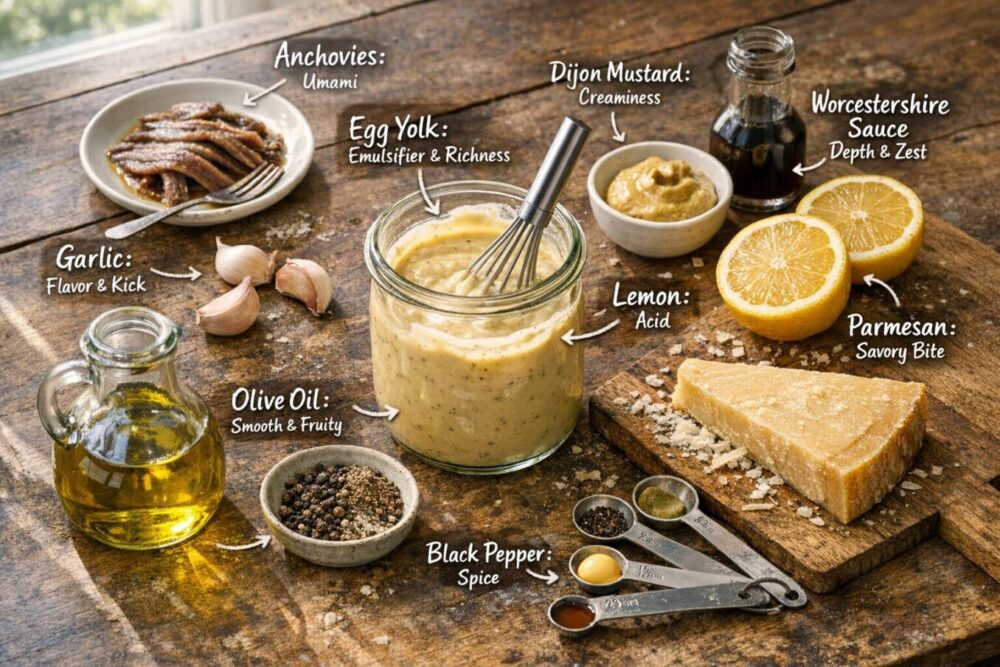
Here’s the classic lineup:
- Anchovy fillets or anchovy paste for deep savory flavor
- Garlic for sharpness
- Egg yolk or mayonnaise for creaminess and emulsion
- Dijon mustard for tang and stability
- Fresh lemon juice for brightness
- Parmesan cheese for salty, nutty flavor
- Olive oil or neutral oil for body
- Worcestershire sauce for extra umami
- Black pepper for bite
- Salt, only as needed
Simple ingredient guide
| Ingredient | What it does | Choose this if… |
|---|---|---|
| Anchovy | Adds umami and depth | You want classic Caesar flavor |
| Garlic | Adds bite | You like a sharper dressing |
| Egg yolk | Makes it rich and thick | You want traditional texture |
| Mayonnaise | Makes it easy and stable | You want a quick version |
| Lemon juice | Adds acid and freshness | The dressing tastes heavy |
| Parmesan | Adds salt and nuttiness | You want a restaurant-style finish |
| Dijon mustard | Helps emulsify | The dressing tends to separate |
Common substitution rules
Choose these if you need a swap:
- Use mayonnaise instead of egg yolk if you want a safer, faster dressing.
- Use anchovy paste instead of fillets if you want easier measuring.
- Use pecorino if Parmesan is unavailable, but expect a saltier result.
- Use a neutral oil if extra-virgin olive oil tastes too bitter.
Common mistake: adding too much Parmesan too early. Parmesan thickens and salts the dressing fast, so add it after the emulsion starts.
How do you make homemade caesar salad dressing step by step?
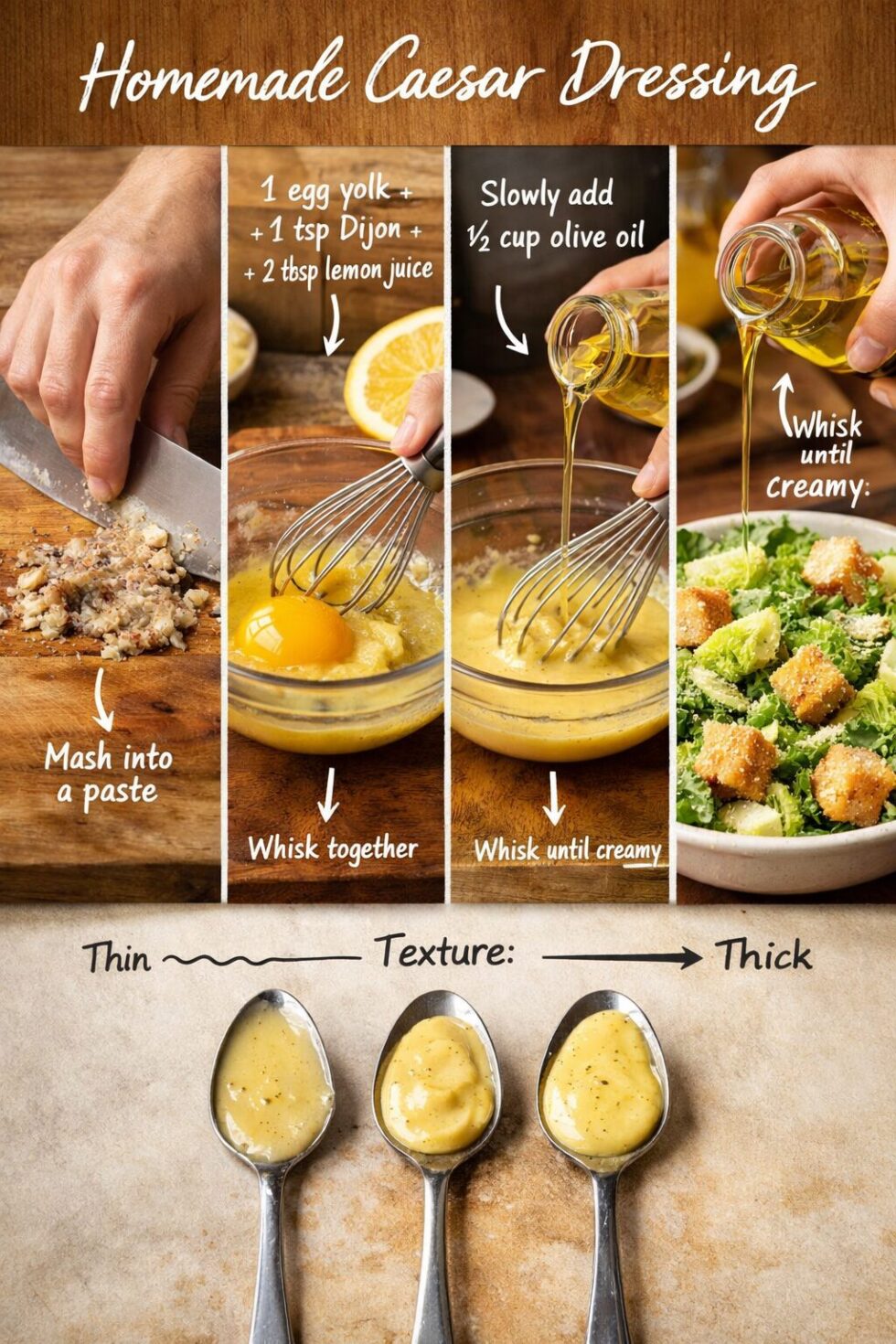
Homemade caesar salad dressing is easy to make if you build it in the right order. Start with the strong flavors first, then slowly add the fat so the dressing turns creamy instead of greasy.
Basic 10-minute method
Mash the garlic and anchovy
- On a cutting board or in a bowl, mash garlic and anchovy into a paste.
- This spreads flavor evenly.
Whisk the base
- Add egg yolk or mayonnaise, Dijon mustard, lemon juice, and Worcestershire sauce.
- Whisk until smooth.
Add oil slowly
- Drizzle in oil while whisking.
- The mixture should thicken as the oil blends in.
Stir in Parmesan and pepper
- Add grated Parmesan and black pepper.
- Taste before adding salt.
Adjust texture
- Add a teaspoon of water or lemon juice if it’s too thick.
- Chill for a few minutes if you want it slightly thicker.
Quick example recipe
- 2 anchovy fillets
- 1 small garlic clove
- 1 egg yolk or 2 tablespoons mayonnaise
- 1 teaspoon Dijon mustard
- 1 tablespoon lemon juice
- 1/4 teaspoon Worcestershire sauce
- 1/3 cup oil
- 1/4 cup finely grated Parmesan
- Black pepper to taste
Decision rule
- Choose whisking by hand if you want more control over thickness.
- Choose a blender or mini food processor if you want a very smooth dressing fast.
How do you make homemade caesar salad dressing without raw egg?
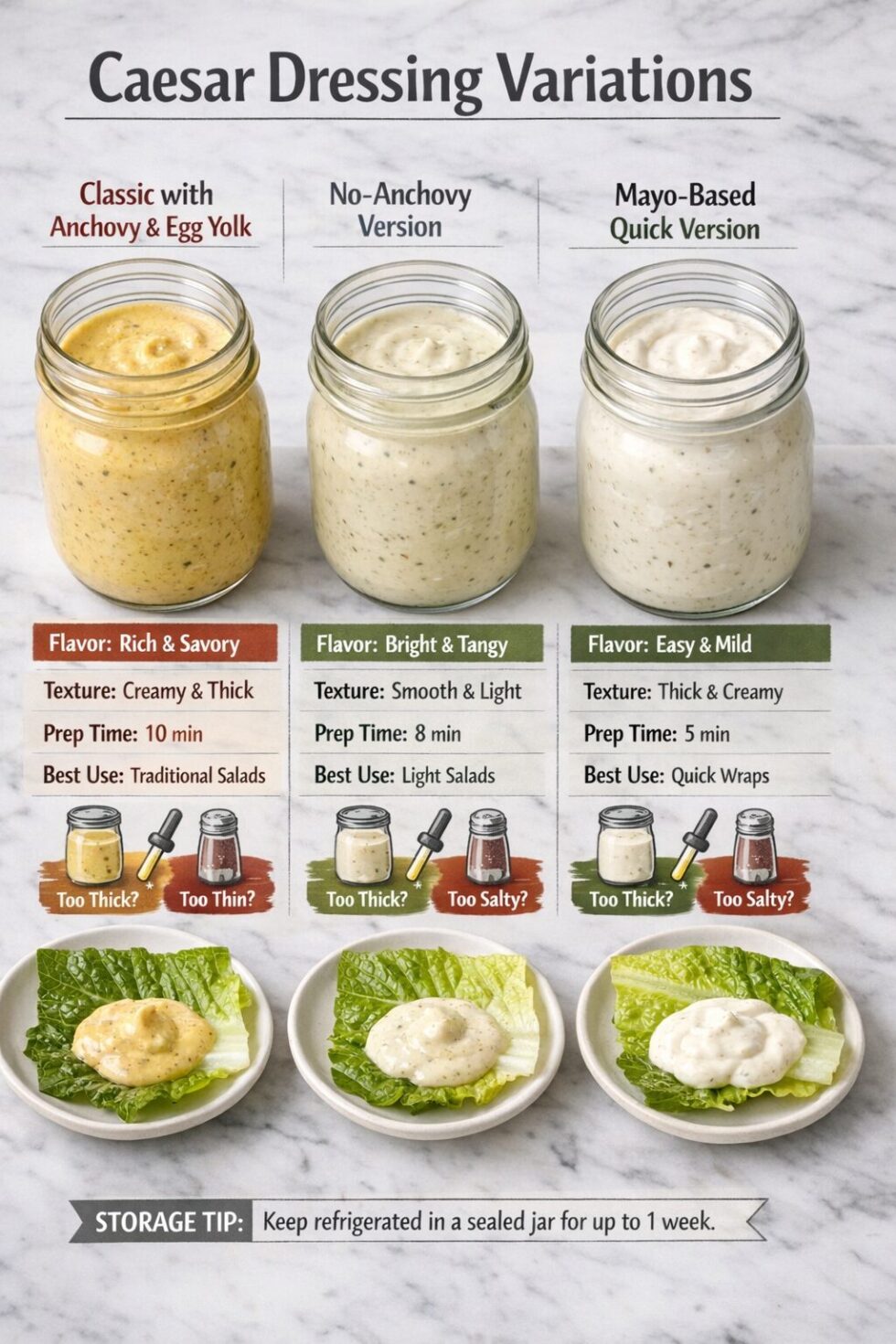
You can make homemade caesar salad dressing without raw egg by using mayonnaise, Greek yogurt, or a fully egg-free base. For most home cooks, mayonnaise is the easiest swap because it keeps the dressing creamy and stable.
Best no-raw-egg options
1. Mayonnaise-based Caesar
Best for speed and consistency.
- Use mayo in place of egg yolk
- Keep the anchovy, garlic, lemon, mustard, and Parmesan
- Thin with water or lemon juice as needed
2. Greek yogurt Caesar
Best for a lighter dressing.
- Use plain Greek yogurt
- Add a little olive oil so it doesn’t taste chalky
- Expect more tang and less richness
3. Egg-free and anchovy-free version
Best for dietary needs.
- Skip anchovy
- Add a little extra Worcestershire if acceptable, or leave it out
- Boost savory flavor with extra Parmesan, capers, or a small amount of miso
Pros and cons
Mayonnaise-based
- Pros: easy, creamy, reliable
- Cons: slightly less sharp and fresh
Yogurt-based
- Pros: lighter, tangy
- Cons: less classic flavor
Common mistake: using too much yogurt without enough fat or salt. That version often tastes sour instead of Caesar-like.
How can you make homemade caesar salad dressing taste better?
Homemade caesar salad dressing tastes better when you adjust it after mixing, not before. The key is to taste for balance, because garlic gets stronger, Parmesan adds salt, and lemon changes the finish.
Use this taste-check checklist
If the dressing tastes…
- Too salty: add more oil, lemon, or a spoon of mayo
- Too thick: add cold water 1 teaspoon at a time
- Too thin: whisk in more Parmesan or a little mayo
- Too sharp: add a bit more oil or cheese
- Too bland: add anchovy, black pepper, or lemon
- Too garlicky: let it rest 10 minutes, then retaste
Small upgrades that help
- Use freshly grated Parmesan, not shelf-stable powder
- Use fresh lemon juice
- Grind black pepper fresh
- Let the dressing sit for 10 to 20 minutes before serving
Edge case: Extra-virgin olive oil can turn bitter in some dressings. If that happens, switch to a milder oil or use half olive oil and half neutral oil.
How does homemade caesar salad dressing compare with store-bought?
Homemade caesar salad dressing usually tastes fresher and more complex than bottled dressing, but store-bought wins on convenience and shelf life. The better choice depends on how often you cook and how much control you want.
Quick comparison
| Factor | Homemade | Store-bought |
|---|---|---|
| Flavor | Fresher, bolder | Usually milder |
| Texture | Adjustable | Fixed |
| Prep time | About 10 minutes | None |
| Ingredient control | High | Low to medium |
| Shelf life | Shorter | Longer |
| Cost per batch | Often reasonable | Varies by brand |
Choose homemade if:
- You care about fresh flavor
- You already keep basic ingredients at home
- You want to adjust salt, acid, and thickness
Choose store-bought if:
- You need convenience
- You want a longer-lasting backup
- You rarely use Caesar dressing
How long does homemade caesar salad dressing last, and how should you store it?
Homemade caesar salad dressing should be stored in the refrigerator in a sealed container and used promptly. The exact storage time depends on whether it contains raw egg, mayo, or dairy, so ingredient choice matters.
Best storage habits
- Store in a clean glass jar or airtight container
- Keep it cold
- Stir or shake before each use
- Use a clean spoon every time
Practical storage rule
- If your dressing contains raw egg, use extra caution and make only what you’ll use soon.
- If your dressing uses mayonnaise and grated cheese, it may hold texture better for a bit longer, but it still needs refrigeration.
Because home storage conditions vary, the safest approach is simple: make small batches and use them quickly.
Common mistake: leaving Caesar dressing out on the table for too long during a party. If serving outside the fridge, put out a small amount and refill as needed.
What are the most common homemade caesar salad dressing mistakes?
Most homemade caesar salad dressing problems come from imbalance or poor mixing. The good news is that nearly all of them are fixable in a minute or two.
Top mistakes and fixes
Adding oil too fast
- Problem: dressing separates
- Fix: whisk in a little mayo or another yolk base, then drizzle slowly
Oversalting
- Problem: Parmesan and anchovy stack up fast
- Fix: don’t add salt until the end
Using pre-shredded cheese
- Problem: grainy texture
- Fix: grate Parmesan finely yourself
Too much raw garlic
- Problem: harsh bite
- Fix: use a small clove, mash it well, and let the dressing rest
Wrong texture for the use
- Problem: too thick for tossing salad, too thin for dipping
- Fix: thin with water, thicken with cheese or mayo
What can you serve with homemade caesar salad dressing?
Homemade caesar salad dressing works on more than just romaine lettuce. It’s especially useful when you want one bold dressing that can handle crunchy greens, roasted vegetables, or protein.
Best uses
- Classic Caesar salad with romaine and croutons
- Chicken Caesar wraps
- Pasta salad
- Grain bowls
- Dip for vegetables
- Drizzle for roasted potatoes
- Spread for sandwiches
Quick example
If I’m using the dressing for a salad, I keep it a little thinner. If I’m using it as a wrap spread or dip, I make it thicker with a bit more Parmesan or mayo.
FAQ
Can I make homemade caesar salad dressing without anchovies?
Yes. The dressing will lose some classic umami depth, but it can still taste good with extra Parmesan, capers, or a small amount of miso.
Is homemade caesar salad dressing supposed to be thick?
Yes, homemade caesar salad dressing should be creamy and cling to lettuce, but it should still be pourable.
Can I use mayonnaise instead of egg yolk?
Yes. Mayonnaise is the easiest substitute and makes homemade caesar salad dressing more stable.
Why is my Caesar dressing too salty?
Caesar dressing often gets too salty from anchovy and Parmesan together, so taste before adding any extra salt.
Can I freeze homemade caesar salad dressing?
Freezing is not ideal because the emulsion can break and the texture may turn grainy after thawing.
What oil is best for Caesar dressing?
A mild olive oil or neutral oil works best if you want a smooth, balanced dressing without bitterness.
Can I make it in a blender?
Yes. A blender or mini food processor makes homemade caesar salad dressing smoother and faster.
How do I thin thick Caesar dressing?
Add cold water or lemon juice a teaspoon at a time until the texture loosens.
Conclusion
Homemade caesar salad dressing is one of the easiest upgrades you can make in your kitchen. It’s fast, flexible, and far better when you adjust it to your taste instead of following a rigid formula.
If you want the best result, start with a small batch, use fresh lemon and Parmesan, and add oil slowly. Then taste and fix what’s off. That simple habit will give you a Caesar dressing that tastes like your version of perfect.
Next steps:
- Pick your base: egg yolk, mayo, or yogurt
- Make one small batch today
- Adjust salt, acid, and thickness
- Try it on salad first, then on wraps or roasted vegetables

Sarah Anderson . J
I’m the mom behind Wise Mom Blogger, where everyday creativity meets real-life motherhood. I share easy DIY crafts, cozy knitting and crochet projects, beginner-friendly sewing ideas, and family-tested recipes—plus quick baking hacks that make homemade feel doable on busy days.
